Guan Yuanfang, Wang Xueqing, Li Hongyang, Zhang Zhenning, Chen Xianghao, Siddiqui Omer, Nehring Sara, Huang Xiuzhen
Department of Computational Medicine & Bioinformatics, University of Michigan, Ann Arbor, MI 48109, USA.
Lead Contact.
Patterns (N Y). 2020 Oct 9;1(7). doi: 10.1016/j.patter.2020.100106. Epub 2020 Sep 21.
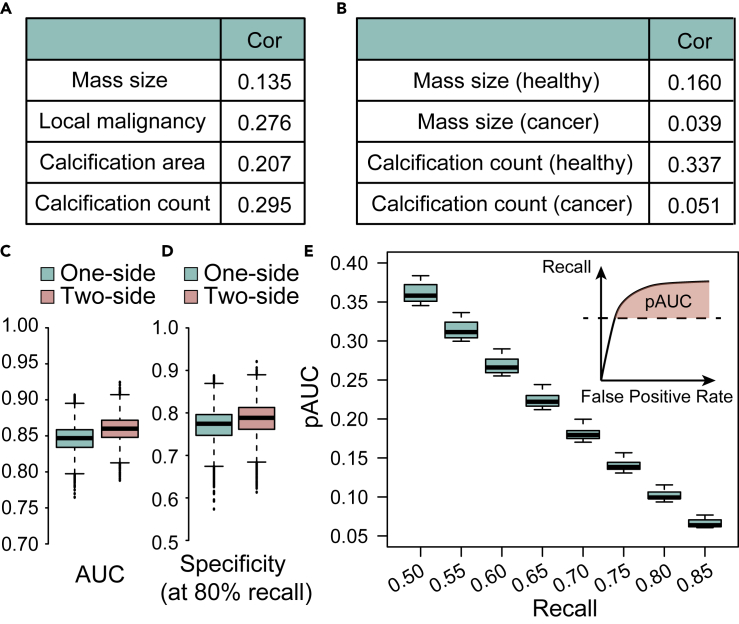
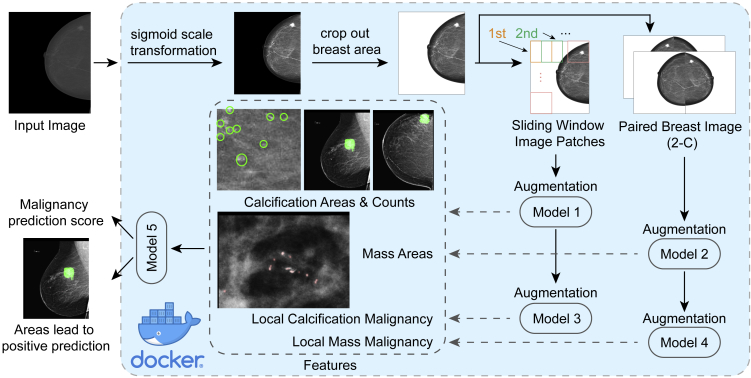
One in eight women develops invasive breast cancer in her lifetime. The frontline protection against this disease is mammography. While computer-assisted diagnosis algorithms have made great progress in generating reliable global predictions, few focus on simultaneously producing regions of interest (ROIs) for biopsy. Can we combine ROI-oriented algorithms with global classification of cancer status, which simultaneously highlight suspicious regions and optimize classification performance? Can the asymmetry of breasts be adopted in deep learning for finding lesions and classifying cancers? We answer the above questions by building deep-learning networks that identify masses and microcalcifications in paired mammograms, exclude false positives, and stepwisely improve performance of the model with asymmetric information regarding the breasts. This method achieved a co-leading place in the Digital Mammography DREAM Challenge for predicting breast cancer. We highlight here the importance of this dual-purpose process that simultaneously provides the locations of potential lesions in mammograms.
八分之一的女性在一生中会患上浸润性乳腺癌。针对这种疾病的一线防护手段是乳房X光检查。虽然计算机辅助诊断算法在生成可靠的整体预测方面取得了很大进展,但很少有算法专注于同时生成用于活检的感兴趣区域(ROI)。我们能否将面向ROI的算法与癌症状态的整体分类相结合,从而同时突出可疑区域并优化分类性能?在深度学习中,能否采用乳房的不对称性来发现病变并对癌症进行分类?我们通过构建深度学习网络来回答上述问题,该网络可识别配对乳房X光片中的肿块和微钙化,排除假阳性,并利用有关乳房的不对称信息逐步提高模型性能。这种方法在数字乳房X光摄影DREAM挑战赛中预测乳腺癌时取得了并列领先的成绩。我们在此强调这个双重目的过程的重要性,它能同时提供乳房X光片中潜在病变的位置。