Higher Education Sport, Hartpury University, Gloucester GL19 3BE, UK.
Department of Physical Education and Sport, University of Granada, 52005 Granada, Spain.
Int J Environ Res Public Health. 2020 Oct 26;17(21):7811. doi: 10.3390/ijerph17217811.
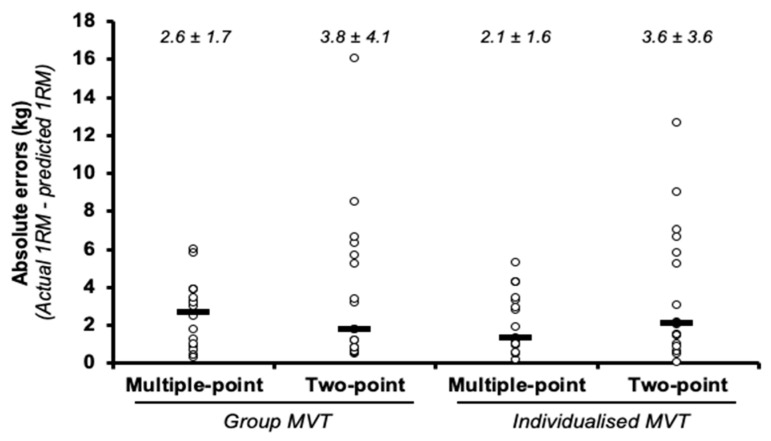
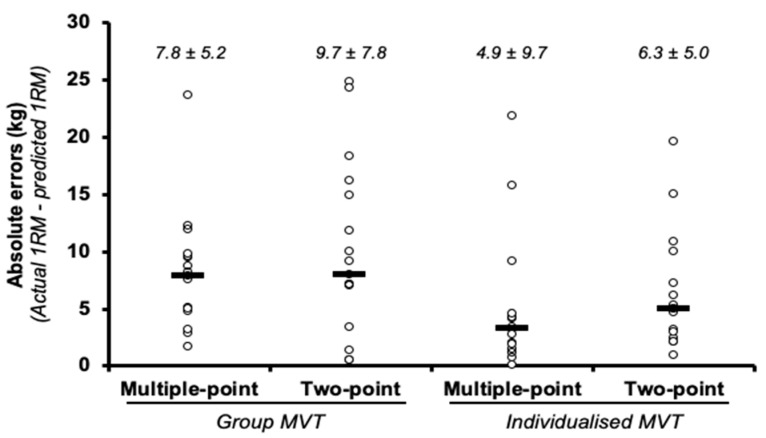
This study examined the accuracy of different velocity-based methods in the prediction of bench press and squat one-repetition maximum (1RM) in female athletes. Seventeen trained females (age 17.8 ± 1.3 years) performed an incremental loading test to 1RM on bench press and squat with the mean velocity being recorded. The 1RM was estimated from the load-velocity relationship using the multiple- (8 loads) and two-point (2 loads) methods and group and individual minimum velocity thresholds (MVT). No significant effect of method, MVT or interaction was observed for the two exercises ( > 0.05). For bench press and squat, all prediction methods demonstrated to correlations with respect to the actual 1RM (r range = 0.76 to 0.97). The absolute error (range = 2.1 to 3.8 kg) for bench press demonstrated low errors that were independent of the method and MVT used. For squat, the favorable group MVT errors for the multiple- and two-point methods (absolute error = 7.8 and 9.7 kg, respectively) were greater than the individual MVT errors (absolute error = 4.9 and 6.3 kg, respectively). The 1RM can be accurately predicted from the load-velocity relationship in trained females, with the two-point method offering a quick and less fatiguing alternative to the multiple-point method.
本研究旨在检验不同基于速度的方法在预测女性运动员卧推和深蹲 1 次最大重复次数(1RM)中的准确性。17 名受过训练的女性(年龄 17.8±1.3 岁)进行了卧推和深蹲的递增负荷测试,直至达到 1RM,并记录平均速度。使用多点(8 个负荷)和两点(2 个负荷)方法以及组和个体最小速度阈值(MVT),从负荷-速度关系中估计 1RM。对于两种练习,方法、MVT 或交互作用均无显著影响(>0.05)。对于卧推和深蹲,所有预测方法与实际 1RM 均呈显著相关(r 范围=0.76 至 0.97)。卧推的绝对误差(范围=2.1 至 3.8 千克)较小,且不受方法和 MVT 使用的影响。对于深蹲,多点和两点方法的有利组 MVT 误差(绝对误差分别为 7.8 和 9.7 千克)大于个体 MVT 误差(绝对误差分别为 4.9 和 6.3 千克)。从负荷-速度关系可以准确预测训练有素的女性的 1RM,两点法是比多点法更快速且疲劳程度更低的替代方法。