Sommerlad Andrew, Sabia Séverine, Livingston Gill, Kivimäki Mika, Lewis Glyn, Singh-Manoux Archana
From the Division of Psychiatry (A.S., G. Livingston, G. Lewis) and Department of Epidemiology and Public Health (S.S., M.K., A.-S.M.), University College London; Camden and Islington NHS Foundation Trust (A.S., G. Livingston, G. Lewis), London, UK; Université de Paris (S.S., A.-S.M.), Inserm U1153, Epidemiology of Ageing and Neurodegenerative Diseases, France; and Clinicum and Helsinki Institute of Life Science (M.K.), University of Helsinki, Finland.
Neurology. 2020 Nov 17;95(20):e2803-e2815. doi: 10.1212/WNL.0000000000010966. Epub 2020 Oct 28.
To test the hypothesis that leisure activity participation is associated with lower dementia risk, we examined the association between participation in leisure activities and incident dementia in a large longitudinal study with average 18-year follow-up.
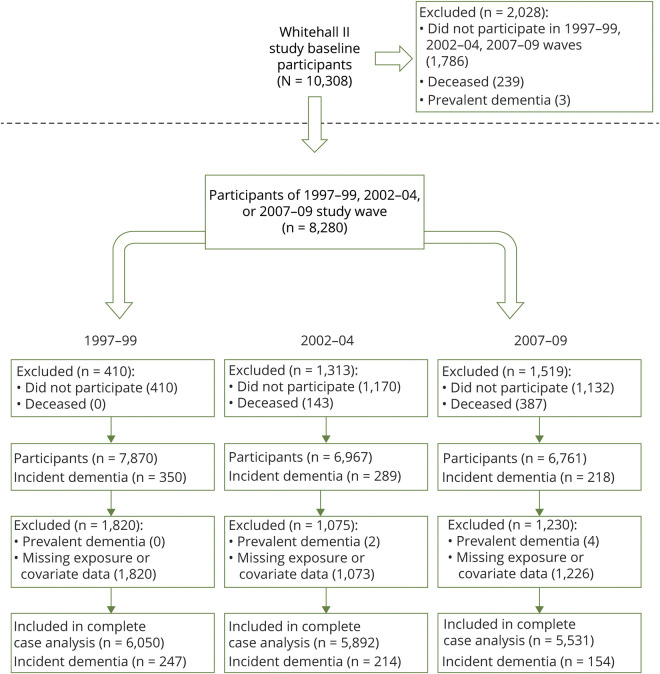
We used data from 8,280 participants of the Whitehall II prospective cohort study. A 13-item scale assessed leisure activity participation in 1997-1999, 2002-2004, and 2007-2009, and incidence of dementia (n cases = 360, mean age at diagnosis 76.2 years, incidence rate 2.4 per 1,000 person-years) was ascertained from 3 comprehensive national registers with follow-up until March 2017. Primary analyses were based on complete cases (n = 6,050, n cases = 247) and sensitivity analyses used multiple imputation for missing data.
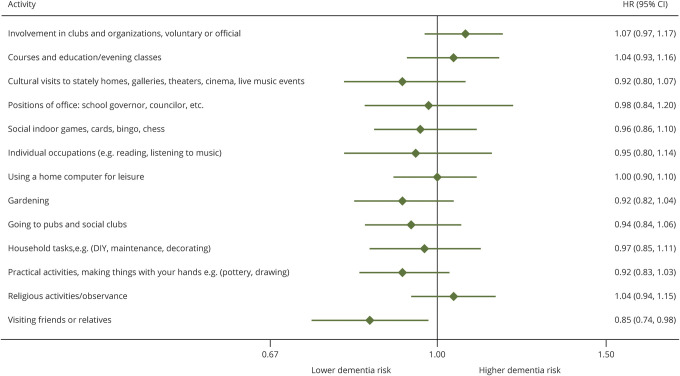
Participation in leisure activities at mean age 55.8 (1997-1999 assessment), with 18.0-year follow-up, was not associated with dementia (hazard ratio [HR] 0.92 [95% confidence interval 0.79-1.06]), but those with higher participation at mean age 65.7 (2007-2009 assessment) were less likely to develop dementia with 8.3-year follow-up (HR 0.82 [0.69-0.98]). No specific type of leisure activity was consistently associated with dementia risk. Decline in participation between 1997-1999 and 2007-2009 was associated with subsequent dementia risk.
Our findings suggest that participation in leisure activities declines in the preclinical phase of dementia; there was no robust evidence for a protective association between leisure activity participation and dementia. Future research should investigate the sociobehavioral, cognitive, and neurobiological drivers of decline in leisure activity participation to determine potential approaches to improving social participation of those developing dementia.
为验证休闲活动参与度与较低痴呆风险相关这一假设,我们在一项平均随访18年的大型纵向研究中,考察了休闲活动参与度与痴呆症发病之间的关联。
我们使用了白厅II前瞻性队列研究中8280名参与者的数据。一个包含13个条目的量表评估了1997 - 1999年、2002 - 2004年和2007 - 2009年的休闲活动参与情况,痴呆症发病率(病例数 = 360,诊断时平均年龄76.2岁,发病率为每1000人年2.4例)通过3个综合国家登记处确定,随访至2017年3月。主要分析基于完整病例(n = 6050,病例数 = 247),敏感性分析使用多重填补法处理缺失数据。
在平均年龄55.8岁(1997 - 1999年评估)时参与休闲活动,随访18.0年,与痴呆症无关(风险比[HR] 0.92 [95%置信区间0.79 - 1.06]),但在平均年龄65.7岁(2007 - 2009年评估)时参与度较高的人,随访8.3年时患痴呆症的可能性较小(HR 0.82 [0.69 - 0.98])。没有特定类型的休闲活动与痴呆风险始终相关。1997 - 1999年至2007 - 2009年期间参与度下降与随后的痴呆风险相关。
我们的研究结果表明,在痴呆症临床前期,休闲活动参与度会下降;没有有力证据表明休闲活动参与度与痴呆症之间存在保护性关联。未来的研究应调查休闲活动参与度下降的社会行为、认知和神经生物学驱动因素,以确定改善痴呆症患者社会参与度的潜在方法。