Department of Chemistry and Chemical Biology, Rutgers University, 123 Bevier Road, Piscataway, NJ, 08854, USA.
Department of Materials Science and Engineering, Rutgers University, 607 Taylor Road, Piscataway, NJ, 08854, USA.
Chembiochem. 2021 Apr 6;22(7):1176-1189. doi: 10.1002/cbic.202000744. Epub 2020 Dec 9.
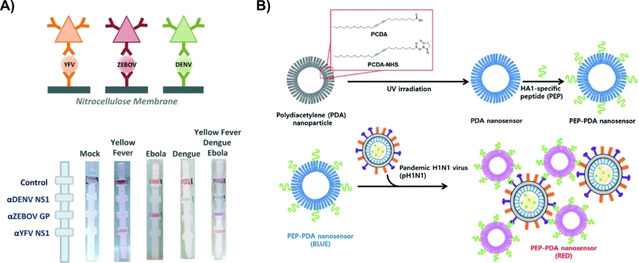
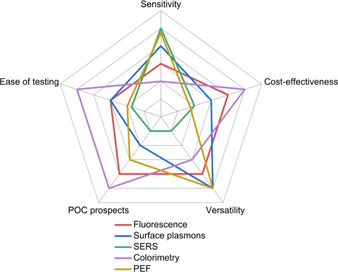
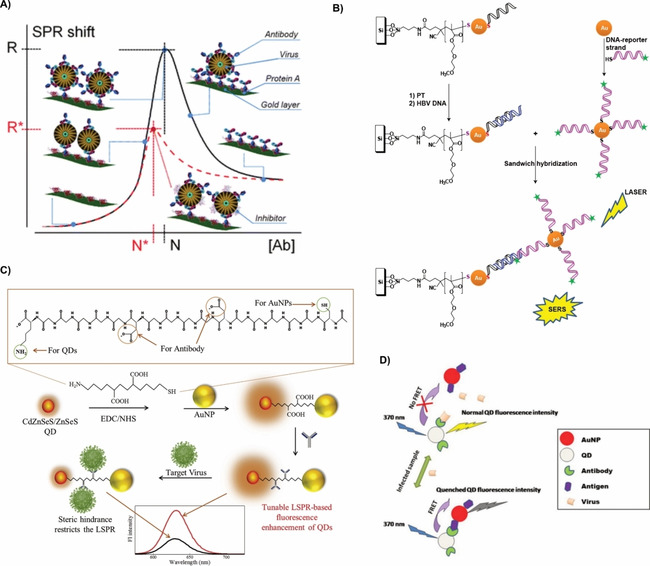
The recent pandemic of the novel coronavirus disease 2019 (COVID-19) has caused huge worldwide disruption due to the lack of available testing locations and equipment. The use of optical techniques for viral detection has flourished in the past 15 years, providing more reliable, inexpensive, and accurate detection methods. In the current minireview, optical phenomena including fluorescence, surface plasmons, surface-enhanced Raman scattering (SERS), and colorimetry are discussed in the context of detecting virus pathogens. The sensitivity of a viral detection method can be dramatically improved by using materials that exhibit surface plasmons or SERS, but often this requires advanced instrumentation for detection. Although fluorescence and colorimetry lack high sensitivity, they show promise as point-of-care diagnostics because of their relatively less complicated instrumentation, ease of use, lower costs, and the fact that they do not require nucleic acid amplification. The advantages and disadvantages of each optical detection method are presented, and prospects for applying optical biosensors in COVID-19 detection are discussed.
由于缺乏可用的检测地点和设备,新型冠状病毒病 2019(COVID-19)的最近一次大流行造成了巨大的全球混乱。在过去的 15 年中,光学技术在病毒检测中的应用蓬勃发展,提供了更可靠、更廉价、更准确的检测方法。在当前的小型综述中,讨论了包括荧光、表面等离子体、表面增强拉曼散射(SERS)和比色法在内的光学现象,以检测病毒病原体。通过使用表现出表面等离子体或 SERS 的材料,可以大大提高病毒检测方法的灵敏度,但通常这需要先进的检测仪器。尽管荧光和比色法灵敏度不高,但由于其仪器相对简单、易于使用、成本较低以及不需要核酸扩增,因此它们作为即时检测诊断具有很大的应用潜力。本文介绍了每种光学检测方法的优缺点,并讨论了将光学生物传感器应用于 COVID-19 检测的前景。