Department of Engineering Science and Mechanics, Pennsylvania State University, University Park, PA, 16802, USA.
Department of Materials Science and Engineering, Pennsylvania State University, University Park, PA, 16802, USA.
Nat Commun. 2020 Oct 29;11(1):5474. doi: 10.1038/s41467-020-19203-z.
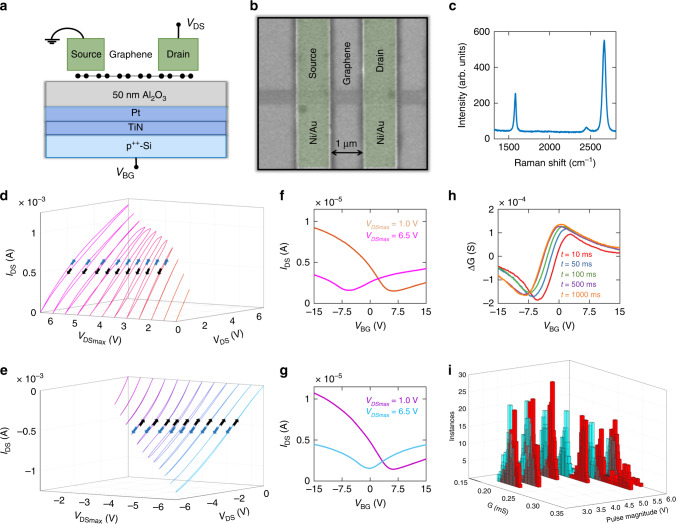
Memristive crossbar architectures are evolving as powerful in-memory computing engines for artificial neural networks. However, the limited number of non-volatile conductance states offered by state-of-the-art memristors is a concern for their hardware implementation since trained weights must be rounded to the nearest conductance states, introducing error which can significantly limit inference accuracy. Moreover, the incapability of precise weight updates can lead to convergence problems and slowdown of on-chip training. In this article, we circumvent these challenges by introducing graphene-based multi-level (>16) and non-volatile memristive synapses with arbitrarily programmable conductance states. We also show desirable retention and programming endurance. Finally, we demonstrate that graphene memristors enable weight assignment based on k-means clustering, which offers greater computing accuracy when compared with uniform weight quantization for vector matrix multiplication, an essential component for any artificial neural network.
忆阻器交叉架构正在发展成为用于人工神经网络的强大的内存计算引擎。然而,最先进的忆阻器提供的非易失性电导状态数量有限,这是其硬件实现的一个关注点,因为训练好的权重必须舍入到最接近的电导状态,从而引入误差,这会显著限制推理精度。此外,精确的权重更新能力的缺失可能会导致收敛问题和片上训练速度的降低。在本文中,我们通过引入基于石墨烯的多级(>16 级)和具有任意可编程电导状态的非易失性忆阻突触来规避这些挑战。我们还展示了理想的保持和编程耐久性。最后,我们证明了石墨烯忆阻器能够基于 k-均值聚类进行权重分配,这在进行向量矩阵乘法时提供了更高的计算精度,这是任何人工神经网络的基本组成部分。