Masurkar Nirul, Thangavel Naresh Kumar, Yurgelevic Sally, Varma Sundeep, Auner Gregory W, Reddy Arava Leela Mohana
Department of Mechanical Engineering, Wayne State University, Detroit, MI, 48202, USA.
Michael and Marian Ilitch Department of Surgery, School of Medicine, Wayne State University, Detroit, MI, 48202, USA.
Biosens Bioelectron. 2021 Jan 15;172:112724. doi: 10.1016/j.bios.2020.112724. Epub 2020 Oct 17.
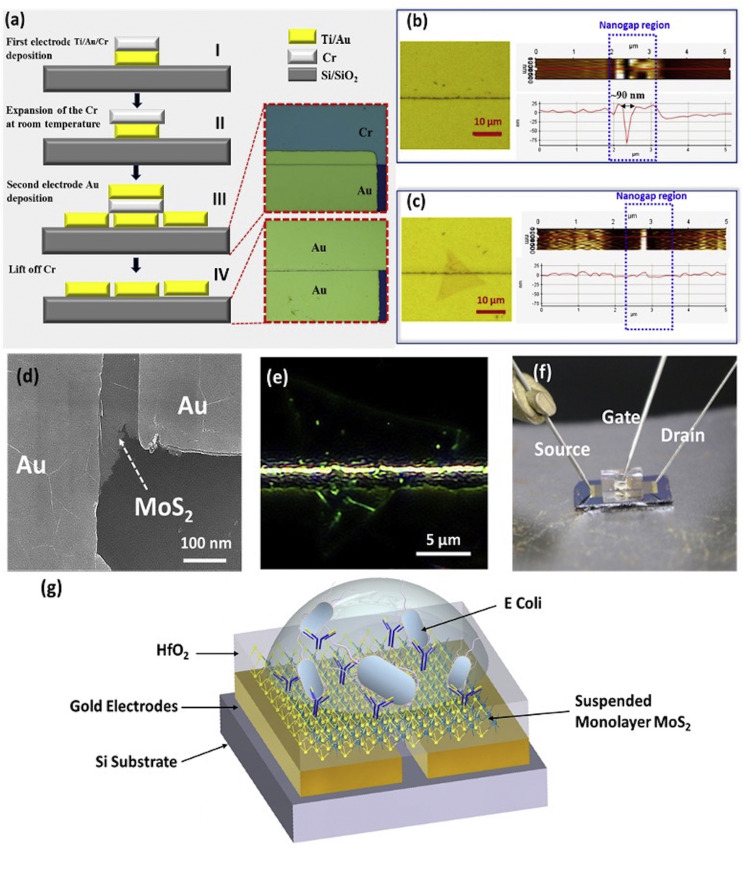
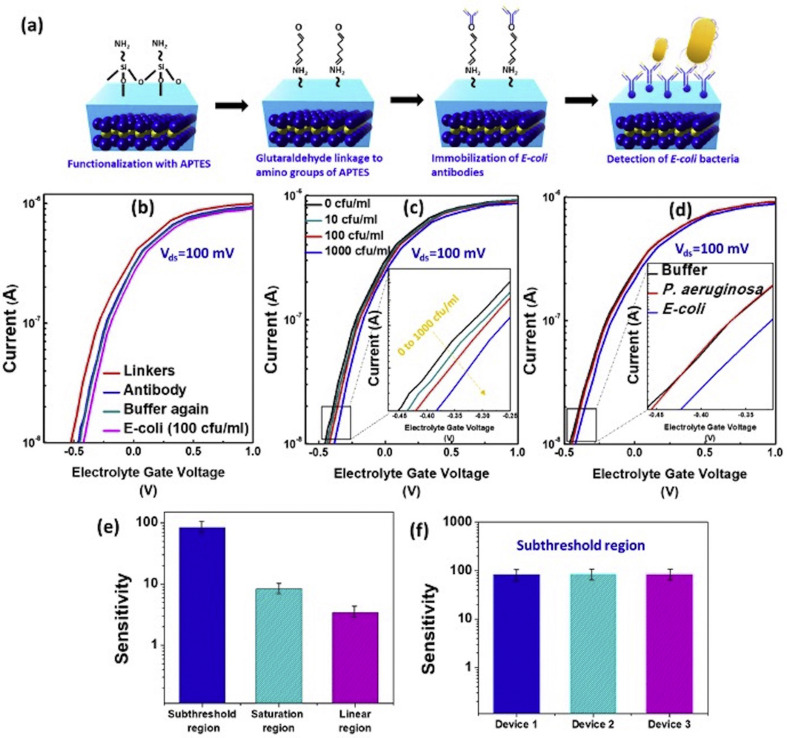
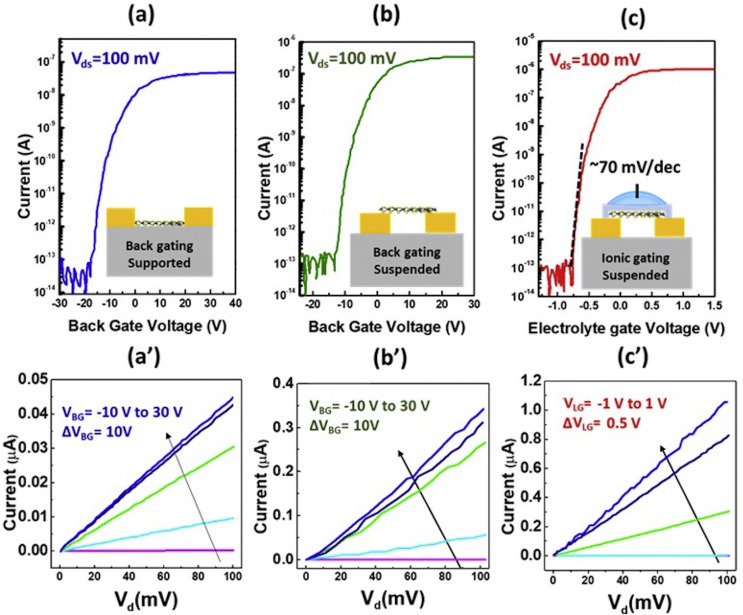
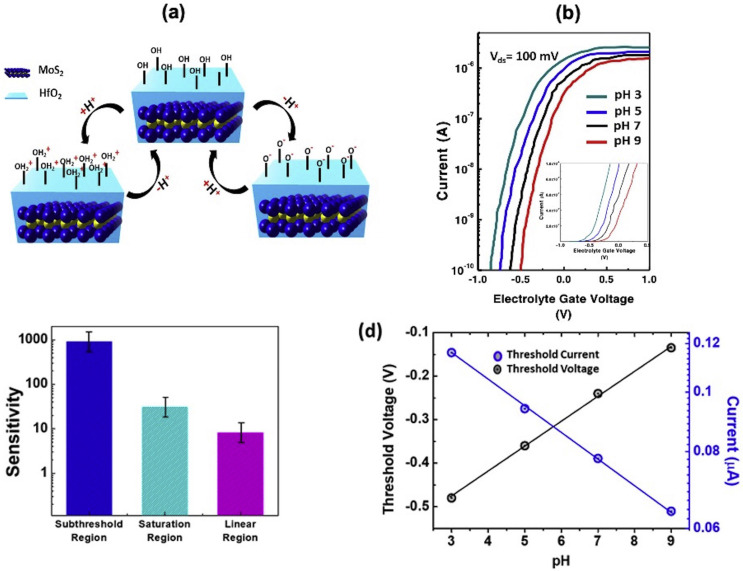
The uneven morphology and the trapped charges at the surface of the traditionally used supporting substrate-based 2D biosensors produces a scattering effect, which leads to a irregular signals from individually fabricated devices. Though suspended 2D channel material has the potential to overcome scattering effects from the substrates but achieving reliability and selectivity, have been limiting the using of this biosensor technology. Here, we have demonstrated nanogap electrodes fabrication by using the self-assembly technique, which provides suspension to the 2D-MoS. These nano-spacing electrodes not only give suspension but also provide robustness strength to the atomic layer, which remains freestanding after coating of the Hafnium oxide (HfO) as well as linkers and antibodies. For evaluating the electrical characteristics of suspended MoS FET, gating potential was applied through an electrolyte on the suspended MoS transistor. This helped in achieved a lower subthreshold swing 70 mV/dec and ON/OFF ratio 10. Later, pH detection was conducted at room temperature, which showed an impressive sensitivity of ~880 by changing 1 unit of pH. We have also successfully shown Escherichia coli (E. coli) bacteria sensing from the suspended MoS transistor by functionalizing dielectric layer with E. coli antibodies. The reported biosensor has shown the ~9% of conductance changes with a lower concentration of E. coli (10 CFU/mL; colony-forming unit per mL) as well as maintain the constant sensitivity in three fabricated devices. The obtained enhancement in the sensitivity of devices and its effect on biomolecules detection can be extened to other biomolecules and this type of architecture has the potential to detect COVID-19 viruses based biomolecules.
传统的基于支撑基板的二维生物传感器表面形态不均匀且存在捕获电荷,会产生散射效应,导致各个制造的器件发出不规则信号。尽管悬浮的二维通道材料有潜力克服来自基板的散射效应,但实现可靠性和选择性一直限制着这种生物传感器技术的应用。在此,我们展示了通过自组装技术制造纳米间隙电极,该技术为二维二硫化钼提供了悬浮。这些纳米间距电极不仅提供悬浮,还为原子层提供了坚固的强度,在涂覆氧化铪(HfO)以及连接体和抗体后,原子层仍能保持独立。为了评估悬浮二硫化钼场效应晶体管的电学特性,通过悬浮二硫化钼晶体管上的电解质施加门控电位。这有助于实现较低的亚阈值摆幅70 mV/dec和开/关比10。随后,在室温下进行pH检测,结果表明,pH值每变化1个单位,灵敏度约为880,令人印象深刻。我们还通过用大肠杆菌抗体功能化介电层,成功地展示了悬浮二硫化钼晶体管对大肠杆菌的传感。所报道的生物传感器在较低浓度的大肠杆菌(10 CFU/mL;每毫升菌落形成单位)下显示出约9%的电导变化,并且在三个制造的器件中保持恒定的灵敏度。器件灵敏度的提高及其对生物分子检测的影响可以扩展到其他生物分子,这种架构有潜力检测基于新冠病毒的生物分子。