Laboratory of Plant Genetic Improvement and Biotechnology, Jiangxi Normal University, Nanchang 330000, Jiangxi, China.
Institute of Biophysics, College of Life Sciences, Zhejiang University, Hangzhou 310000, Zhejiang, China.
Molecules. 2020 Oct 30;25(21):5046. doi: 10.3390/molecules25215046.
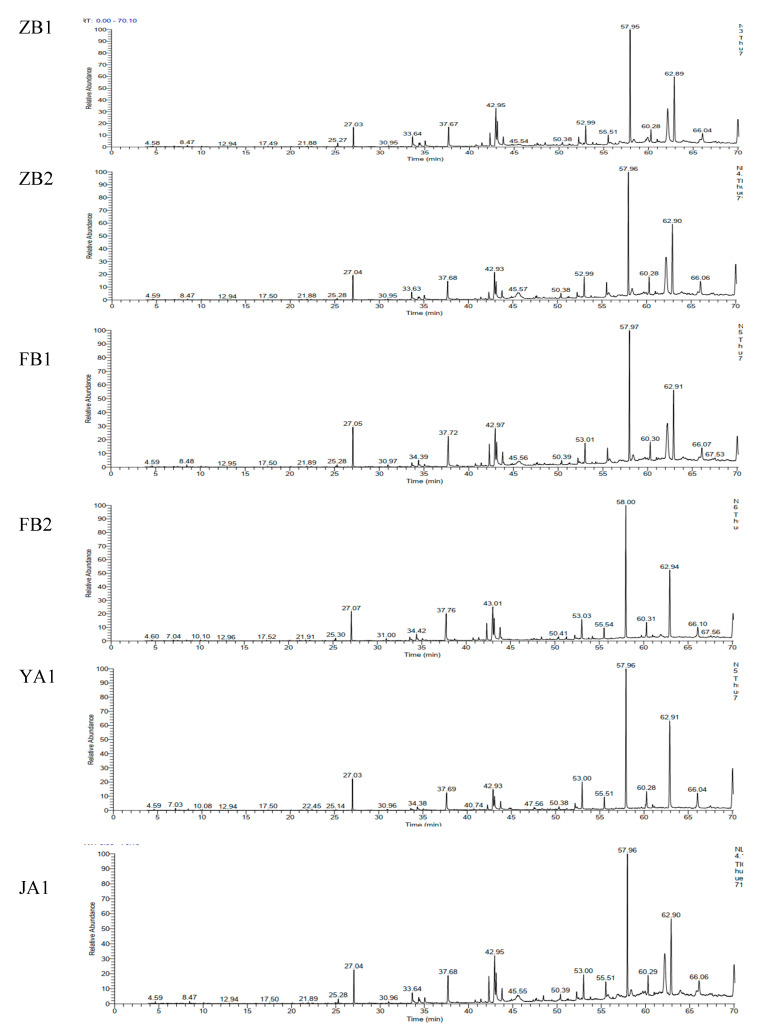
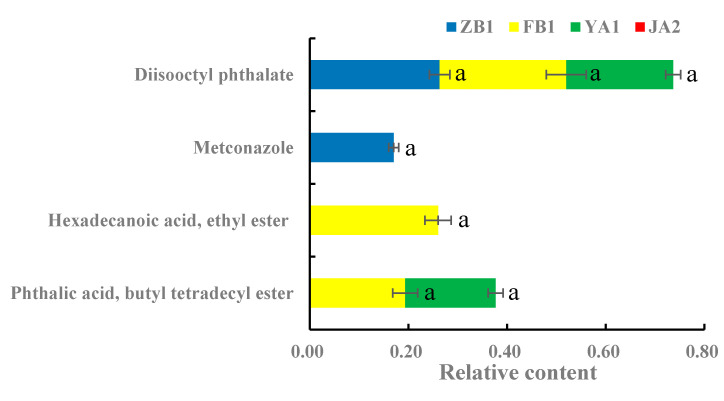
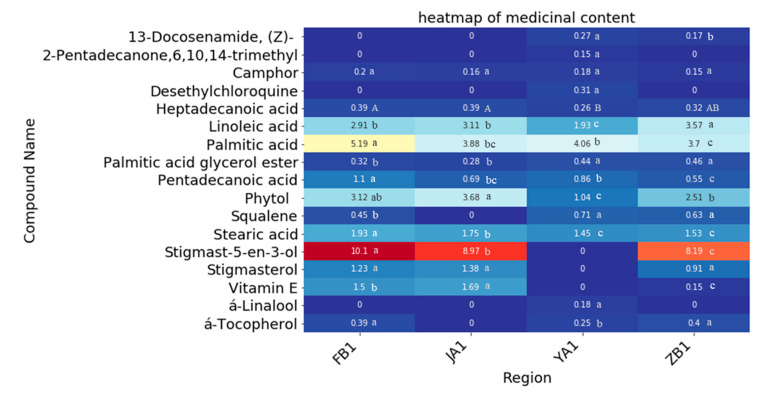
Kimura et Migo, a rare and traditional medicinal plant, contains many nutrients such as polysaccharides, alkaloids, amino acids and so on. Different growth environment and intraspecific hybridization of different germplasm resources lead to large differences in the yield, quality and medicinal value of . Here, the volatile compounds of from four producing regions (Zhejiang, Fujian, Yunnan and Jiangxi) were analyzed to provide a certain reference value for the selection of a specific medicinal component in breeding. Fresh stems of germplasm resources were collected, and the chemical constituents were determined by gas chromatography-mass spectrometry. A total of 101 volatile compounds were identified, of which esters and alcohols accounted for 23 and 22. Hexacosane is the highest relative content of all volatile components. The highest content of hexacosane was observed in YA1 from Yunnan was 34.41%, and the lowest (23.41%) in JA1 from Jiangxi. Moreover, 5-10 unique substances were determined in different regions. A total of 17 medicinal components were detected, and three unique medicinal components were detected only in YA1, revealing that YA1 can provide raw materials for the application of specific medicinal substances extraction. A total of four toxic components were detected, but no toxic components were detected in JA1 from Jiangxi, suggested that the germplasm resources from Jiangxi could be exploited efficiently for breeding superior specimens. The results provide a theoretical basis for the collection, protection and utilization of germplasm resources in different regions.
木村和米果,一种罕见的传统药用植物,含有许多营养物质,如多糖、生物碱、氨基酸等。不同的生长环境和不同种质资源的种内杂交导致产量、质量和药用价值存在很大差异。在这里,对来自四个产区(浙江、福建、云南和江西)的药用植物的挥发性化合物进行了分析,为药用植物的特定药用成分的选育提供了一定的参考价值。采集新鲜药用植物种质资源的茎,采用气相色谱-质谱法测定其化学成分。共鉴定出 101 种挥发性化合物,其中酯类和醇类分别占 23 和 22。二十六烷是所有挥发性成分中相对含量最高的。云南 YA1 中二十六烷的相对含量最高,为 34.41%,江西 JA1 中含量最低(23.41%)。此外,不同地区还确定了 5-10 种独特物质。共检测到 17 种药用成分,仅在 YA1 中检测到 3 种独特的药用成分,表明 YA1 可以为特定药用物质提取的应用提供原料。共检测到四种有毒成分,但江西 JA1 中未检测到有毒成分,表明江西的种质资源可以有效地用于选育优良的药用植物。研究结果为不同地区药用植物种质资源的收集、保护和利用提供了理论依据。