Faculty of Psychology, University of Guayaquil, Guayaquil, Ecuador.
Department of Clinical Psychology, Complutense University of Madrid, Madrid, Spain.
BMC Psychol. 2020 Nov 10;8(1):120. doi: 10.1186/s40359-020-00482-6.
Decisions made by individuals with disordered gambling are markedly inflexible. However, whether anomalies in learning from feedback are gambling-specific, or extend beyond gambling contexts, remains an open question. More generally, addictive disorders-including gambling disorder-have been proposed to be facilitated by individual differences in feedback-driven decision-making inflexibility, which has been studied in the lab with the Probabilistic Reversal Learning Task (PRLT). In this task, participants are first asked to learn which of two choice options is more advantageous, on the basis of trial-by-trial feedback, but, once preferences are established, reward contingencies are reversed, so that the advantageous option becomes disadvantageous and vice versa. Inflexibility is revealed by a less effective reacquisition of preferences after reversal, which can be distinguished from more generalized learning deficits.
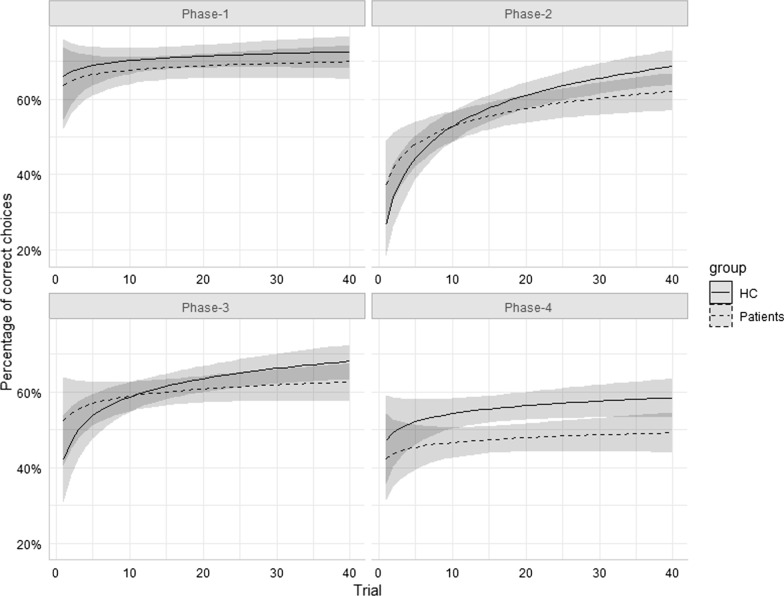
In the present study, we compared PRLT performance across two groups of 25 treatment-seeking patients diagnosed with an addictive disorder and who reported gambling problems, and 25 matched controls [18 Males/7 Females in both groups, M(SD) = 25.24 (8.42) and 24.96 (7.90), for patients and controls, respectively]. Beyond testing for differences in the shape of PRLT learning curves across groups, the specific effect of problematic gambling symptoms' severity was also assessed independently of group assignment. In order to surpass previous methodological problems, full acquisition and reacquisition curves were fitted using generalized mixed-effect models.
Results showed that (1) controls did not significantly differ from patients in global PRLT performance nor showed specific signs of decision-making inflexibility; and (2) regardless of whether group affiliation was controlled for or not, gambling severity was specifically associated with more inefficient learning in phases with reversed contingencies.
Decision-making inflexibility, as revealed by difficulty to reacquire decisional preferences based on feedback after contingency reversals, seems to be associated with gambling problems, but not necessarily with a substance-use disorder diagnosis. This result aligns with gambling disorder models in which domain-general compulsivity is linked to vulnerability to develop gambling-specific problems with exposure to gambling opportunities.
有赌博障碍的个体做出的决策明显缺乏灵活性。然而,从反馈中学习的异常是否是赌博特有的,或者是否超出了赌博环境,这仍然是一个悬而未决的问题。更一般地说,包括赌博障碍在内的成瘾障碍被认为是由反馈驱动的决策灵活性个体差异所促进的,这已经在实验室的概率反转学习任务(PRLT)中进行了研究。在这个任务中,参与者首先根据试次反馈学习哪个选择选项更有利,但一旦偏好建立,奖励条件就会反转,因此有利选项变得不利,反之亦然。灵活性的表现是反转后偏好的重新获得效果较差,可以与更广泛的学习缺陷区分开来。
在本研究中,我们比较了两组 25 名寻求治疗的患者的 PRLT 表现,这些患者被诊断为成瘾障碍并报告有赌博问题,以及 25 名匹配的对照组[两组中 18 名男性/7 名女性,患者组和对照组的平均值(标准差)分别为 25.24(8.42)和 24.96(7.90)]。除了测试两组之间 PRLT 学习曲线的形状差异外,还独立于组分配评估了问题赌博症状严重程度的特定影响。为了克服先前的方法学问题,使用广义混合效应模型拟合了完整的习得和重新习得曲线。
结果表明,(1)对照组在整体 PRLT 表现上与患者没有显著差异,也没有表现出决策灵活性的特定迹象;(2)无论是否控制组分配,赌博严重程度与反转后基于反馈重新获得决策偏好的效率降低特别相关。
基于反馈反转后重新获得决策偏好的困难而表现出的决策灵活性似乎与赌博问题相关,但不一定与物质使用障碍诊断相关。这一结果与赌博障碍模型一致,即一般领域的强迫性与接触赌博机会后易患特定赌博问题的脆弱性有关。