Bustamante-Castañeda F, Caputo J-G, Cruz-Pacheco G, Knippel A, Mouatamide F
Posgrado de Matematicas, UNAM, Apdo. Postal 20-726, 01000 México D.F., Mexico.
Laboratoire de Mathématiques, INSA de Rouen Normandie, 76801 Saint-Etienne du Rouvray, France.
Physica A. 2021 Feb 15;564:125520. doi: 10.1016/j.physa.2020.125520. Epub 2020 Nov 5.
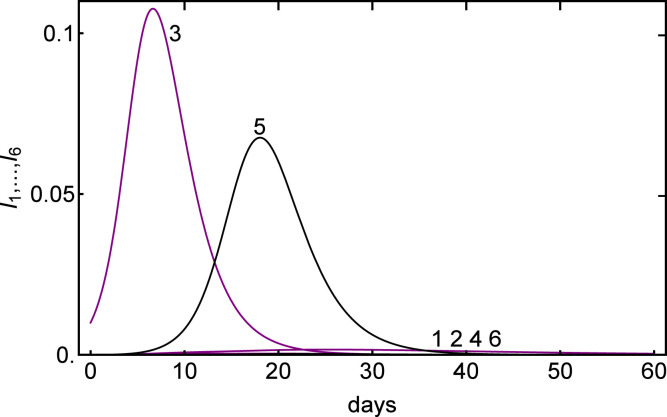
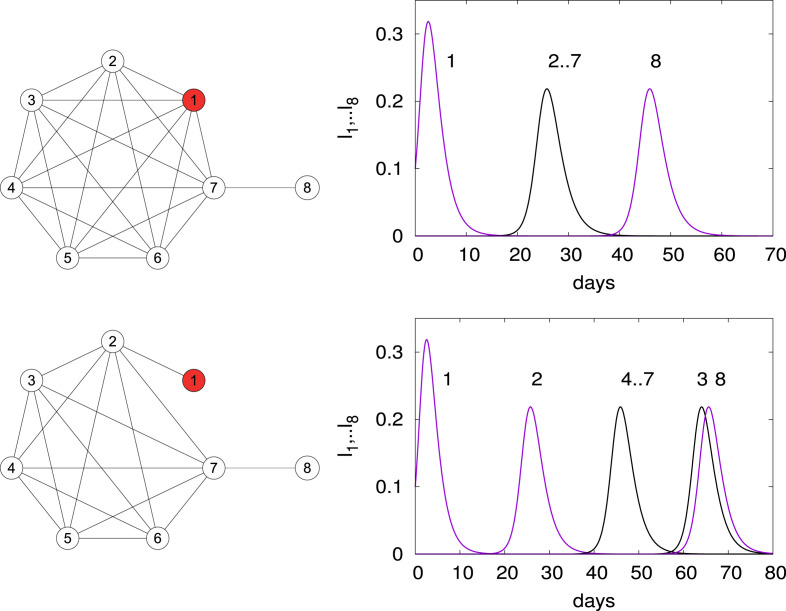
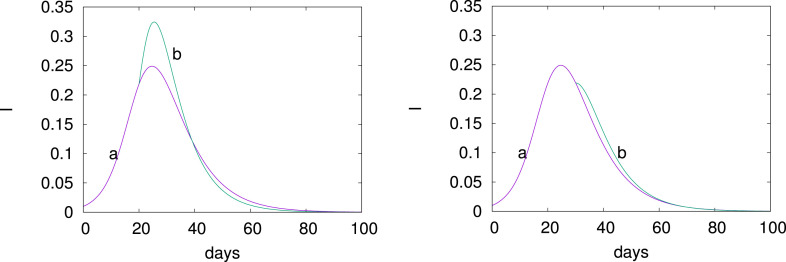
We analyze an epidemic model on a network consisting of susceptible-infected-recovered equations at the nodes coupled by diffusion using a graph Laplacian. We introduce an epidemic criterion and examine different isolation strategies: we prove that it is most effective to isolate a node of highest degree. The model is also useful to evaluate deconfinement scenarios and prevent a so-called second wave. The model has few parameters enabling fitting to the data and the essential ingredient of importation of infected; these features are particularly important for the current COVID-19 epidemic.
我们分析了一个网络上的流行病模型,该网络由节点处的易感-感染-康复方程组成,通过使用图拉普拉斯算子的扩散进行耦合。我们引入了一个流行病标准并研究了不同的隔离策略:我们证明隔离度数最高的节点是最有效的。该模型对于评估解除限制的情况和预防所谓的第二波疫情也很有用。该模型具有很少的参数,能够拟合数据以及感染输入的关键因素;这些特征对于当前的新冠疫情尤为重要。