Wang Xu, Li Feng, Guo Yirong
Wyss Institute for Biologically Inspired Engineering, Harvard University, Boston, MA, United States.
College of Chemistry, Sichuan University, Chengdu, China.
Front Chem. 2020 Oct 16;8:586702. doi: 10.3389/fchem.2020.586702. eCollection 2020.
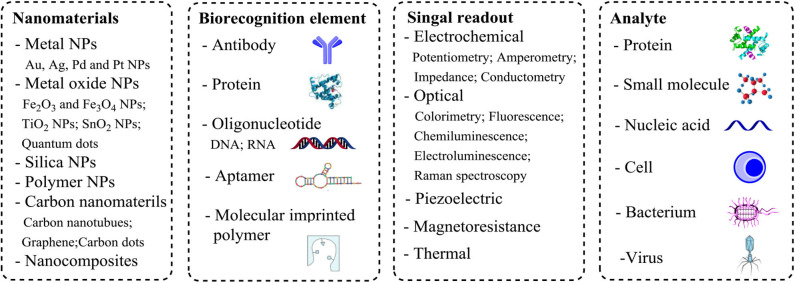
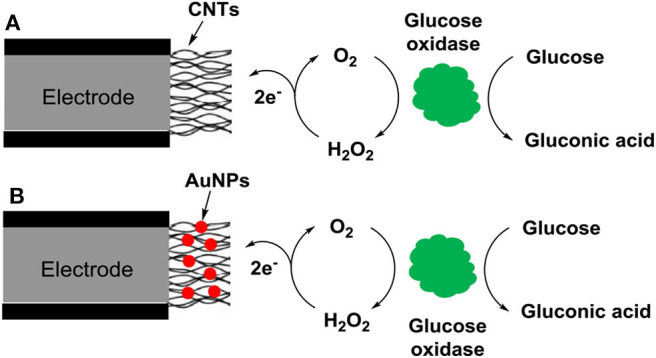
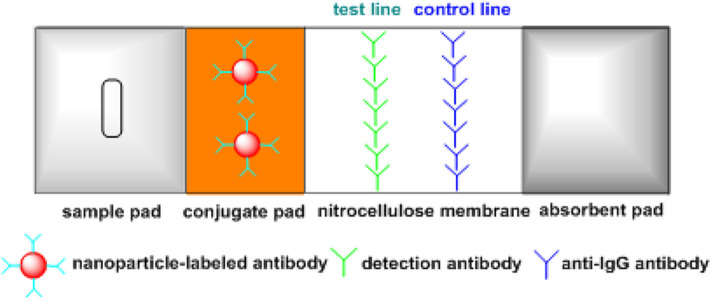
In recent years, nanomaterials of different shape, size, and composition have been prepared and characterized, such as gold and silver nanoparticles, quantum dots, mesoporous silica nanoparticles, carbon nanomaterials, and hybrid nanocomposites. Because of their unique physical and chemical properties, these nanomaterials are increasingly used in point-of-care testing (POCT) to improve analytical performance and simplify detection process. They are used either as carriers for immobilizing biorecognition elements, or as labels for signal generation, transduction and amplification. In this commentary, we highlight recent POCT technologies that employ nanotechnology for the analysis of disease biomarkers, including small-molecule metabolites, enzymes, proteins, nucleic acids, cancer cells, and pathogens. Recent advances in lateral flow tests, printable electrochemical biosensors, and microfluidics-based devices are summarized. Existing challenges and future directions are also discussed.
近年来,人们制备并表征了不同形状、尺寸和组成的纳米材料,如金纳米颗粒、银纳米颗粒、量子点、介孔二氧化硅纳米颗粒、碳纳米材料以及杂化纳米复合材料。由于这些纳米材料具有独特的物理和化学性质,它们在即时检验(POCT)中越来越多地被用于提高分析性能和简化检测过程。它们既可以用作固定生物识别元件的载体,也可以用作信号产生、转导和放大的标记物。在这篇评论中,我们重点介绍了最近采用纳米技术分析疾病生物标志物的即时检验技术,包括小分子代谢物、酶、蛋白质、核酸、癌细胞和病原体。总结了横向流动检测、可打印电化学生物传感器和基于微流控的设备的最新进展。还讨论了现存的挑战和未来的发展方向。