College of Agriculture, Shihezi University, Shihezi, 832003, Xinjiang, People's Republic of China.
Sci Rep. 2020 Nov 18;10(1):20112. doi: 10.1038/s41598-020-77142-7.
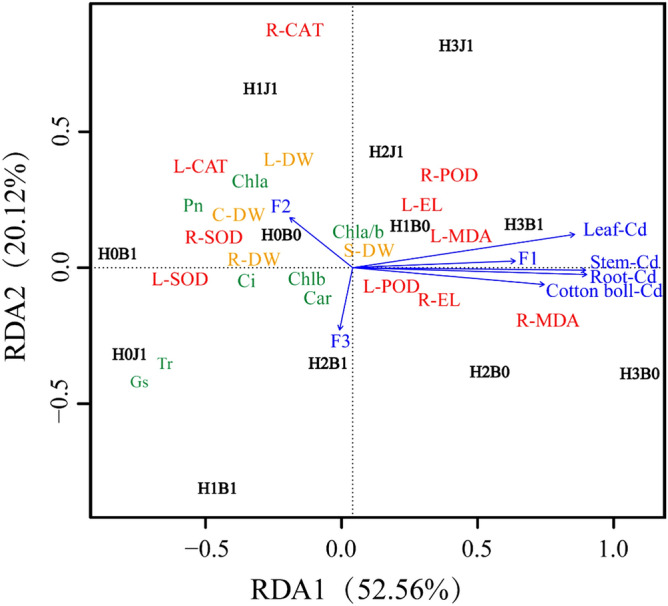
Consistent use of large amounts of fertilizers, pesticides, and mulch can cause the accumulation of harmful substances in cotton plants. Among these harmful substances, cadmium (Cd), an undegradable element, stands out as being particularly highly toxic to plants. The objective of this study was to evaluate the ability of biochar (3%) and biofertilizer (1.5%) to decrease Cd uptake, increase cotton dry weight, and modulate the activities of photosynthetic and peroxidase (POD), superoxide dismutase (SOD), catalase enzyme (CAT) in cotton (Gossypium hirsutum L.) grown in Cd-contaminated soil (0, 1, 2, or 4 mg Cd kg soil) in pots. These studies showed that, as expected, exogenous Cd adversely affects cotton chlorophyll and photosynthesis. However, biochar and biofertilizer increased cotton dry weight by an average of 16.82% and 32.62%, respectively. Meanwhile, biochar and biofertilizer decreased the accumulation of Cd in cotton organs, and there was a significant reduction in the amount of Cd in bolls (P < 0.05). Biochar and biofertilizer have a positive impact on cotton chlorophyll content, net photosynthesis, stomatal conductance, transpiration rate, and intercellular CO concentration. Thus, the addition of biochar and biofertilizer promote cotton growth. However, biochar and biofertilizer increased the SOD activity of leaves (47.70% and 77.21%), CAT activity of leaves (35.40% and 72.82%), SOD activity of roots (33.62% and 39.37%), and CAT activity of roots (36.91% and 60.29%), respectively, and the addition of biochar and biofertilizer decreased the content of MDA and electrolyte leakage rate. Redundancy analyses showed that biochar and biofertilizer also improved SOD and POD activities by reducing the heavy metal-induced oxidative stress in cotton and reducing Cd uptake in cotton organs. Therefore, biochar and biofertilizer have a positive effect on the growth of cotton.
大量使用化肥、农药和覆盖物会导致棉花植株中有害物质的积累。在这些有害物质中,镉(Cd)作为一种不可降解的元素,对植物的毒性尤其高。本研究的目的是评估生物炭(3%)和生物肥料(1.5%)对降低棉花对镉的吸收、增加棉花干重以及调节光合和过氧化物酶(POD)、超氧化物歧化酶(SOD)、过氧化氢酶(CAT)活性的能力,这些酶在种植于含镉土壤(0、1、2 或 4 mg Cd kg 土壤)的棉花(Gossypium hirsutum L.)中。这些研究表明,正如预期的那样,外源性 Cd 会对棉花叶绿素和光合作用产生不利影响。然而,生物炭和生物肥料分别使棉花干重增加了 16.82%和 32.62%。同时,生物炭和生物肥料降低了棉花器官中 Cd 的积累,并且铃中的 Cd 含量显著减少(P<0.05)。生物炭和生物肥料对棉花叶绿素含量、净光合作用、气孔导度、蒸腾速率和胞间 CO 浓度有积极影响。因此,添加生物炭和生物肥料促进了棉花的生长。然而,生物炭和生物肥料增加了叶片的 SOD 活性(分别为 47.70%和 77.21%)、CAT 活性(分别为 35.40%和 72.82%)、根的 SOD 活性(分别为 33.62%和 39.37%)和根的 CAT 活性(分别为 36.91%和 60.29%),并降低了 MDA 含量和电解质渗漏率。冗余分析表明,生物炭和生物肥料通过降低重金属诱导的棉花氧化应激和减少棉花器官对 Cd 的吸收,也改善了 SOD 和 POD 活性。因此,生物炭和生物肥料对棉花的生长有积极的影响。