Sanchez Helen M, Whitener Victoria A, Thulsiraj Vanessa, Amundson Alicia, Collins Carolyn, Duran-Gonzalez Mckenzie, Giragossian Edwin, Hornstra Allison, Kamel Sarah, Maben Andrea, Reynolds Amelia, Roswell Elizabeth, Schmidt Benjamin, Sevigny Lauren, Xiong Cindy, Jay Jennifer A
Department of Civil and Environmental Engineering, University of California at Los Angeles, Los Angeles, CA 90095, USA.
Institute of the Environment and Sustainability, University of California at Los Angeles, Los Angeles, CA 90095, USA.
Animals (Basel). 2020 Nov 26;10(12):2217. doi: 10.3390/ani10122217.
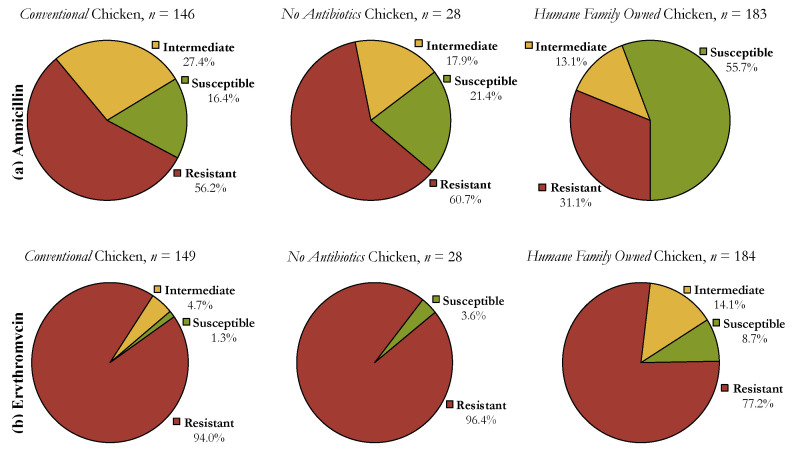
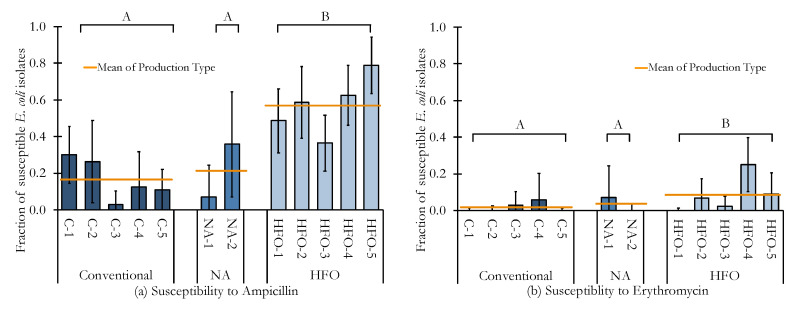
The use of antibiotics for therapeutic and especially non-therapeutic purposes in livestock farms promotes the development of antibiotic resistance in previously susceptible bacteria through selective pressure. In this work, we examined isolates using the standard Kirby-Bauer disk diffusion susceptibility protocol and the CLSI standards. Companies selling retail chicken products in Los Angeles, California were grouped into three production groupings-, , and . is not a federally regulated category in the United States, but shows the reader that the chicken is incubated, hatched, raised, slaughtered, and packaged by one party, ensuring that the use of antibiotics in the entire production of the chicken is known and understood. We then examined the antibiotic resistance of the isolates ( = 325) by exposing them to seven common antibiotics, and resistance was seen to two of the antibiotics, ampicillin and erythromycin. As has been shown previously, it was found that for both ampicillin and erythromycin, there was no significant difference ( > 0.05) between and USDA (United States Department of Agriculture)-certified chicken. Unique to this work, we additionally found that chicken had fewer ( ≤ 0.05) antibiotic-resistant isolates than both of the previous. Although not considered clinically relevant, we chose to test erythromycin because of its ecological significance to the environmental antibiotic resistome, which is not generally done. To our knowledge, consumer chicken has not previously been studied for its antibiotic resistance. This work contributes to a better understanding of a potential strategy of chicken production for the overall benefit of human health, giving evidentiary support to the One Health approach implemented by the World Health Organization.
在畜牧场中,将抗生素用于治疗尤其是非治疗目的,会通过选择性压力促使先前敏感的细菌产生抗生素耐药性。在这项研究中,我们使用标准的 Kirby-Bauer 纸片扩散药敏试验方案和 CLSI 标准对分离株进行了检测。在加利福尼亚州洛杉矶市销售零售鸡肉产品的公司被分为三个生产类别——A、B 和 C。在美国,C 类别并非联邦监管类别,但向读者表明鸡肉由一方进行孵化、饲养、屠宰和包装,确保鸡肉整个生产过程中抗生素的使用情况是已知且可理解的。然后,我们通过将 325 株分离株暴露于七种常见抗生素来检测其抗生素耐药性,结果发现对其中两种抗生素氨苄西林和红霉素存在耐药性。如先前所示,发现对于氨苄西林和红霉素,A 类鸡肉与美国农业部(USDA)认证的 B 类鸡肉之间没有显著差异(P>0.05)。这项研究的独特之处在于,我们还发现 C 类鸡肉的抗生素耐药分离株比前两者都少(P≤0.05)。尽管红霉素耐药性在临床上不被认为具有相关性,但由于其对环境抗生素耐药基因组具有生态意义,我们还是选择对其进行检测,而这一点通常未被纳入研究。据我们所知,此前尚未对 C 类消费鸡肉的抗生素耐药性进行过研究。这项工作有助于更好地理解一种对人类健康总体有益的鸡肉生产潜在策略,为世界卫生组织实施的“同一健康”方法提供了证据支持。