Finnish Institute for Health and Welfare, Social and Health System Research Unit, Helsinki, Finland.
Research Unit of Nursing Science and Health Management, University of Oulu, Oulu, Finland.
J Med Internet Res. 2020 Dec 8;22(12):e21623. doi: 10.2196/21623.
The popularity of web-based patient-professional communication over patient portals is constantly increasing. Good patient-professional communication is a prerequisite for high-quality care and patient centeredness. Understanding health care professionals' experiences of web-based patient-professional communication is important as they play a key role in engaging patients to use portals. More information is needed on how patient-professional communication could be supported by patient portals in health care.
This systematic review of qualitative studies aims to identify how health care professionals experience web-based patient-professional communication over the patient portals.
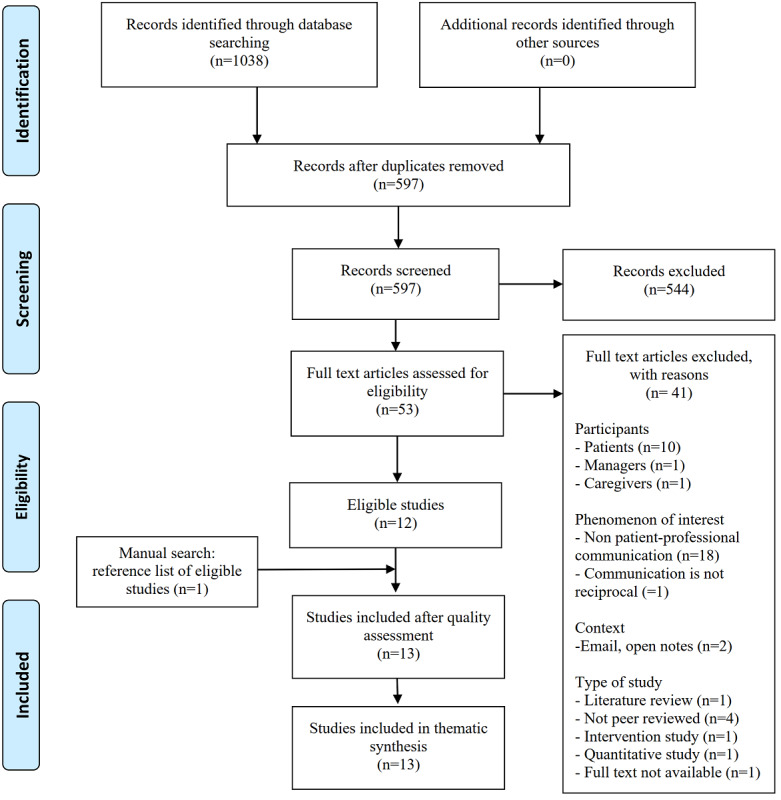
Abstract and full-text reviews were conducted by 2 reviewers independently. A total of 4 databases were used for the study: CINAHL (EBSCO), ProQuest (ABI/INFORM), Scopus, and PubMed. The inclusion criteria for the reviewed studies were as follows: the examination of health care professionals' experiences, reciprocal communication between patients and health care professionals, peer-reviewed scientific articles, and studies published between 2010 and 2019. The Joanna Briggs Institute's quality assessment criteria were used in the review process. A total of 13 included studies were analyzed using a thematic synthesis, which was conducted by 3 reviewers.
A total of 6 analytical themes concerning health care professionals' experiences of web-based patient-professional communication were identified. The themes were related to health care professionals' work, change in communication over patient portals, patients' use of patient portals, the suitability of patient portals for communication, the convenience of patient portals for communication, and change in roles.
Health care professionals' experiences contain both positive and negative insights into web-based patient-professional communication over patient portals. Most commonly, the positive experiences seem to be related to the patients and patient outcomes, such as having better patient engagement. Health care professionals also have negative experiences, for example, web-based patient-professional communication sometimes has deficiencies and has a negative impact on their workload. These negative experiences may be explained by the poor functionality of the patient portals and insufficient training and resources. To reduce health care professionals' negative experiences of web-based patient-professional communication, their experiences should be taken into account by policy makers, health care organizations, and information technology enterprises when developing patient portals. In addition, more training regarding web-based patient-professional communication and patient portals should be provided to health care professionals.
基于网络的医患交流在患者门户中越来越受欢迎。良好的医患沟通是高质量护理和以患者为中心的前提。了解医疗保健专业人员对基于网络的医患交流的体验很重要,因为他们在促使患者使用门户方面发挥着关键作用。需要更多关于患者门户如何支持医疗保健中的医患沟通的信息。
本系统评价的目的是确定医疗保健专业人员对患者门户中基于网络的医患沟通的体验。
两名审查员独立进行了摘要和全文审查。共使用了 4 个数据库进行研究:CINAHL(EBSCO)、ProQuest(ABI/INFORM)、Scopus 和 PubMed。审查研究的纳入标准如下:检查医患沟通经验、患者与医疗保健专业人员之间的相互沟通、同行评审的科学文章以及 2010 年至 2019 年期间发表的研究。审查过程中使用了乔安娜·布里格斯研究所的质量评估标准。共有 13 项纳入的研究通过主题综合分析进行了分析,由 3 名审查员进行。
确定了与医疗保健专业人员基于网络的医患沟通体验相关的 6 个分析主题。这些主题涉及医疗保健专业人员的工作、患者门户沟通方式的变化、患者对患者门户的使用、患者门户沟通的适宜性、患者门户沟通的便利性以及角色的变化。
医疗保健专业人员的体验包含了基于网络的医患交流的积极和消极的见解。最常见的是,积极的体验似乎与患者和患者结果有关,例如更好的患者参与度。医疗保健专业人员也有消极的体验,例如基于网络的医患沟通有时存在缺陷,并对他们的工作量产生负面影响。这些负面体验可能是由于患者门户的功能不完善以及培训和资源不足造成的。为了减少医疗保健专业人员对基于网络的医患交流的负面体验,政策制定者、医疗保健组织和信息技术企业在开发患者门户时应考虑他们的体验。此外,应向医疗保健专业人员提供更多关于基于网络的医患交流和患者门户的培训。