Health Economics and Policy Research and Evaluation for Development Results Group, Yaounde, Cameroon.
Psychiatry Internship Program, Université de Bourgogne, Dijon, Bourgogne, France.
BMJ Open. 2020 Dec 10;10(12):e037975. doi: 10.1136/bmjopen-2020-037975.
Better knowledge of epidemiology of depressive disorders in people living with hypertension can help to implement pertinent strategies to address its burden. The objective was to estimate the prevalence of depressive disorders and symptoms in people living with hypertension in Africa.
Systematic review and meta-analysis.
PubMed, EMBASE, African Index Medicus, African Journals OnLine were searched up to 31 January 2020, regardless of the language of publication.
We included studies conducted among adult patients with hypertension (≥18 years) living in Africa and reporting the prevalence of depressive disorders and symptoms.
Two independent investigators selected studies, extracted data and assessed the methodological quality of included studies by using the tools developed by Joanna Briggs Institute. Multivariate random-effects meta-analysis served to pool data by considering the variability between diagnostic tools used to identify patients with depressive disorders or symptoms.
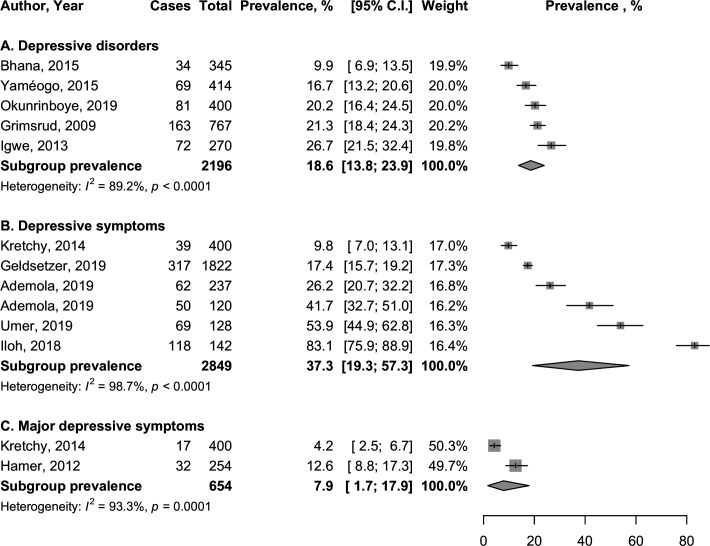
We included 11 studies with 5299 adults with hypertension. Data were collected between 2002 and 2017, from South Africa, Nigeria, Ghana, Ethiopia and Burkina Faso. The mean age varied between 50.3 years and 59.6 years. The proportion of men ranged from 28% to 54%. The adjusted prevalence of depressive disorders taking into account the variance between diagnostic tools was 17.9% (95% CI 13.0% to 23.4%). The prevalence of depressive symptoms and major depressive symptoms was 33.3% (95% CI 9.9% to 61.6%) and 7.8% (95% CI 3.0% to 14.5%), respectively. There was heterogeneity attributable to the diagnostic tools for depressive disorders and symptoms. There was no publication bias.
Notwithstanding the representativeness lack of some (sub) regions of Africa, weakening the generalisability of findings to the entire region; depressive disorders and symptoms are prevalent in people living with hypertension in Africa, indicating that strategies from clinicians, researchers and public health makers are needed to reduce its burden in the region.
更好地了解高血压患者中抑郁障碍的流行病学情况,有助于制定相关策略来应对其负担。本研究旨在评估非洲高血压患者中抑郁障碍和症状的患病率。
系统评价和荟萃分析。
截至 2020 年 1 月 31 日,检索了 PubMed、EMBASE、非洲医学索引、非洲期刊在线数据库,无论出版语言如何,均进行了检索。
纳入研究为在非洲进行的,针对成年高血压患者(≥18 岁)且报告抑郁障碍和症状患病率的研究。
两名独立的研究者选择研究、提取数据,并使用 Joanna Briggs 研究所开发的工具评估纳入研究的方法学质量。使用多变量随机效应荟萃分析,通过考虑用于识别抑郁障碍或症状患者的诊断工具之间的差异,汇总数据。
共纳入 11 项研究,共纳入 5299 名高血压成年人。数据收集时间为 2002 年至 2017 年,来自南非、尼日利亚、加纳、埃塞俄比亚和布基纳法索。平均年龄在 50.3 岁至 59.6 岁之间。男性比例在 28%至 54%之间。考虑到诊断工具之间的差异,抑郁障碍的调整后患病率为 17.9%(95%CI 13.0%至 23.4%)。抑郁症状和重度抑郁症状的患病率分别为 33.3%(95%CI 9.9%至 61.6%)和 7.8%(95%CI 3.0%至 14.5%)。抑郁障碍和症状的诊断工具存在异质性。不存在发表偏倚。
尽管非洲一些(次)地区代表性不足,削弱了研究结果在整个地区的普遍性;但非洲高血压患者中抑郁障碍和症状普遍存在,表明需要临床医生、研究人员和公共卫生决策者制定策略来减轻该地区的负担。