Department of Medical Translational Sciences, University Federico II, 80131 Naples, Italy.
European Laboratory for the Investigation of Food-Induced Diseases, University Federico II, 80131 Naples, Italy.
Nutrients. 2020 Dec 11;12(12):3802. doi: 10.3390/nu12123802.
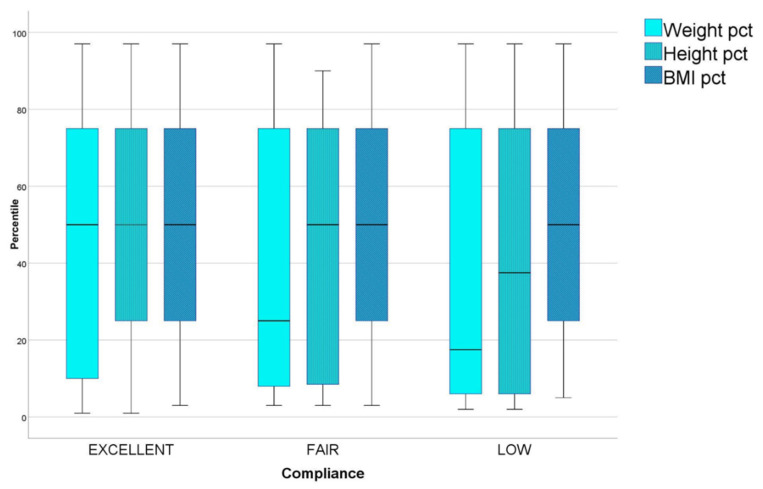
Assessment of adherence to gluten-free diet (GFD) represents the cornerstone in the management of coeliac disease. The primary aim of this study was to assess diet adherence through a questionnaire adapted to children. The secondary aim was to identify influencing factors and outcomes related to diet adherence. In this study, data about diagnosis, education, quality of life (QoL) and anti-transglutaminase (anti-TG2) titers of 160 coeliac children were collected. For the assessment of diet adherence, all participants completed the questionnaire modified from Leffler et al. (2009), while a random sample of 37 also underwent an extensive dietary interview. According to the questionnaire, diet adherence was excellent in 95 (59.4%), fair in 46 (28.8%) and low in 19 (11.9%) patients. Children diagnosed with biopsy showed better adherence than those with a biopsy-sparing approach ( 0.036). Adherence to GFD tended to worsen during the follow up, with the average length of follow up being associated with lower scores of diet adherence ( 0.009). Moreover, adherence to GFD decreased throughout school career, dropping from elementary until high school ( 0.037). A positive correlation was observed between adherence to GFD and growth percentiles, which increased when higher scores of adherence were achieved. Diet adherence positively correlated with QoL ( 0.001). In conclusion, the questionnaire displayed good sensitivity in detecting problems in diet adherence, being useful as a screening tool. Better comprehension of influencing factors and outcomes may allow the development of new strategies to improve diet adherence.
评估 gluten-free 饮食(GFD)的依从性是治疗乳糜泻的基石。本研究的主要目的是通过适用于儿童的问卷评估饮食依从性。次要目的是确定与饮食依从性相关的影响因素和结果。在这项研究中,收集了 160 名乳糜泻儿童的诊断、教育、生活质量(QoL)和抗转谷氨酰胺酶(anti-TG2)滴度的数据。为了评估饮食依从性,所有参与者都完成了 Leffler 等人(2009 年)改编的问卷,而随机抽取的 37 名参与者还接受了广泛的饮食访谈。根据问卷,95 名(59.4%)患者饮食依从性极好,46 名(28.8%)患者饮食依从性良好,19 名(11.9%)患者饮食依从性较差。活检诊断的儿童比非活检诊断的儿童具有更好的依从性( 0.036)。随着随访时间的延长,饮食依从性趋于恶化,平均随访时间与饮食依从性评分较低相关( 0.009)。此外,饮食依从性随着学业生涯的进展而逐渐下降,从小学到高中呈下降趋势( 0.037)。饮食依从性与生长百分位数呈正相关,当依从性评分较高时,生长百分位数增加。饮食依从性与生活质量呈正相关( 0.001)。总之,该问卷在检测饮食依从性问题方面具有良好的敏感性,可作为一种筛选工具。更好地理解影响因素和结果可能有助于制定新的策略来提高饮食依从性。