Mei Xuan, Cheng Ke
Department of Molecular Biomedical Sciences and Comparative Medicine Institute, North Carolina State University, Raleigh, NC, United States.
Joint Department of Biomedical Engineering, University of North Carolina at Chapel Hill and North Carolina State University, Raleigh, NC, United States.
Front Cardiovasc Med. 2020 Nov 27;7:610364. doi: 10.3389/fcvm.2020.610364. eCollection 2020.
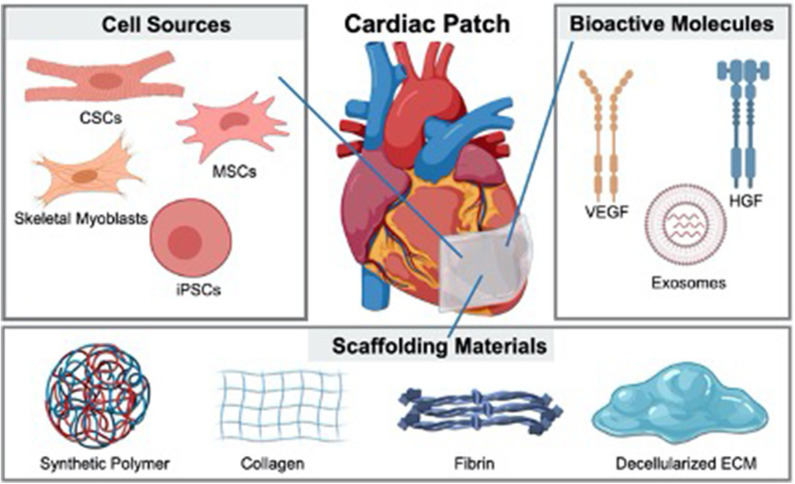
For the past decades, heart diseases remain the leading cause of death worldwide. In the adult mammalian heart, damaged cardiomyocytes will be replaced by non-contractile fibrotic scar tissues due to the poor regenerative ability of heart, causing heart failure subsequently. The development of tissue engineering has launched a new medical innovation for heart regeneration. As one of the most outstanding technology, cardiac patches hold the potential to restore cardiac function clinically. Consisted of two components: therapeutic ingredients and substrate scaffolds, the fabrication of cardiac patches requires both advanced bioactive molecules and biomaterials. In this review, we will present the most state-of-the-art cardiac patches and analysis their compositional details. The therapeutic ingredients will be discussed from cell sources to bioactive molecules. In the meanwhile, the recent advances to obtain scaffold biomaterials will be highlighted, including synthetic and natural materials. Also, we have focused on the challenges and potential strategies to fabricate clinically applicable cardiac patches.
在过去几十年里,心脏病仍然是全球主要的死亡原因。在成年哺乳动物心脏中,由于心脏再生能力差,受损的心肌细胞会被无收缩能力的纤维化瘢痕组织取代,随后导致心力衰竭。组织工程的发展为心脏再生带来了新的医学创新。作为最杰出的技术之一,心脏补片在临床上具有恢复心脏功能的潜力。心脏补片由治疗成分和基质支架两个部分组成,其制造需要先进的生物活性分子和生物材料。在这篇综述中,我们将介绍最先进的心脏补片并分析其组成细节。治疗成分将从细胞来源到生物活性分子进行讨论。同时,将重点介绍获得支架生物材料的最新进展,包括合成材料和天然材料。此外,我们关注了制造临床适用心脏补片的挑战和潜在策略。