Department of Translational Neuroscience, Faculty of Medicine and Health Science, University of Antwerp, Antwerp, Belgium.
University Department of Otorhinolaryngology and Head and Neck Surgery, Antwerp University Hospital, Edegem, Belgium.
PLoS One. 2020 Dec 17;15(12):e0243785. doi: 10.1371/journal.pone.0243785. eCollection 2020.
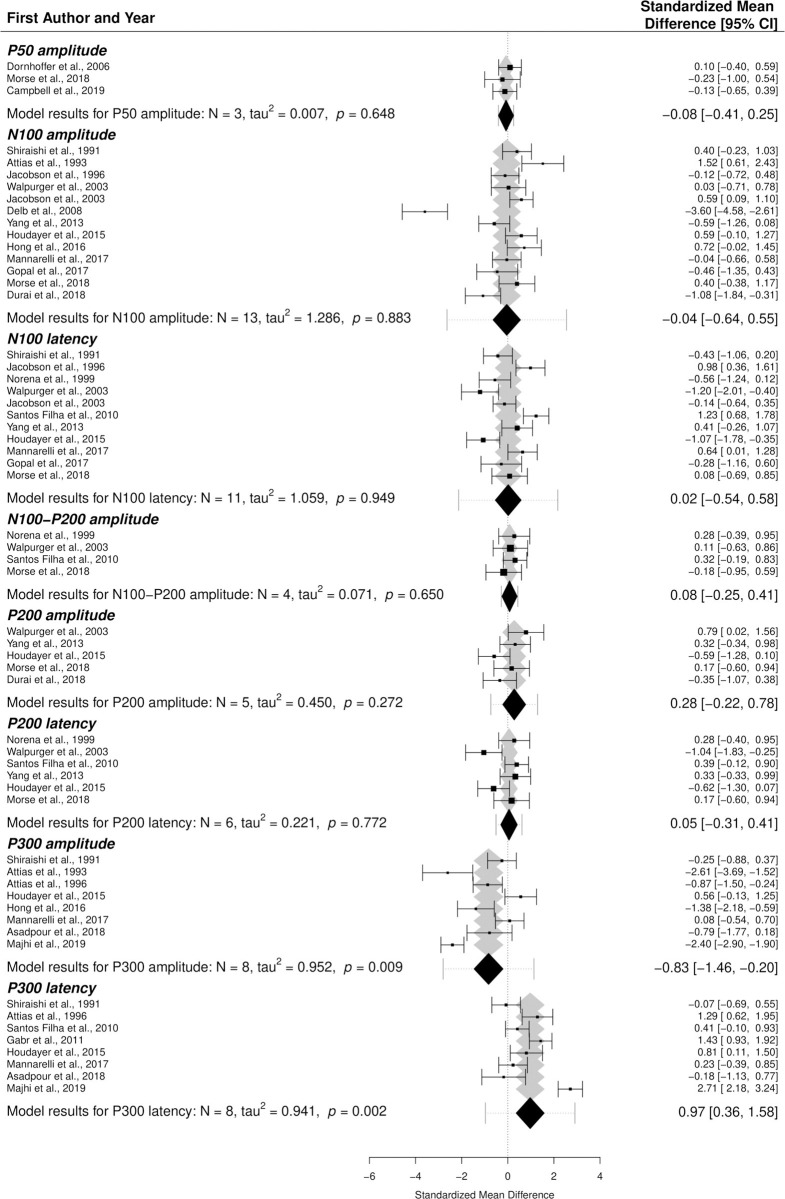
Subjective tinnitus, the perception of sound in the absence of any sound source, is routinely assessed using questionnaires. The subjective nature of these tools hampers objective evaluation of tinnitus presence, severity and treatment effects. Late auditory evoked potentials (LAEPs) might be considered as a potential biomarker for assessing tinnitus complaints. Using a multivariate meta-analytic model including data from twenty-one studies, we determined the LAEP components differing systematically between tinnitus patients and controls. Results from this model indicate that amplitude of the P300 component is lower in tinnitus patients (standardized mean difference (SMD) = -0.83, p < 0.01), while latency of this component is abnormally prolonged in this population (SMD = 0.97, p < 0.01). No other investigated LAEP components were found to differ between tinnitus and non-tinnitus subjects. Additional sensitivity analyses regarding differences in experimental conditions confirmed the robustness of these results. Differences in age and hearing levels between the two experimental groups might have a considerable impact on LAEP outcomes and should be carefully considered in future studies. Although we established consistent differences in the P300 component between tinnitus patients and controls, we could not identify any evidence that this component might covary with tinnitus severity. We conclude that out of several commonly assessed LAEP components, only the P300 can be considered as a potential biomarker for subjective tinnitus, although more research is needed to determine its relationship with subjective tinnitus measures. Future trials investigating experimental tinnitus therapies should consider including P300 measurements in the evaluation of treatment effect.
主观耳鸣,即无任何声源存在时感知到的声音,通常通过问卷进行评估。这些工具的主观性阻碍了对耳鸣存在、严重程度和治疗效果的客观评估。晚期听觉诱发电位(LAEPs)可被视为评估耳鸣主诉的潜在生物标志物。通过包括 21 项研究数据的多元荟萃分析模型,我们确定了 LAEP 成分在耳鸣患者和对照组之间存在系统差异。该模型的结果表明,耳鸣患者的 P300 成分振幅较低(标准化均数差(SMD)=-0.83,p<0.01),而该成分的潜伏期在该人群中异常延长(SMD=0.97,p<0.01)。未发现其他调查的 LAEP 成分在耳鸣和非耳鸣受试者之间存在差异。针对实验条件差异的额外敏感性分析证实了这些结果的稳健性。两组实验中年龄和听力水平的差异可能对 LAEP 结果产生重大影响,在未来研究中应予以仔细考虑。尽管我们在耳鸣患者和对照组之间的 P300 成分中建立了一致的差异,但我们无法确定该成分是否与耳鸣严重程度相关。我们得出结论,在几种常见的 LAEP 成分中,只有 P300 可以被视为主观耳鸣的潜在生物标志物,尽管需要进一步研究来确定其与主观耳鸣测量的关系。未来研究实验性耳鸣疗法的试验应考虑在评估治疗效果时纳入 P300 测量。