• 文献检索
  • 文档翻译
  • 深度研究
  • 学术资讯
  • Suppr Zotero 插件Zotero 插件
  • 邀请有礼
  • 套餐&价格
  • 历史记录
应用&插件
Suppr Zotero 插件Zotero 插件浏览器插件Mac 客户端Windows 客户端微信小程序
定价
高级版会员购买积分包购买API积分包
服务
文献检索文档翻译深度研究API 文档MCP 服务
关于我们
关于 Suppr公司介绍联系我们用户协议隐私条款
关注我们

Suppr 超能文献

核心技术专利:CN118964589B侵权必究
粤ICP备2023148730 号-1Suppr @ 2026

文献检索

告别复杂PubMed语法,用中文像聊天一样搜索,搜遍4000万医学文献。AI智能推荐,让科研检索更轻松。

立即免费搜索

文件翻译

保留排版,准确专业,支持PDF/Word/PPT等文件格式,支持 12+语言互译。

免费翻译文档

深度研究

AI帮你快速写综述,25分钟生成高质量综述,智能提取关键信息,辅助科研写作。

立即免费体验

展示白盒机器学习方法从心血管疾病心电图中获得洞见的潜力。

Demonstration of the potential of white-box machine learning approaches to gain insights from cardiovascular disease electrocardiograms.

机构信息

Machine Learning Research Group, Aalen University, Aalen, Germany.

出版信息

PLoS One. 2020 Dec 17;15(12):e0243615. doi: 10.1371/journal.pone.0243615. eCollection 2020.

DOI:10.1371/journal.pone.0243615
PMID:33332440
原文链接:https://pmc.ncbi.nlm.nih.gov/articles/PMC7746264/
Abstract

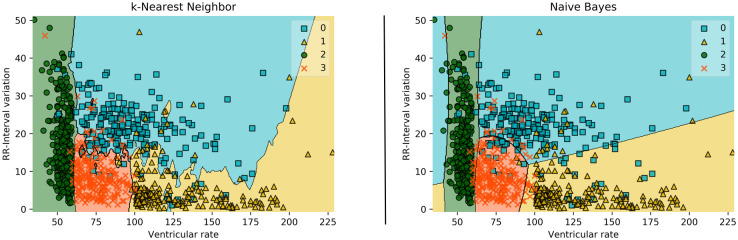
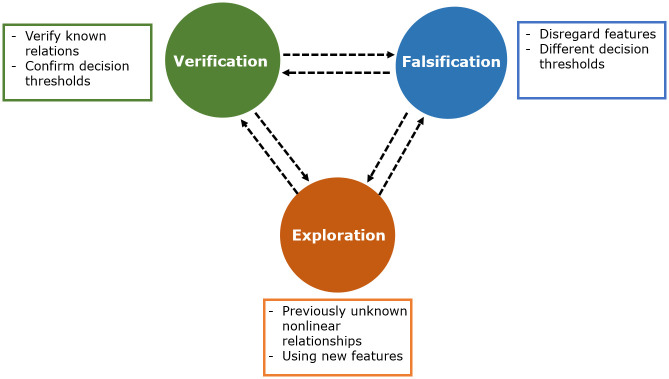
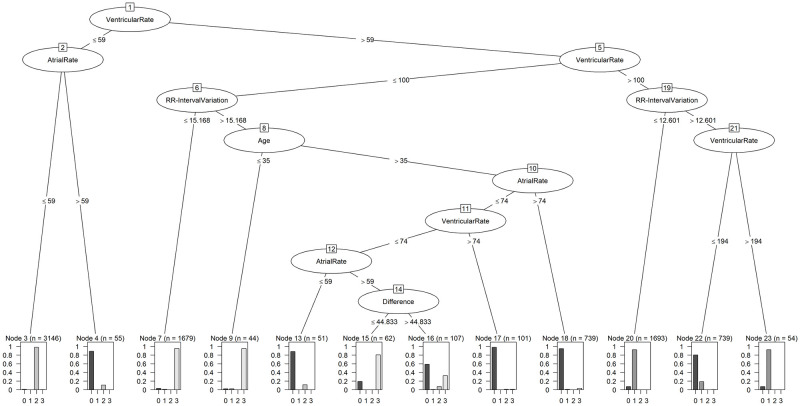
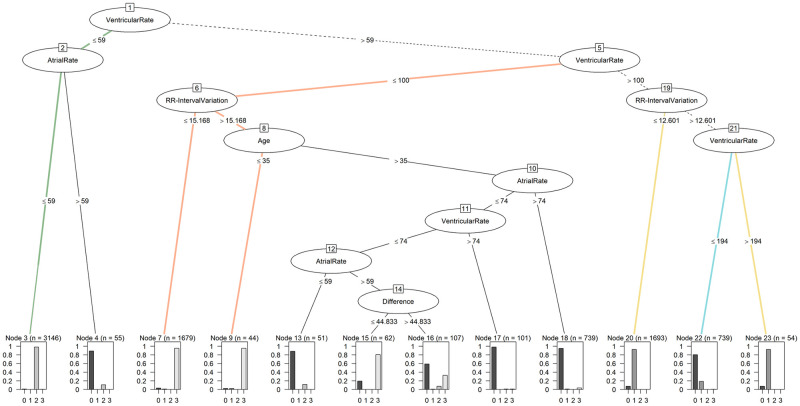
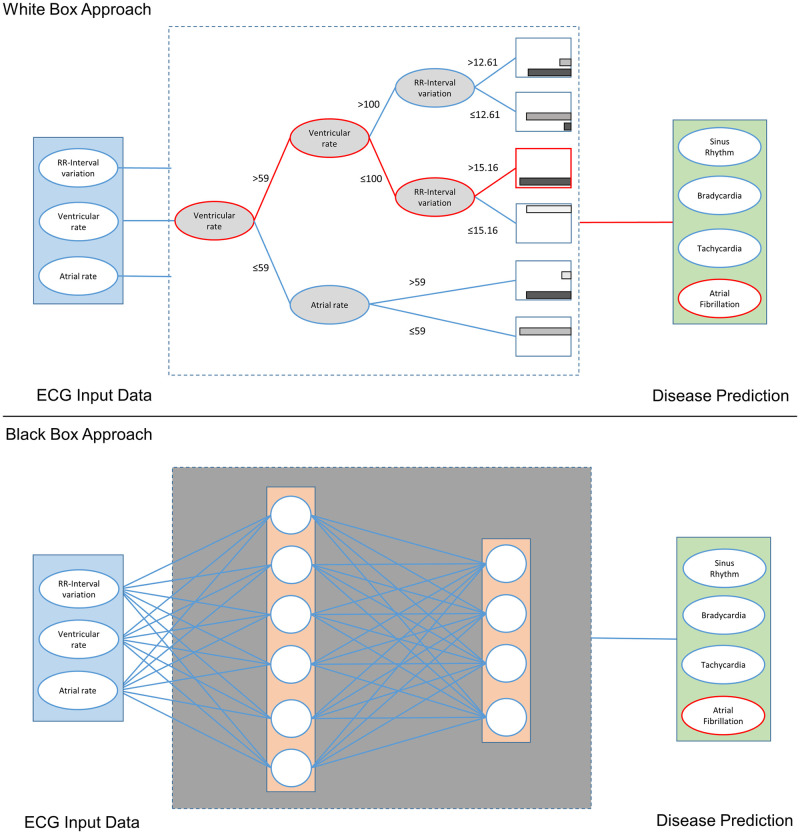
We present the results from a white-box machine learning approach to detect cardiac arrhythmias using electrocardiographic data. A C5.0 is trained to recognize four classes using common features. The four classes are (i) atrial fibrillation and atrial flutter, (ii) tachycardias (iii), sinus bradycardia and (iv) sinus rhythm. Data from 10,646 subjects, 83% of whom have at least one arrhythmia and 17% of whom exhibit a normal sinus rhythm, are used. The C5.0 is trained using 10-fold cross-validation and is able to achieve a balanced accuracy of 95.35%. By using the white-box machine learning approach, a clear and comprehensible tree structure can be revealed, which has selected the 5 most important features from a total of 24 features. These 5 features are ventricular rate, RR-Interval variation, atrial rate, age and difference between longest and shortest RR-Interval. The combination of ventricular rate, RR-Interval variation and atrial rate is especially relevant to achieve classification accuracy, which can be disclosed through the tree. The tree assigns unique values to distinguish the classes. These findings could be applied in medicine in the future. It can be shown that a white-box machine learning approach can reveal granular structures, thus confirming known linear relationships and also revealing nonlinear relationships. To highlight the strength of the C5.0 with respect to this structural revelation, the results of further white-box machine learning and black-box machine learning algorithms are presented.

摘要

我们提出了一种使用心电图数据通过白盒机器学习方法检测心律失常的结果。使用常见特征对 C5.0 进行训练以识别四个类别。这四个类别是(i)心房颤动和心房扑动,(ii)心动过速,(iii)窦性心动过缓和(iv)窦性节律。使用了来自 10646 名受试者的数据,其中 83%至少有一种心律失常,17%表现出正常窦性节律。C5.0 使用 10 折交叉验证进行训练,能够达到 95.35%的平衡准确性。通过使用白盒机器学习方法,可以揭示清晰易懂的树状结构,该结构从总共 24 个特征中选择了 5 个最重要的特征。这 5 个特征是心室率、RR 间隔变化、心房率、年龄和最长与最短 RR 间隔之间的差异。心室率、RR 间隔变化和心房率的组合对于实现分类准确性特别重要,这可以通过树状结构揭示。树为区分不同类别分配了唯一的值。这些发现将来可能会在医学中得到应用。可以证明,白盒机器学习方法可以揭示颗粒状结构,从而确认已知的线性关系,同时也揭示非线性关系。为了突出 C5.0 在这种结构揭示方面的优势,还呈现了进一步的白盒机器学习和黑盒机器学习算法的结果。
https://cdn.ncbi.nlm.nih.gov/pmc/blobs/a07c/7746264/03ee81bd084d/pone.0243615.g008.jpg
https://cdn.ncbi.nlm.nih.gov/pmc/blobs/a07c/7746264/04e1619f8841/pone.0243615.g001.jpg
https://cdn.ncbi.nlm.nih.gov/pmc/blobs/a07c/7746264/71af3fcd808f/pone.0243615.g002.jpg
https://cdn.ncbi.nlm.nih.gov/pmc/blobs/a07c/7746264/3f2f422b43d8/pone.0243615.g003.jpg
https://cdn.ncbi.nlm.nih.gov/pmc/blobs/a07c/7746264/633cdbf82d5f/pone.0243615.g004.jpg
https://cdn.ncbi.nlm.nih.gov/pmc/blobs/a07c/7746264/7a04abca8f96/pone.0243615.g005.jpg
https://cdn.ncbi.nlm.nih.gov/pmc/blobs/a07c/7746264/452208457d23/pone.0243615.g006.jpg
https://cdn.ncbi.nlm.nih.gov/pmc/blobs/a07c/7746264/b046befd0be2/pone.0243615.g007.jpg
https://cdn.ncbi.nlm.nih.gov/pmc/blobs/a07c/7746264/03ee81bd084d/pone.0243615.g008.jpg
https://cdn.ncbi.nlm.nih.gov/pmc/blobs/a07c/7746264/04e1619f8841/pone.0243615.g001.jpg
https://cdn.ncbi.nlm.nih.gov/pmc/blobs/a07c/7746264/71af3fcd808f/pone.0243615.g002.jpg
https://cdn.ncbi.nlm.nih.gov/pmc/blobs/a07c/7746264/3f2f422b43d8/pone.0243615.g003.jpg
https://cdn.ncbi.nlm.nih.gov/pmc/blobs/a07c/7746264/633cdbf82d5f/pone.0243615.g004.jpg
https://cdn.ncbi.nlm.nih.gov/pmc/blobs/a07c/7746264/7a04abca8f96/pone.0243615.g005.jpg
https://cdn.ncbi.nlm.nih.gov/pmc/blobs/a07c/7746264/452208457d23/pone.0243615.g006.jpg
https://cdn.ncbi.nlm.nih.gov/pmc/blobs/a07c/7746264/b046befd0be2/pone.0243615.g007.jpg
https://cdn.ncbi.nlm.nih.gov/pmc/blobs/a07c/7746264/03ee81bd084d/pone.0243615.g008.jpg

相似文献

1
Demonstration of the potential of white-box machine learning approaches to gain insights from cardiovascular disease electrocardiograms.展示白盒机器学习方法从心血管疾病心电图中获得洞见的潜力。
PLoS One. 2020 Dec 17;15(12):e0243615. doi: 10.1371/journal.pone.0243615. eCollection 2020.
2
Expert-enhanced machine learning for cardiac arrhythmia classification.专家增强机器学习在心律失常分类中的应用。
PLoS One. 2021 Dec 23;16(12):e0261571. doi: 10.1371/journal.pone.0261571. eCollection 2021.
3
Prediction model of atrial fibrillation recurrence after Cox-Maze IV procedure in patients with chronic valvular disease and atrial fibrillation based on machine learning algorithm.基于机器学习算法的慢性瓣膜病合并心房颤动患者 Cox-Maze IV 术后心房颤动复发预测模型。
Zhong Nan Da Xue Xue Bao Yi Xue Ban. 2023 Jul 28;48(7):995-1007. doi: 10.11817/j.issn.1672-7347.2023.230018.
4
Automated Method for Discrimination of Arrhythmias Using Time, Frequency, and Nonlinear Features of Electrocardiogram Signals.基于心电图信号时间、频率和非线性特征的心律失常自动判别方法。
Sensors (Basel). 2018 Jun 29;18(7):2090. doi: 10.3390/s18072090.
5
Short-term atrial fibrillation detection using electrocardiograms: A comparison of machine learning approaches.基于心电图的短期心房颤动检测:机器学习方法的比较。
Int J Med Inform. 2022 Jul;163:104790. doi: 10.1016/j.ijmedinf.2022.104790. Epub 2022 May 7.
6
Usefulness of Machine Learning-Based Detection and Classification of Cardiac Arrhythmias With 12-Lead Electrocardiograms.基于机器学习的 12 导联心电图心律失常检测和分类的实用性。
Can J Cardiol. 2021 Jan;37(1):94-104. doi: 10.1016/j.cjca.2020.02.096. Epub 2020 Mar 5.
7
Single-lead arrhythmia detection through machine learning: cross-sectional evaluation of a novel algorithm using real-world data.基于机器学习的单导联心律失常检测:使用真实世界数据对一种新型算法的横断面评估。
Open Heart. 2023 Sep;10(2). doi: 10.1136/openhrt-2022-002228.
8
Support vector machine-based arrhythmia classification using reduced features of heart rate variability signal.基于支持向量机的心律失常分类,使用心率变异性信号的降维特征
Artif Intell Med. 2008 Sep;44(1):51-64. doi: 10.1016/j.artmed.2008.04.007. Epub 2008 Jun 27.
9
Optimal Multi-Stage Arrhythmia Classification Approach.最优多阶段心律失常分类方法。
Sci Rep. 2020 Feb 19;10(1):2898. doi: 10.1038/s41598-020-59821-7.
10
P wave detector with PP rhythm tracking: evaluation in different arrhythmia contexts.具有PP节律跟踪功能的P波检测器:在不同心律失常情况下的评估
Physiol Meas. 2008 Jan;29(1):141-55. doi: 10.1088/0967-3334/29/1/010. Epub 2008 Jan 3.

引用本文的文献

1
Explainable AI in early autism detection: a literature review of interpretable machine learning approaches.早期自闭症检测中的可解释人工智能:可解释机器学习方法的文献综述
Discov Ment Health. 2025 Jul 1;5(1):98. doi: 10.1007/s44192-025-00232-3.
2
The AI Efficiency Paradox: Reclaiming Quality Patient Care in an Era of Optimization.人工智能效率悖论:在优化时代重塑优质患者护理
J Med Syst. 2025 Apr 17;49(1):49. doi: 10.1007/s10916-025-02183-2.
3
Logic-based mechanistic machine learning on high-content images reveals how drugs differentially regulate cardiac fibroblasts.

本文引用的文献

1
Stop Explaining Black Box Machine Learning Models for High Stakes Decisions and Use Interpretable Models Instead.停止为高风险决策解释黑箱机器学习模型,转而使用可解释模型。
Nat Mach Intell. 2019 May;1(5):206-215. doi: 10.1038/s42256-019-0048-x. Epub 2019 May 13.
2
Illuminating the dark spaces of healthcare with ambient intelligence.用环境智能照亮医疗保健的黑暗空间。
Nature. 2020 Sep;585(7824):193-202. doi: 10.1038/s41586-020-2669-y. Epub 2020 Sep 9.
3
A 12-lead electrocardiogram database for arrhythmia research covering more than 10,000 patients.
基于逻辑的机制性机器学习在高内涵图像上揭示了药物如何差异调节心肌成纤维细胞。
Proc Natl Acad Sci U S A. 2024 Jan 30;121(5):e2303513121. doi: 10.1073/pnas.2303513121. Epub 2024 Jan 24.
4
Exploring alternative approaches to precision medicine through genomics and artificial intelligence - a systematic review.通过基因组学和人工智能探索精准医学的替代方法——一项系统综述
Front Med (Lausanne). 2023 Oct 2;10:1227168. doi: 10.3389/fmed.2023.1227168. eCollection 2023.
5
Logic-based mechanistic machine learning on high-content images reveals how drugs differentially regulate cardiac fibroblasts.基于逻辑的高内涵图像机械机器学习揭示了药物如何差异性地调节心脏成纤维细胞。
bioRxiv. 2023 Oct 23:2023.03.01.530599. doi: 10.1101/2023.03.01.530599.
6
Wearable Devices for Remote Monitoring of Heart Rate and Heart Rate Variability-What We Know and What Is Coming.可穿戴设备远程监测心率和心率变异性——我们知道什么和即将到来什么。
Sensors (Basel). 2022 Nov 17;22(22):8903. doi: 10.3390/s22228903.
7
Addressing bias in big data and AI for health care: A call for open science.解决医疗保健领域大数据和人工智能中的偏见:呼吁开放科学。
Patterns (N Y). 2021 Oct 8;2(10):100347. doi: 10.1016/j.patter.2021.100347.
一个包含超过 10000 名患者的心律失常研究用 12 导联心电图数据库。
Sci Data. 2020 Feb 12;7(1):48. doi: 10.1038/s41597-020-0386-x.
4
Definitions, methods, and applications in interpretable machine learning.可解释机器学习中的定义、方法和应用。
Proc Natl Acad Sci U S A. 2019 Oct 29;116(44):22071-22080. doi: 10.1073/pnas.1900654116. Epub 2019 Oct 16.
5
Chinese Patent medicine to treat a 32-year-old man with sinus bradycardia and cardiac sinus arrests: A case report.中成药治疗一名32岁窦性心动过缓和心脏停搏患者:病例报告
Medicine (Baltimore). 2019 May;98(19):e15536. doi: 10.1097/MD.0000000000015536.
6
A hierarchical method based on weighted extreme gradient boosting in ECG heartbeat classification.基于加权极端梯度提升的 ECG 心跳分类分层方法。
Comput Methods Programs Biomed. 2019 Apr;171:1-10. doi: 10.1016/j.cmpb.2019.02.005. Epub 2019 Feb 20.
7
Cardiologist-level arrhythmia detection and classification in ambulatory electrocardiograms using a deep neural network.使用深度神经网络在动态心电图中进行心脏病学家级别的心律失常检测和分类。
Nat Med. 2019 Jan;25(1):65-69. doi: 10.1038/s41591-018-0268-3. Epub 2019 Jan 7.
8
Differences in the upslope of the precordial body surface ECG T wave reflect right to left dispersion of repolarization in the intact human heart.胸前体表心电图 T 波升支的差异反映了完整人心室内复极的右向左离散。
Heart Rhythm. 2019 Jun;16(6):943-951. doi: 10.1016/j.hrthm.2018.12.006. Epub 2018 Dec 12.
9
Big data and black-box medical algorithms.大数据与黑盒医疗算法。
Sci Transl Med. 2018 Dec 12;10(471). doi: 10.1126/scitranslmed.aao5333.
10
ECG Signal Classification Using Various Machine Learning Techniques.基于各种机器学习技术的心电图信号分类。
J Med Syst. 2018 Oct 18;42(12):241. doi: 10.1007/s10916-018-1083-6.