Department of Plant Sciences, University of Oxford, Oxford OX1 3RB, United Kingdom.
State Key Laboratory of Plant Physiology and Biochemistry, College of Life Sciences, Zhejiang University, Hangzhou, 310058 China.
Genome Res. 2021 Jan;31(1):40-50. doi: 10.1101/gr.259853.119. Epub 2020 Dec 17.
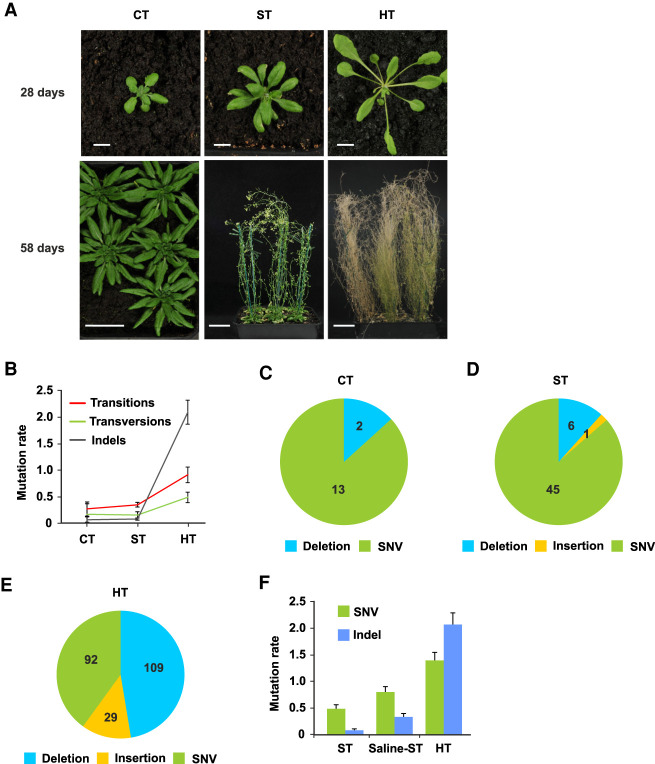
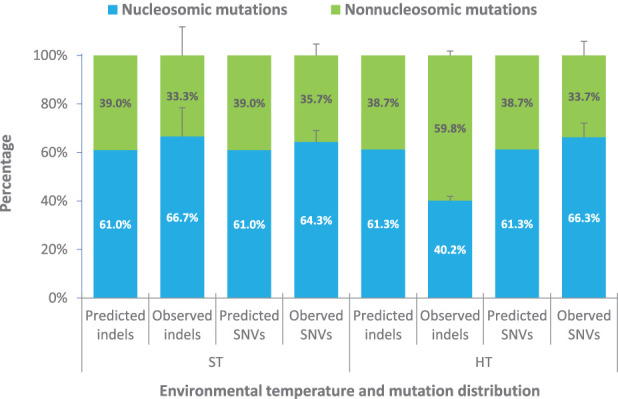
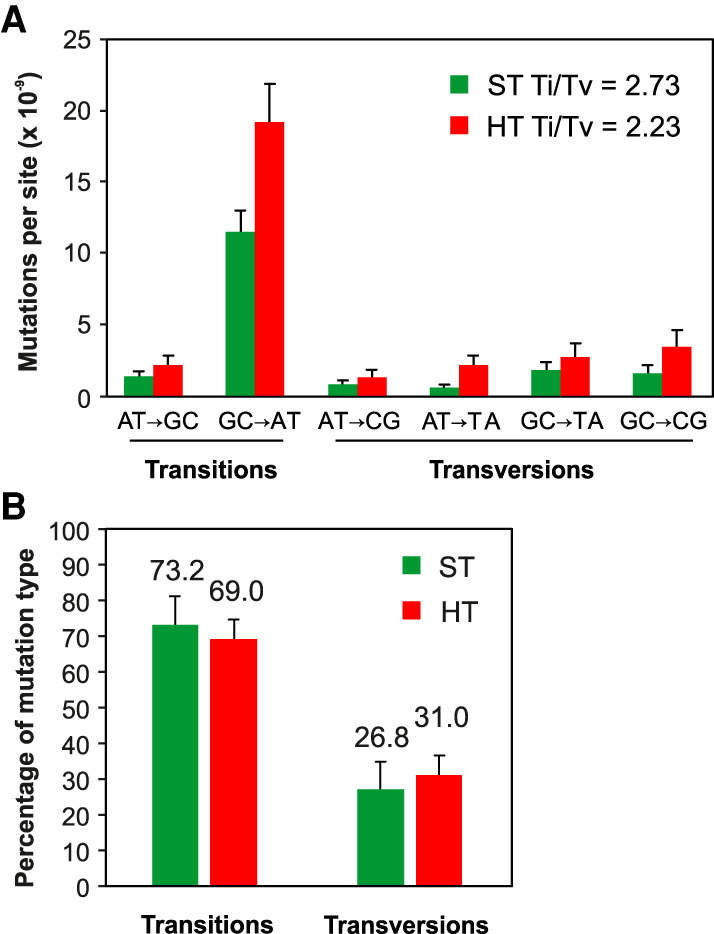
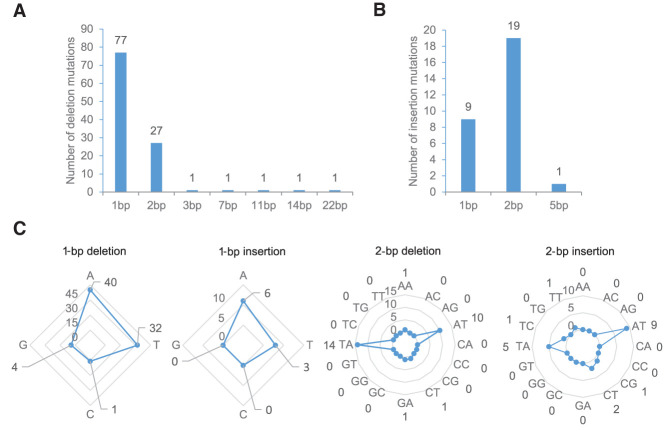
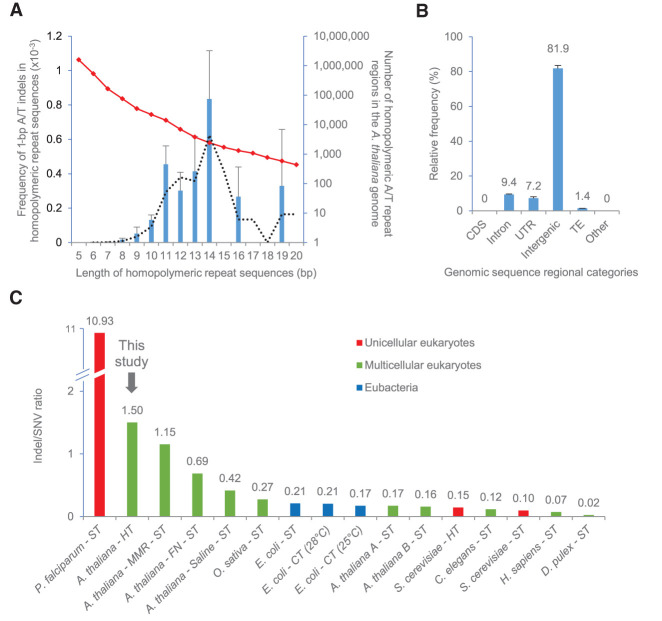
Mutations are the source of both genetic diversity and mutational load. However, the effects of increasing environmental temperature on plant mutation rates and relative impact on specific mutational classes (e.g., insertion/deletion [indel] vs. single nucleotide variant [SNV]) are unknown. This topic is important because of the poorly defined effects of anthropogenic global temperature rise on biological systems. Here, we show the impact of temperature increase on mutation, studying whole genome profiles of mutation accumulation (MA) lineages grown for 11 successive generations at 29°C. Whereas growth of at standard temperature (ST; 23°C) is associated with a mutation rate of 7 × 10 base substitutions per site per generation, growth at stressful high temperature (HT; 29°C) is highly mutagenic, increasing the mutation rate to 12 × 10 SNV frequency is approximately two- to threefold higher at HT than at ST, and HT-growth causes an ∼19- to 23-fold increase in indel frequency, resulting in a disproportionate increase in indels (vs. SNVs). Most HT-induced indels are 1-2 bp in size and particularly affect homopolymeric or dinucleotide A or T stretch regions of the genome. HT-induced indels occur disproportionately in nucleosome-free regions, suggesting that much HT-induced mutational damage occurs during cell-cycle phases when genomic DNA is packaged into nucleosomes. We conclude that stressful experimental temperature increases accelerate plant mutation rates and particularly accelerate the rate of indel mutation. Increasing environmental temperatures are thus likely to have significant mutagenic consequences for plants growing in the wild and may, in particular, add detrimentally to mutational load.
突变是遗传多样性和突变负荷的来源。然而,增加环境温度对植物突变率的影响,以及对特定突变类型(例如插入/缺失[indel]与单核苷酸变异[SNV])的相对影响尚不清楚。这个话题很重要,因为人为的全球气温上升对生物系统的影响还没有明确的定义。在这里,我们研究了温度升高对突变的影响,通过研究在 29°C 下连续 11 代生长的突变积累(MA)谱系的全基因组突变谱。在标准温度(ST;23°C)下生长时,的突变率与每代每位点 7×10 个碱基取代相关,而在高温胁迫(HT;29°C)下生长时则具有高度的突变性,将突变率提高到 12×10 SNV 频率在 HT 下比在 ST 下大约高出两到三倍,并且 HT 生长导致 indel 频率增加约 19-23 倍,导致 indel (与 SNV 相比)不成比例地增加。大多数 HT 诱导的 indel 大小为 1-2 bp,特别影响基因组中同源多聚体或二核苷酸 A 或 T 延伸区域。HT 诱导的 indel 不成比例地发生在无核小体区域,这表明在基因组 DNA包装到核小体的细胞周期阶段,发生了大量的 HT 诱导的突变损伤。我们得出结论,实验性的高温胁迫会加速植物的突变率,特别是加速 indel 突变的速率。因此,环境温度的升高很可能对野生环境中生长的植物产生重大的诱变后果,特别是可能会增加突变负荷的不利影响。