Prevention, Programme and Knowledge Management, Nigeria Centre for Disease Control, Abuja, Nigeria
Department of Microbiology, Faculty of Life Sciences, University of Benin, Benin City, Nigeria.
BMJ Open. 2020 Dec 17;10(12):e044079. doi: 10.1136/bmjopen-2020-044079.
Despite the increasing disease burden, there is a dearth of context-specific evidence on the risk factors for COVID-19 positivity and subsequent death in Nigeria. Thus, the study objective was to identify context-specific factors associated with testing positive for COVID-19 and fatality in Nigeria.
Retrospective cohort study.
COVID-19 surveillance and laboratory centres in 36 states and the Federal Capital Territory reporting data to the Nigeria Centre for Disease Control.
Individuals who were investigated for SARS-CoV-2 using real-time PCR testing during the study period 27 February-8 June 2020.
COVID-19 positivity and subsequent mortality. Multivariable logistic regression analyses were performed to identify factors independently associated with both outcome variables, and findings are presented as adjusted ORs (aORs) and 95% CIs.
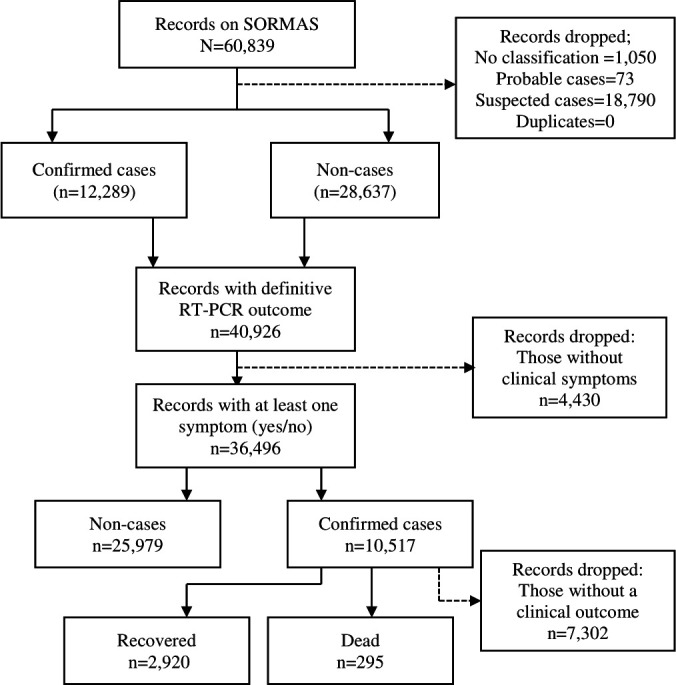
A total of 36 496 patients were tested for COVID-19, with 10 517 confirmed cases. Of 3215 confirmed cases with available clinical outcomes, 295 died. Factors independently associated with COVID-19 positivity were older age (p value for trend<0.0001), male sex (aOR 1.11, 95% CI 1.04 to 1.18) and the following presenting symptoms: cough (aOR 1.23, 95% CI 1.13 to 1.32), fever (aOR 1.45, 95% CI 1.45 to 1.71), loss of smell (aOR 7.78, 95% CI 5.19 to 11.66) and loss of taste (aOR 2.50, 95% CI 1.60 to 3.90). An increased risk of mortality following COVID-19 was observed in those aged ≥51 years, patients in farming occupation (aOR 7.56, 95% CI 1.70 to 33.53) and those presenting with cough (aOR 2.06, 95% CI 1.41 to 3.01), breathing difficulties (aOR 5.68, 95% CI 3.77 to 8.58) and vomiting (aOR 2.54, 95% CI 1.33 to 4.84).
The significant risk factors associated with COVID-19 positivity and subsequent mortality in the Nigerian population are similar to those reported in studies from other countries and should guide clinical decisions for COVID-19 testing and specialist care referrals.
尽管疾病负担不断增加,但在尼日利亚,针对 COVID-19 阳性和随后死亡的风险因素,仍缺乏特定于当地情况的证据。因此,本研究旨在确定与尼日利亚 COVID-19 检测阳性和死亡相关的特定于当地情况的因素。
回顾性队列研究。
36 个州和联邦首都地区的 COVID-19 监测和实验室中心向尼日利亚疾病控制中心报告数据。
在 2020 年 2 月 27 日至 6 月 8 日期间,使用实时 PCR 检测调查 SARS-CoV-2 的个体。
COVID-19 阳性和随后的死亡率。使用多变量逻辑回归分析确定与两个结局变量均相关的因素,并以调整后的比值比(aOR)和 95%置信区间(95%CI)表示结果。
共对 36496 例患者进行了 COVID-19 检测,其中 10517 例确诊。在 3215 例有可用临床结局的确诊病例中,有 295 例死亡。与 COVID-19 阳性独立相关的因素是年龄较大(趋势检验的 p 值<0.0001)、男性(aOR 1.11,95%CI 1.04 至 1.18)和以下症状:咳嗽(aOR 1.23,95%CI 1.13 至 1.32)、发热(aOR 1.45,95%CI 1.45 至 1.71)、嗅觉丧失(aOR 7.78,95%CI 5.19 至 11.66)和味觉丧失(aOR 2.50,95%CI 1.60 至 3.90)。与 COVID-19 相关的死亡率在≥51 岁、农业职业(aOR 7.56,95%CI 1.70 至 33.53)和咳嗽(aOR 2.06,95%CI 1.41 至 3.01)、呼吸困难(aOR 5.68,95%CI 3.77 至 8.58)和呕吐(aOR 2.54,95%CI 1.33 至 4.84)的患者中更高。
与尼日利亚人群 COVID-19 阳性和随后死亡相关的显著风险因素与其他国家的研究报告相似,应指导 COVID-19 检测和专科护理转诊的临床决策。