Institute of Psychology, University of Wroclaw, Dawida 1, 50-527 Wroclaw, Poland.
Faculty of Medicine and Medical Sciences, Holy Spirit University of Kaslik (USEK), Jounieh, Lebanon.
Nutrients. 2020 Dec 17;12(12):3865. doi: 10.3390/nu12123865.
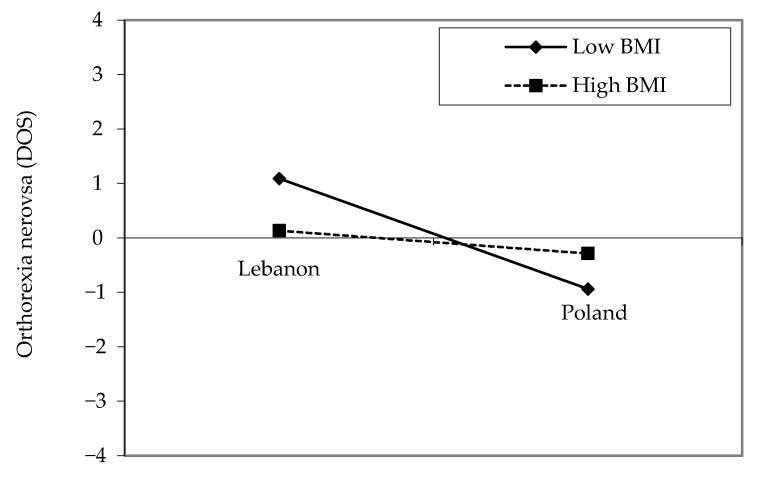
The prevalence of orthorexia nervosa (ON) appears to be increasing, and more research into its cross-cultural aspects is required to provide culturally appropriate psychological treatment. Until now, there has been relatively little research published about ON across cultures. Therefore, the objectives of the present study were to determine: (1) the prevalence of ON in Polish and Lebanese adults and (2) the association between ON and sociodemographic variables and Body Mass Index (BMI) in two culturally different samples. One thousand two hundred and sixty-two adults participated in the present study ( = 743 adults; = 519 adults). The Düsseldorf Orthorexia Scale and the Eating Habits Questionnaire were used in the present study. Information about age, sex, anthropometry, and marital status was obtained from all participants as well. The Polish sample had an ON prevalence rate of 2.6%, while the Lebanese sample had an ON prevalence rate of 8.4%. No significant correlation was found between ON and age in both samples. A statistically significant difference was found between marital status and country on ON, with the highest mean score seen among Lebanese singles. In Lebanon, having a low of BMI ≤ 25 kg/m compared to a high BMI was significantly associated with lower ON tendencies, while this association was not significant among Polish participants. This study was the second to focus on the prevalence of ON in Western and non-Western countries and its association with sociodemographic characteristics and BMI ranges. Knowledge about ON and its correlates in diverse populations may inform the design of culturally tailored behavior change interventions and the development of culturally appropriate tools in various groups to improve their dietary patterns.
神经强迫症(ON)的患病率似乎在上升,需要更多跨文化方面的研究,为提供文化上适当的心理治疗提供依据。到目前为止,跨文化的 ON 研究相对较少。因此,本研究的目的是确定:(1)波兰和黎巴嫩成年人中 ON 的患病率;(2)在两个文化不同的样本中,ON 与社会人口统计学变量和体重指数(BMI)之间的关联。本研究共有 1262 名成年人参与(=743 名成年人;=519 名成年人)。本研究使用了杜塞尔多夫神经强迫症量表和饮食习惯问卷。所有参与者还提供了年龄、性别、人体测量学和婚姻状况等信息。波兰样本的 ON 患病率为 2.6%,而黎巴嫩样本的 ON 患病率为 8.4%。在两个样本中,ON 与年龄之间均无显著相关性。ON 与婚姻状况和国家在统计学上存在显著差异,黎巴嫩单身者的平均得分最高。在黎巴嫩,与高 BMI 相比,BMI≤25kg/m2 的人 ON 倾向较低,而波兰参与者中这种关联不显著。本研究是第二次关注西方和非西方国家 ON 的患病率及其与社会人口统计学特征和 BMI 范围的关联。了解不同人群中的 ON 及其相关因素可能有助于为不同群体设计文化上适当的行为改变干预措施,并开发各种群体的文化上适当的工具,以改善他们的饮食模式。