Escuela Universitaria de Osuna (Centro Adscrito a la Universidad de Sevilla), 41640 Osuna, Spain.
Departamento de Educación Física y Deporte, Universidad de Sevilla, 41013 Sevilla, Spain.
Nutrients. 2020 Dec 18;12(12):3871. doi: 10.3390/nu12123871.
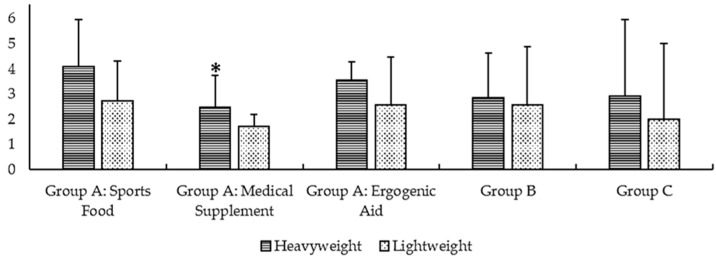
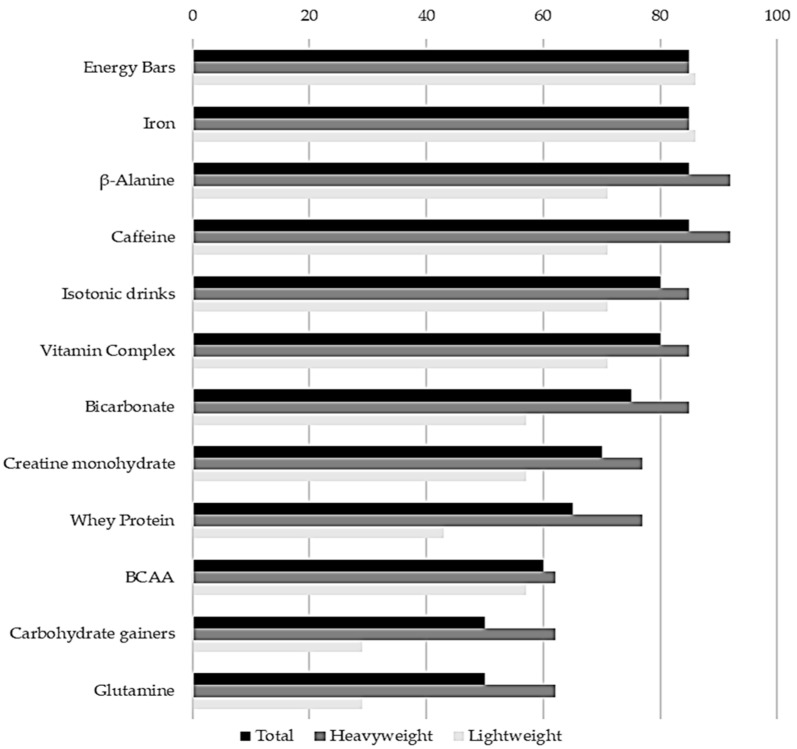
The aim of this study was to analyze the anthropometric characteristics and sport supplement (SS) consumption patterns of heavyweight and lightweight international rowers. Methods: The 13 heavyweights (11 males) and seven lightweights (five males) of the Spanish National Rowing Team were recruited for the study. Body composition was measured by bio-impedance analysis, and the questionnaire used in this investigation was previously validated to assess SS consumption. According to anthropometrics parameters, it was reported that male heavyweight rowers were heavier ( < 0.001) and taller ( < 0.001), but no statistical differences were reported for % body fat ( = 0.104) or % lean body mass ( = 0.161). All rowers reported consumption of at least one SS. Based on the Australian Institute of Sport's classification, higher medical supplement consumption was observed when comparing heavyweight rowers to lightweight rowers (2.5 ± 1.1 vs. 1.7 ± 0.5, = 0.040). There were no differences in the totals of group A (strong scientific evidence for sports scenarios, = 0.069), group B (emerging scientific support, deserving of further research, = 0.776), or group C (scientific evidence not supportive of benefit and/or security amongst athletes, = 0.484). The six most consumed SSs were iron (85%), caffeine (85%), β-alanine (85%), energy bars (85%), vitamin supplements (80%), and isotonic drinks (80%), with no statistical differences between heavyweight and lightweight rowers ( > 0.05). These results suggest that the absence of differences in body composition (expressed as a percentage) do not represent anthropometric disadvantages for heavyweight rowers. In addition, SS consumption was similar between rowers, reporting only higher medical supplement consumption in heavyweight rowers.
本研究旨在分析重量级和轻量级国际赛艇运动员的人体测量特征和运动补剂(SS)消费模式。方法:本研究招募了西班牙国家赛艇队的 13 名重量级(11 名男性)和 7 名轻量级(5 名男性)运动员。采用生物阻抗分析法测量身体成分,本研究使用的问卷先前已通过验证,用于评估 SS 的消费情况。根据人体测量参数,报告称男性重量级赛艇运动员更重(<0.001)和更高(<0.001),但体脂肪百分比(=0.104)或瘦体重百分比(=0.161)无统计学差异。所有赛艇运动员均报告至少消费了一种 SS。根据澳大利亚体育学院的分类,与轻量级赛艇运动员相比,重量级赛艇运动员的医疗补剂消费更高(2.5±1.1 对 1.7±0.5,=0.040)。在 A 组(有强烈科学证据支持运动场景,=0.069)、B 组(新兴科学支持,值得进一步研究,=0.776)或 C 组(没有支持运动员受益和/或安全性的科学证据,=0.484)的总摄入量方面,两组之间没有差异。最常消费的六种 SS 是铁(85%)、咖啡因(85%)、β-丙氨酸(85%)、能量棒(85%)、维生素补充剂(80%)和等渗饮料(80%),重量级和轻量级赛艇运动员之间没有统计学差异(>0.05)。这些结果表明,身体成分(以百分比表示)的差异并不代表重量级赛艇运动员的人体测量学劣势。此外,赛艇运动员的 SS 消费相似,仅报告重量级赛艇运动员的医疗补剂消费更高。