Department of Public and Occupational Health, Amsterdam Public Health Research Institute, Amsterdam UMC, University of Amsterdam, Amsterdam, The Netherlands.
Department of Public and Occupational Health, Amsterdam Public Health Research Institute, Amsterdam UMC, Vrije Universiteit Amsterdam, Amsterdam, The Netherlands.
Obes Rev. 2021 Jul;22(7):e13185. doi: 10.1111/obr.13185. Epub 2020 Dec 27.
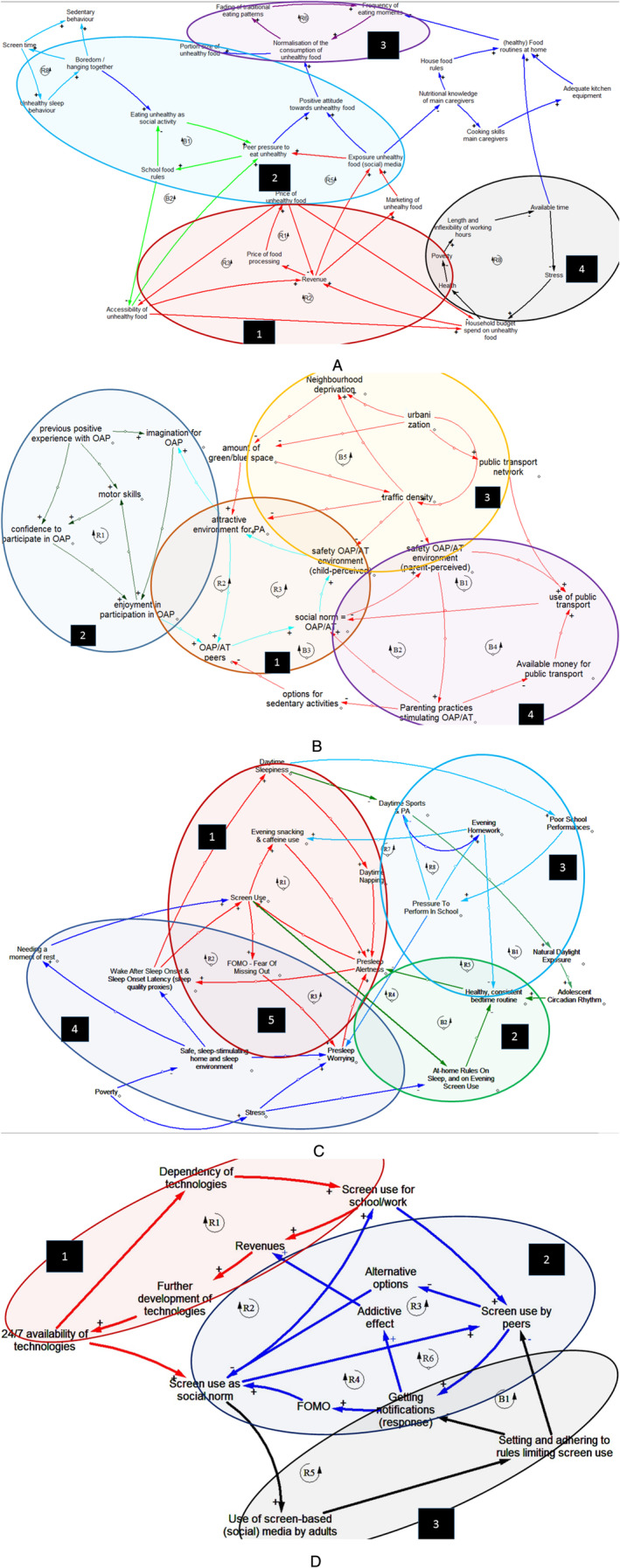
This paper reports how we applied systems dynamics methods to gain insight into the complexity of obesity-related behaviors in youth, including diet, physical activity, sedentary behavior, and sleep, by integrating a literature review into causal loop diagrams (CLDs). Results showed that the CLDs consisted of multiple subsystems and three types of dynamics appeared, including (1) feedback loops, (2) connections between feedback loops and subsystems, and (3) mechanisms. We observed clear similarities in the dynamics for the four behaviors in that they relate to "traditional" subsystems, such as home and school environments, as well as to newly added subsystems, including macroeconomics, social welfare, and urban systems. The CLDs provided insights that can support the development of intervention strategies, including (1) the confirmation that a range of mechanisms cover and connect multiple levels and settings, meaning that there is no silver bullet to address obesity; (2) understanding of how interventions in one particular setting, such as school, might be influenced by the interactions with other settings, such as urban systems; and (3) a comprehensive view of (un)intended consequences. This way of framing the problem will assist moving towards public health interventions that respond to and operate in the complexity of the real world.
本文报告了我们如何应用系统动力学方法,通过将文献综述纳入因果关系图(CLD),深入了解与青少年肥胖相关的行为(包括饮食、身体活动、 sedentary 行为和睡眠)的复杂性。结果表明,CLD 由多个子系统组成,出现了三种类型的动态,包括(1)反馈循环,(2)反馈循环与子系统之间的连接,以及(3)机制。我们观察到四个行为的动态非常相似,它们与“传统”子系统(如家庭和学校环境)以及新添加的子系统(包括宏观经济、社会福利和城市系统)有关。CLD 提供了可以支持干预策略发展的见解,包括(1)确认一系列机制涵盖并连接多个层次和环境,这意味着没有解决肥胖问题的灵丹妙药;(2)了解学校等特定环境中的干预措施如何受到城市系统等其他环境相互作用的影响;以及(3)对(非)预期后果的全面了解。这种问题框架将有助于采取应对现实世界复杂性的公共卫生干预措施。