Ayine Priscilla, Selvaraju Vaithinathan, Venkatapoorna Chandra M K, Bao Yida, Gaillard Philippe, Geetha Thangiah
Department of Nutrition, Dietetics, and Hospitality Management, Auburn University, Auburn, AL 36849, USA.
Department of Mathematics and Statistics, Auburn University, Auburn, AL 36849, USA.
Children (Basel). 2021 Jan 7;8(1):32. doi: 10.3390/children8010032.
The eating behavior of children is important to maintain a healthy weight. This current study explored the differences in children's eating behaviors and their relation to weight status and maternal education level, using the child eating behavior questionnaire (CEBQ).
The study recruited 169 participants aged between six and ten years. Multinomial logistic regression was conducted to examine the association between the CEBQ factors and children's body weight status. The association between the CEBQ scores and maternal educational levels was examined using a one-way analysis of variance (ANOVA).
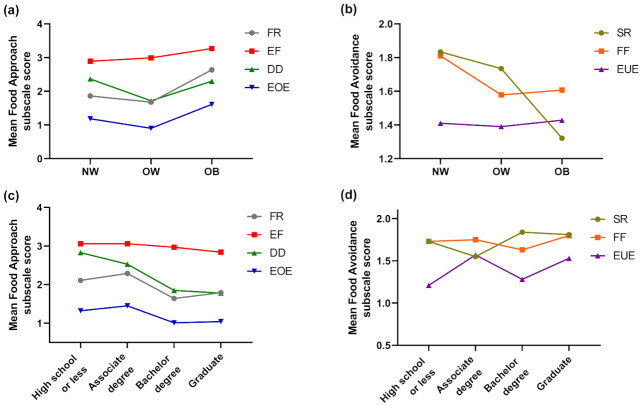
The multinomial logistic regression findings indicate that children in the obese group exhibited a significant increase in food responsiveness, enjoyment of food, emotional overeating, and a decrease in satiety responsiveness compared to normal weight children. The one-way ANOVA showed a significant difference in subscales under the food approach (food responsiveness, desire to drink, emotional overeating) and food avoidance (satiety responsiveness) based upon the child's weight status. The three subscales under the food approach category were significantly dependent upon the maternal education but did not have a significant association with food avoidance.
The results suggest that the increase in food responsiveness and emotional overeating in obese children is influenced by maternal education.
儿童的饮食行为对于维持健康体重至关重要。本研究使用儿童饮食行为问卷(CEBQ)探讨了儿童饮食行为的差异及其与体重状况和母亲教育水平的关系。
该研究招募了169名年龄在6至10岁之间的参与者。进行多项逻辑回归以检验CEBQ因素与儿童体重状况之间的关联。使用单因素方差分析(ANOVA)检验CEBQ分数与母亲教育水平之间的关联。
多项逻辑回归结果表明,与正常体重儿童相比,肥胖组儿童在食物反应性、对食物的喜爱、情绪性暴饮暴食方面显著增加,而饱腹感反应性降低。单因素方差分析显示,根据儿童的体重状况,在食物趋近(食物反应性、饮水欲望、情绪性暴饮暴食)和食物回避(饱腹感反应性)量表下存在显著差异。食物趋近类别下的三个子量表显著依赖于母亲的教育程度,但与食物回避没有显著关联。
结果表明,肥胖儿童食物反应性和情绪性暴饮暴食的增加受母亲教育程度的影响。