• 文献检索
  • 文档翻译
  • 深度研究
  • 学术资讯
  • Suppr Zotero 插件Zotero 插件
  • 邀请有礼
  • 套餐&价格
  • 历史记录
应用&插件
Suppr Zotero 插件Zotero 插件浏览器插件Mac 客户端Windows 客户端微信小程序
定价
高级版会员购买积分包购买API积分包
服务
文献检索文档翻译深度研究API 文档MCP 服务
关于我们
关于 Suppr公司介绍联系我们用户协议隐私条款
关注我们

Suppr 超能文献

核心技术专利:CN118964589B侵权必究
粤ICP备2023148730 号-1Suppr @ 2026

文献检索

告别复杂PubMed语法,用中文像聊天一样搜索,搜遍4000万医学文献。AI智能推荐,让科研检索更轻松。

立即免费搜索

文件翻译

保留排版,准确专业,支持PDF/Word/PPT等文件格式,支持 12+语言互译。

免费翻译文档

深度研究

AI帮你快速写综述,25分钟生成高质量综述,智能提取关键信息,辅助科研写作。

立即免费体验

预测 2019 年冠状病毒病的院内死亡率:一个简单的经验证的临床应用应用程序。

Predicting in-hospital mortality from Coronavirus Disease 2019: A simple validated app for clinical use.

机构信息

Gastroenterology Hepatology and Transplantation, ASST Papa Giovanni XXIII-Bergamo, Bergamo, Italy.

Department of Infectious Diseases, IRCCS Fondazione Policlinico San Matteo, Pavia, Italy.

出版信息

PLoS One. 2021 Jan 14;16(1):e0245281. doi: 10.1371/journal.pone.0245281. eCollection 2021.

DOI:10.1371/journal.pone.0245281
PMID:33444411
原文链接:https://pmc.ncbi.nlm.nih.gov/articles/PMC7808616/
Abstract

BACKGROUNDS

Validated tools for predicting individual in-hospital mortality of COVID-19 are lacking. We aimed to develop and to validate a simple clinical prediction rule for early identification of in-hospital mortality of patients with COVID-19.

METHODS AND FINDINGS

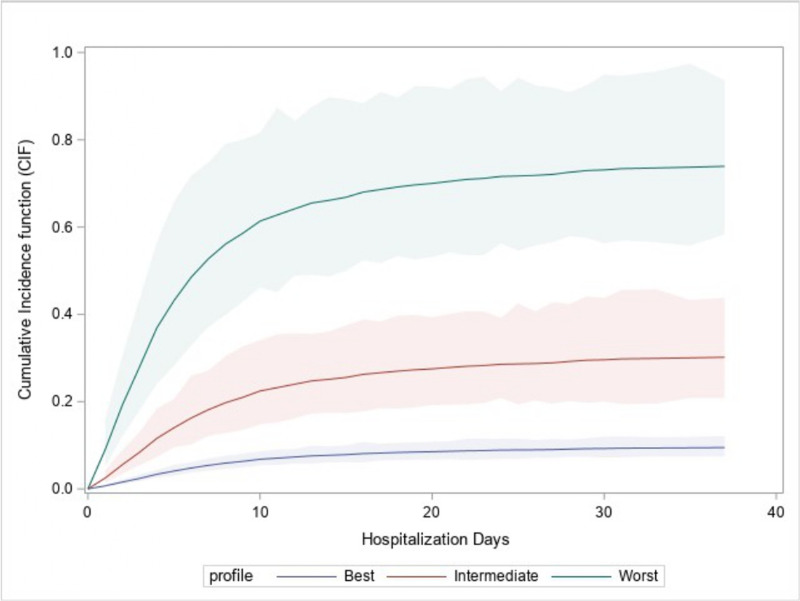
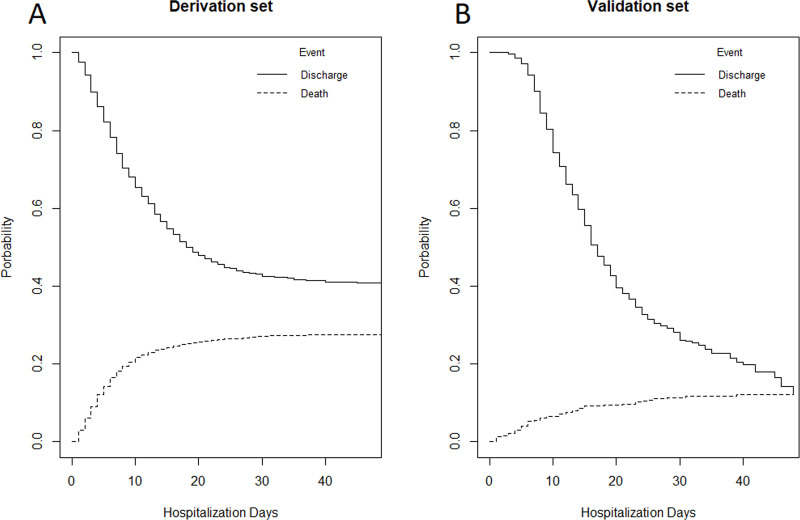
We enrolled 2191 consecutive hospitalized patients with COVID-19 from three Italian dedicated units (derivation cohort: 1810 consecutive patients from Bergamo and Pavia units; validation cohort: 381 consecutive patients from Rome unit). The outcome was in-hospital mortality. Fine and Gray competing risks multivariate model (with discharge as a competing event) was used to develop a prediction rule for in-hospital mortality. Discrimination and calibration were assessed by the area under the receiver operating characteristic curve (AUC) and by Brier score in both the derivation and validation cohorts. Seven variables were independent risk factors for in-hospital mortality: age (Hazard Ratio [HR] 1.08, 95% Confidence Interval [CI] 1.07-1.09), male sex (HR 1.62, 95%CI 1.30-2.00), duration of symptoms before hospital admission <10 days (HR 1.72, 95%CI 1.39-2.12), diabetes (HR 1.21, 95%CI 1.02-1.45), coronary heart disease (HR 1.40 95% CI 1.09-1.80), chronic liver disease (HR 1.78, 95%CI 1.16-2.72), and lactate dehydrogenase levels at admission (HR 1.0003, 95%CI 1.0002-1.0005). The AUC was 0.822 (95%CI 0.722-0.922) in the derivation cohort and 0.820 (95%CI 0.724-0.920) in the validation cohort with good calibration. The prediction rule is freely available as a web-app (COVID-CALC: https://sites.google.com/community.unipa.it/covid-19riskpredictions/c19-rp).

CONCLUSIONS

A validated simple clinical prediction rule can promptly and accurately assess the risk for in-hospital mortality, improving triage and the management of patients with COVID-19.

摘要

背景

目前缺乏用于预测 COVID-19 患者院内死亡率的有效工具。本研究旨在开发并验证一种简单的临床预测规则,以早期识别 COVID-19 患者的院内死亡风险。

方法和发现

我们纳入了来自意大利三个专门病房的 2191 例连续住院的 COVID-19 患者(推导队列:来自贝加莫和帕维亚病房的 1810 例连续患者;验证队列:来自罗马病房的 381 例连续患者)。主要结局为院内死亡率。采用 Fine-Gray 竞争风险多变量模型(以出院为竞争事件),建立预测院内死亡率的规则。在推导队列和验证队列中,通过接受者操作特征曲线下面积(AUC)和 Brier 评分评估预测模型的区分度和校准度。7 个变量是院内死亡的独立危险因素:年龄(HR 1.08,95%CI 1.07-1.09)、男性(HR 1.62,95%CI 1.30-2.00)、入院前症状持续时间<10 天(HR 1.72,95%CI 1.39-2.12)、糖尿病(HR 1.21,95%CI 1.02-1.45)、冠心病(HR 1.40,95%CI 1.09-1.80)、慢性肝脏疾病(HR 1.78,95%CI 1.16-2.72)和入院时乳酸脱氢酶水平(HR 1.0003,95%CI 1.0002-1.0005)。推导队列的 AUC 为 0.822(95%CI 0.722-0.922),验证队列为 0.820(95%CI 0.724-0.920),校准度良好。该预测规则可作为一个免费的网络应用程序(COVID-CALC:https://sites.google.com/community.unipa.it/covid-19riskpredictions/c19-rp)使用。

结论

验证后的简单临床预测规则可迅速、准确地评估院内死亡风险,改善 COVID-19 患者的分诊和管理。
https://cdn.ncbi.nlm.nih.gov/pmc/blobs/d763/7808616/fea8e4712640/pone.0245281.g002.jpg
https://cdn.ncbi.nlm.nih.gov/pmc/blobs/d763/7808616/cec0e7e67e4f/pone.0245281.g001.jpg
https://cdn.ncbi.nlm.nih.gov/pmc/blobs/d763/7808616/fea8e4712640/pone.0245281.g002.jpg
https://cdn.ncbi.nlm.nih.gov/pmc/blobs/d763/7808616/cec0e7e67e4f/pone.0245281.g001.jpg
https://cdn.ncbi.nlm.nih.gov/pmc/blobs/d763/7808616/fea8e4712640/pone.0245281.g002.jpg

相似文献

1
Predicting in-hospital mortality from Coronavirus Disease 2019: A simple validated app for clinical use.预测 2019 年冠状病毒病的院内死亡率:一个简单的经验证的临床应用应用程序。
PLoS One. 2021 Jan 14;16(1):e0245281. doi: 10.1371/journal.pone.0245281. eCollection 2021.
2
Development and external validation of a COVID-19 mortality risk prediction algorithm: a multicentre retrospective cohort study.开发和验证 COVID-19 死亡率预测算法的多中心回顾性队列研究。
BMJ Open. 2020 Dec 24;10(12):e044028. doi: 10.1136/bmjopen-2020-044028.
3
Development and validation of a prognostic nomogram for predicting in-hospital mortality of COVID-19: a multicenter retrospective cohort study of 4086 cases in China.开发和验证一种预测 COVID-19 住院患者死亡率的预后列线图:一项中国多中心回顾性队列研究 4086 例。
Aging (Albany NY). 2021 Feb 9;13(3):3176-3189. doi: 10.18632/aging.202605.
4
Development and external validation of a prediction risk model for short-term mortality among hospitalized U.S. COVID-19 patients: A proposal for the COVID-AID risk tool.美国住院 COVID-19 患者短期死亡率预测风险模型的开发和外部验证:COVID-AID 风险工具的建议。
PLoS One. 2020 Sep 30;15(9):e0239536. doi: 10.1371/journal.pone.0239536. eCollection 2020.
5
A Clinical Risk Score to Predict In-hospital Mortality from COVID-19 in South Korea.韩国用于预测 COVID-19 住院患者死亡率的临床风险评分
J Korean Med Sci. 2021 Apr 19;36(15):e108. doi: 10.3346/jkms.2021.36.e108.
6
Development and validation of a nomogram using on admission routine laboratory parameters to predict in-hospital survival of patients with COVID-19.利用入院时常规实验室参数开发和验证列线图,以预测 COVID-19 患者的住院期间生存率。
J Med Virol. 2021 Apr;93(4):2332-2339. doi: 10.1002/jmv.26713. Epub 2020 Dec 23.
7
IL-6-based mortality prediction model for COVID-19: Validation and update in multicenter and second wave cohorts.基于 IL-6 的 COVID-19 死亡率预测模型:多中心和第二波队列的验证和更新。
J Allergy Clin Immunol. 2021 May;147(5):1652-1661.e1. doi: 10.1016/j.jaci.2021.02.021. Epub 2021 Mar 1.
8
Generation and validation of in-hospital mortality prediction score in COVID-19 patients: Alba-score.新冠肺炎患者院内死亡率预测评分 Alba-score 的生成与验证。
Curr Med Res Opin. 2021 May;37(5):719-726. doi: 10.1080/03007995.2021.1891036. Epub 2021 Mar 12.
9
Multivariable mortality risk prediction using machine learning for COVID-19 patients at admission (AICOVID).使用机器学习对入院的 COVID-19 患者进行多变量死亡率风险预测(AICOVID)。
Sci Rep. 2021 Jun 17;11(1):12801. doi: 10.1038/s41598-021-92146-7.
10
A nomogram for predicting mortality in patients with COVID-19 and solid tumors: a multicenter retrospective cohort study.用于预测 COVID-19 合并实体瘤患者死亡率的列线图:一项多中心回顾性队列研究。
J Immunother Cancer. 2020 Sep;8(2). doi: 10.1136/jitc-2020-001314.

引用本文的文献

1
Application of machine learning approach in emergency department to support clinical decision making for SARS-CoV-2 infected patients.机器学习方法在急诊科中的应用,以支持 SARS-CoV-2 感染患者的临床决策。
J Integr Bioinform. 2023 Mar 7;20(2). doi: 10.1515/jib-2022-0047. eCollection 2023 Jun 1.
2
Prognostic models in COVID-19 infection that predict severity: a systematic review.COVID-19 感染中预测严重程度的预后模型:系统评价。
Eur J Epidemiol. 2023 Apr;38(4):355-372. doi: 10.1007/s10654-023-00973-x. Epub 2023 Feb 25.
3
A robust COVID-19 mortality prediction calculator based on Lymphocyte count, Urea, C-Reactive Protein, Age and Sex (LUCAS) with chest X-rays.

本文引用的文献

1
Predictors of in-hospital COVID-19 mortality: A comprehensive systematic review and meta-analysis exploring differences by age, sex and health conditions.预测 COVID-19 院内死亡率的因素:一项全面的系统综述和荟萃分析,探讨了年龄、性别和健康状况的差异。
PLoS One. 2020 Nov 3;15(11):e0241742. doi: 10.1371/journal.pone.0241742. eCollection 2020.
2
Clinical features of COVID-19 mortality: development and validation of a clinical prediction model.COVID-19 死亡率的临床特征:临床预测模型的建立与验证。
Lancet Digit Health. 2020 Oct;2(10):e516-e525. doi: 10.1016/S2589-7500(20)30217-X. Epub 2020 Sep 22.
3
Clinical risk score to predict in-hospital mortality in COVID-19 patients: a retrospective cohort study.
基于淋巴细胞计数、尿素、C 反应蛋白、年龄和性别(LUCAS)与胸部 X 射线的稳健 COVID-19 死亡率预测计算器。
Sci Rep. 2022 Oct 29;12(1):18220. doi: 10.1038/s41598-022-21803-2.
4
Predicting In-Hospital Mortality in Severe COVID-19: A Systematic Review and External Validation of Clinical Prediction Rules.预测重症 COVID-19 的院内死亡率:临床预测规则的系统评价与外部验证
Biomedicines. 2022 Sep 27;10(10):2414. doi: 10.3390/biomedicines10102414.
5
Reliability of predictive models to support early decision making in the emergency department for patients with confirmed diagnosis of COVID-19: the Pescara Covid Hospital score.用于支持确诊 COVID-19 患者在急诊科早期决策的预测模型的可靠性:佩斯卡拉 COVID 医院评分。
BMC Health Serv Res. 2022 Aug 19;22(1):1062. doi: 10.1186/s12913-022-08421-4.
6
External validation of the 4C Mortality Score for hospitalised patients with COVID-19 in the RECOVER network.RECOVER 网络中 COVID-19 住院患者 4C 死亡率评分的外部验证。
BMJ Open. 2022 Apr 21;12(4):e054700. doi: 10.1136/bmjopen-2021-054700.
7
Gut Microbiota Disruption in COVID-19 or Post-COVID Illness Association with severity biomarkers: A Possible Role of Pre / Pro-biotics in manipulating microflora.肠道微生物组在 COVID-19 或新冠后疾病中与严重程度生物标志物的关联:益生菌/益生元在操纵微生物群中的可能作用。
Chem Biol Interact. 2022 May 1;358:109898. doi: 10.1016/j.cbi.2022.109898. Epub 2022 Mar 21.
8
The CCEDRRN COVID-19 Mortality Score to predict death among nonpalliative patients with COVID-19 presenting to emergency departments: a derivation and validation study.CCEDRRN COVID-19 病死率评分模型预测急诊非姑息治疗 COVID-19 患者的死亡风险:一项推导验证研究。
CMAJ Open. 2022 Feb 8;10(1):E90-E99. doi: 10.9778/cmajo.20210243. Print 2022 Jan-Mar.
9
Assessment of Risk Factors for Mortality in Patients in Medical Intensive Care Unit of a Tertiary Hospital.三级医院内科重症监护病房患者死亡危险因素评估
Indian J Crit Care Med. 2022 Jan;26(1):49-52. doi: 10.5005/jp-journals-10071-24092.
10
Development of a prediction score for in-hospital mortality in COVID-19 patients with acute kidney injury: a machine learning approach.基于机器学习的 COVID-19 合并急性肾损伤患者院内死亡预测评分的构建。
Sci Rep. 2021 Dec 24;11(1):24439. doi: 10.1038/s41598-021-03894-5.
临床风险评分预测 COVID-19 患者院内死亡率:一项回顾性队列研究。
BMJ Open. 2020 Sep 25;10(9):e040729. doi: 10.1136/bmjopen-2020-040729.
4
Risk stratification of patients admitted to hospital with covid-19 using the ISARIC WHO Clinical Characterisation Protocol: development and validation of the 4C Mortality Score.利用 ISARIC WHO 临床特征协议对因 COVID-19 住院的患者进行风险分层:4C 死亡率评分的制定和验证。
BMJ. 2020 Sep 9;370:m3339. doi: 10.1136/bmj.m3339.
5
Drug treatments for covid-19: living systematic review and network meta-analysis.Covid-19 的药物治疗:系统评价和网络荟萃分析。
BMJ. 2020 Jul 30;370:m2980. doi: 10.1136/bmj.m2980.
6
High mortality rates for SARS-CoV-2 infection in patients with pre-existing chronic liver disease and cirrhosis: Preliminary results from an international registry.患有慢性肝病和肝硬化的患者感染新型冠状病毒的死亡率很高:一项国际登记处的初步结果
J Hepatol. 2020 Sep;73(3):705-708. doi: 10.1016/j.jhep.2020.05.013. Epub 2020 May 21.
7
Development and Validation of a Clinical Risk Score to Predict the Occurrence of Critical Illness in Hospitalized Patients With COVID-19.开发和验证一种临床风险评分,以预测 COVID-19 住院患者发生危重症的情况。
JAMA Intern Med. 2020 Aug 1;180(8):1081-1089. doi: 10.1001/jamainternmed.2020.2033.
8
Presenting Characteristics, Comorbidities, and Outcomes Among 5700 Patients Hospitalized With COVID-19 in the New York City Area.在纽约市地区,5700 名因 COVID-19 住院的患者的特征、合并症和结局。
JAMA. 2020 May 26;323(20):2052-2059. doi: 10.1001/jama.2020.6775.
9
Prediction models for diagnosis and prognosis of covid-19: systematic review and critical appraisal.COVID-19 诊断和预后预测模型:系统评价和批判性评估。
BMJ. 2020 Apr 7;369:m1328. doi: 10.1136/bmj.m1328.
10
COVID-19 and Italy: what next?COVID-19 和意大利:下一步如何?
Lancet. 2020 Apr 11;395(10231):1225-1228. doi: 10.1016/S0140-6736(20)30627-9. Epub 2020 Mar 13.