Moghaddam Nima, van Diepen Sean, So Derek, Lawler Patrick R, Fordyce Christopher B
Division of Cardiology, Department of Medicine, University of British Columbia, Vancouver, British Columbia, Canada.
Division of Cardiology, University of Alberta, Edmonton, Alberta, Canada.
ESC Heart Fail. 2021 Apr;8(2):988-998. doi: 10.1002/ehf2.13180. Epub 2021 Jan 16.
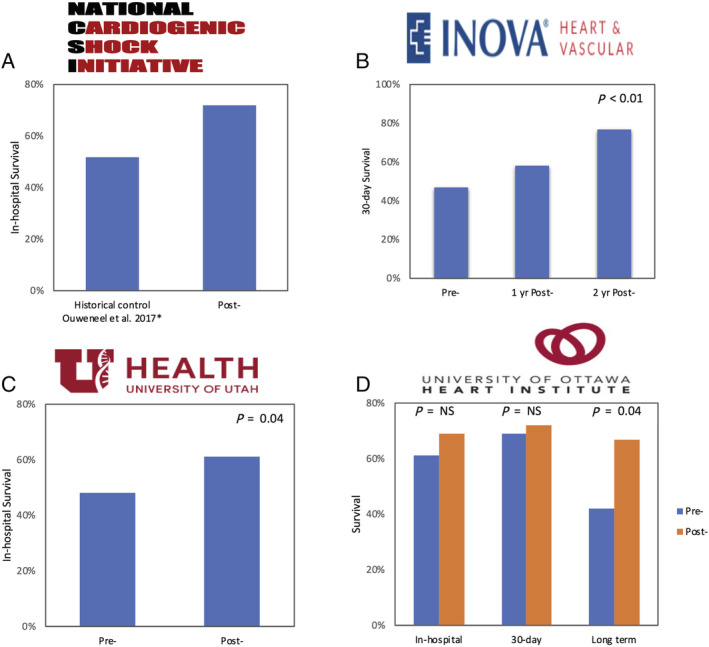
Cardiogenic shock (CS) portends high morbidity and mortality in the contemporary era. Despite advances in temporary mechanical circulatory supports (MCS), their routine use in CS to improve outcomes has not been established. Delays in diagnosis and timely delivery of care, disparities in accessing adjunct therapies such revascularization or MCS, and lack of a systematic approach to care of CS contribute to the poor outcomes observed in CS patients. There is growing interest for developing a standardized multidisciplinary team-based approach in the management of CS. Recent prospective studies have shown feasibility of CS teams in improving survival across a spectrum of CS presentations. Herein, we will review the rationale for CS teams focusing on evidence supporting its use in streamlining care, optimizing revascularization strategies, and patient identification and MCS selection. The proposed structure and flow of CS teams will be outlined. An in-depth analysis of four recent studies demonstrating improved outcomes with CS teams is presented. Finally, we will explore potential implementation hurdles and future directions in refining and widespread implementation of dedicated cross-specialty CS teams.
心源性休克(CS)在当代预示着高发病率和死亡率。尽管临时机械循环支持(MCS)取得了进展,但尚未确定其在CS中常规使用以改善预后的情况。诊断和及时提供治疗的延迟、获得血管重建或MCS等辅助治疗的差异以及缺乏系统性的CS护理方法,导致CS患者的预后较差。人们越来越关注在CS管理中开发标准化的多学科团队方法。最近的前瞻性研究表明,CS团队在改善各种CS表现患者的生存率方面具有可行性。在此,我们将回顾CS团队的基本原理,重点关注支持其在简化护理、优化血管重建策略以及患者识别和MCS选择方面应用的证据。将概述CS团队的提议结构和流程。对四项近期研究进行深入分析,这些研究表明CS团队可改善预后。最后,我们将探讨在完善和广泛实施专门的跨专业CS团队方面潜在的实施障碍和未来方向。