Anderson Brian M, Lin Ethan Y, Cardenas Carlos E, Gress Dustin A, Erwin William D, Odisio Bruno C, Koay Eugene J, Brock Kristy K
Department of Imaging Physics, The University of Texas MD Anderson Cancer Center, Houston, Texas.
Department of Radiation Physics, The University of Texas MD Anderson Cancer Center, Houston, Texas.
Adv Radiat Oncol. 2020 May 16;6(1):100464. doi: 10.1016/j.adro.2020.04.023. eCollection 2021 Jan-Feb.
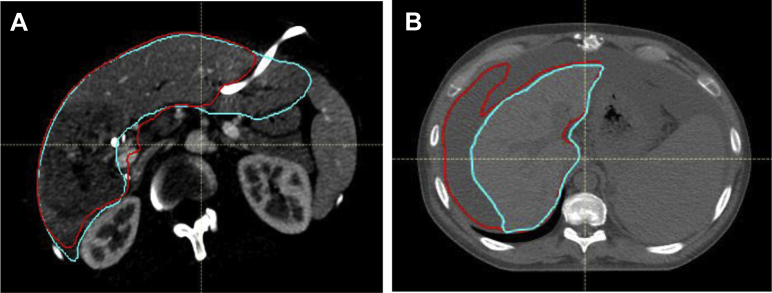
The deformable nature of the liver can make focal treatment challenging and is not adequately addressed with simple rigid registration techniques. More advanced registration techniques can take deformations into account (eg, biomechanical modeling) but require segmentations of the whole liver for each scan, which is a time-intensive process. We hypothesize that fully convolutional networks can be used to rapidly and accurately autosegment the liver, removing the temporal bottleneck for biomechanical modeling.
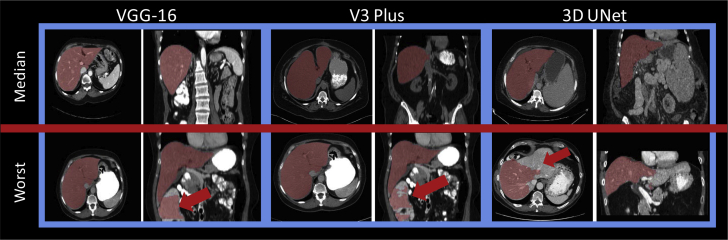
Manual liver segmentations on computed tomography scans from 183 patients treated at our institution and 30 scans from the Medical Image Computing & Computer Assisted Intervention challenges were collected for this study. Three architectures were investigated for rapid automated segmentation of the liver (VGG-16, DeepLabv3 +, and a 3-dimensional UNet). Fifty-six cases were set aside as a final test set for quantitative model evaluation. Accuracy of the autosegmentations was assessed using Dice similarity coefficient and mean surface distance. Qualitative evaluation was also performed by 3 radiation oncologists on 50 independent cases with previously clinically treated liver contours.
The mean (minimum-maximum) mean surface distance for the test groups with the final model, DeepLabv3 +, were as follows: μ: 0.99 mm (0.47-2.2), μ: 1.12 mm (0.41-2.87), and μ: 1.48 mm (0.82-3.96). The qualitative evaluation showed that 30 of 50 autosegmentations (60%) were preferred to manual contours (majority voting) in a blinded comparison, and 48 of 50 autosegmentations (96%) were deemed clinically acceptable by at least 1 reviewing physician.
The autosegmentations were preferred compared with manually defined contours in the majority of cases. The ability to rapidly segment the liver with high accuracy achieved in this investigation has the potential to enable the efficient integration of biomechanical model-based registration into a clinical workflow.
肝脏的可变形特性会使局部治疗具有挑战性,而简单的刚性配准技术无法充分解决这一问题。更先进的配准技术可以考虑变形(例如生物力学建模),但每次扫描都需要对整个肝脏进行分割,这是一个耗时的过程。我们假设全卷积网络可用于快速、准确地自动分割肝脏,消除生物力学建模的时间瓶颈。
本研究收集了在我们机构接受治疗的183例患者的计算机断层扫描的手动肝脏分割数据,以及来自医学图像计算与计算机辅助干预挑战的30次扫描数据。研究了三种用于肝脏快速自动分割的架构(VGG-16、DeepLabv3 +和三维U-Net)。56例被留作最终测试集用于定量模型评估。使用骰子相似系数和平均表面距离评估自动分割的准确性。3名放射肿瘤学家还对50例具有先前临床治疗肝脏轮廓的独立病例进行了定性评估。
最终模型DeepLabv3 +的测试组平均(最小-最大)平均表面距离如下:μ:0.99毫米(0.47-2.2),μ:1.12毫米(0.41-2.87),μ:1.48毫米(0.82-3.96)。定性评估显示,在盲法比较中,50例自动分割中有30例(60%)比手动轮廓更受青睐(多数投票),50例自动分割中有48例(96%)被至少1名审阅医生认为在临床上是可接受的。
在大多数情况下,自动分割比手动定义的轮廓更受青睐。本研究中实现的快速、高精度分割肝脏的能力有可能使基于生物力学模型的配准有效地整合到临床工作流程中。