Welkers Matthijs R A, Han Alvin X, Reusken Chantal B E M, Eggink Dirk
Department of Medical Microbiology & Infection Prevention, Amsterdam University Medical Centers, location AMC, Meibergdreef 9, 1105AZ, Amsterdam, The Netherlands.
Centre for Infectious Disease Control, National Institute for Public Health and the Environment, Antonie van Leeuwenhoeklaan 9, 3721 MA Bilthoven, The Netherlands.
Virus Evol. 2021 Jan 4;7(1):veaa094. doi: 10.1093/ve/veaa094. eCollection 2021 Jan.
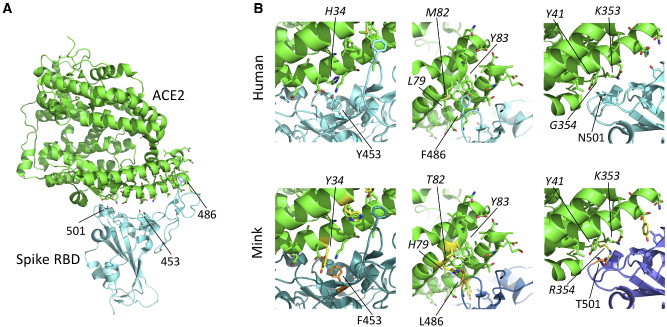
Severe acute respiratory syndrome coronavirus 2 (SARS-CoV-2) infections on mink farms are increasingly observed in several countries, leading to the massive culling of animals on affected farms. Recent studies showed multiple (anthropo)zoonotic transmission events between humans and mink on these farms. Mink-derived SARS-CoV-2 sequences from The Netherlands and Denmark contain multiple substitutions in the S protein receptor binding domain (RBD). Molecular modeling showed that these substitutions increase the mean binding energy, suggestive of potential adaptation of the SARS-CoV-2 S protein to the mink angiotensin-converting enzyme 2 (ACE2) receptor. These substitutions could possibly also impact human ACE2 binding affinity as well as humoral immune responses directed to the RBD region of the SARS-CoV-2 S protein in humans. We wish to highlight these observations to raise awareness and urge for the continued surveillance of mink (and other animal)-related infections.
在几个国家,水貂养殖场中越来越多地观察到严重急性呼吸综合征冠状病毒2(SARS-CoV-2)感染,导致受影响养殖场的动物被大量扑杀。最近的研究表明,这些养殖场的人类和水貂之间发生了多次(人)兽共患病传播事件。来自荷兰和丹麦的水貂源SARS-CoV-2序列在S蛋白受体结合域(RBD)中包含多个替换。分子建模表明,这些替换增加了平均结合能,提示SARS-CoV-2 S蛋白可能适应水貂血管紧张素转换酶2(ACE2)受体。这些替换也可能影响人类ACE2结合亲和力以及针对人类SARS-CoV-2 S蛋白RBD区域的体液免疫反应。我们希望强调这些观察结果,以提高认识,并敦促继续监测与水貂(和其他动物)相关的感染。