Zheng Dongdong, Huo Ming, Li Bo, Wang Weitie, Piao Hulin, Wang Yong, Zhu Zhicheng, Li Dan, Wang Tiance, Liu Kexiang
Department of Cardiovascular Surgery, The Second Hospital of Jilin University, Changchun, China.
Department of Day Operating Room, The Second Hospital of Jilin University, Changchun, China.
Front Cell Dev Biol. 2021 Jan 12;8:616161. doi: 10.3389/fcell.2020.616161. eCollection 2020.
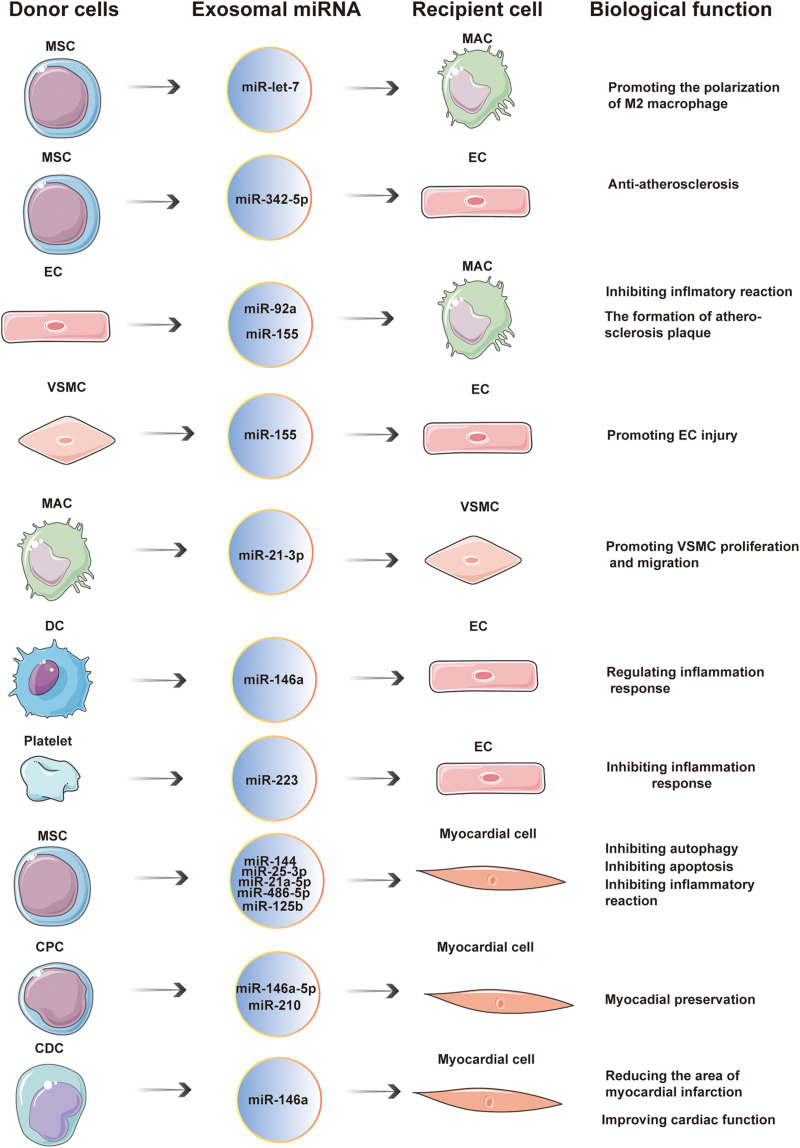
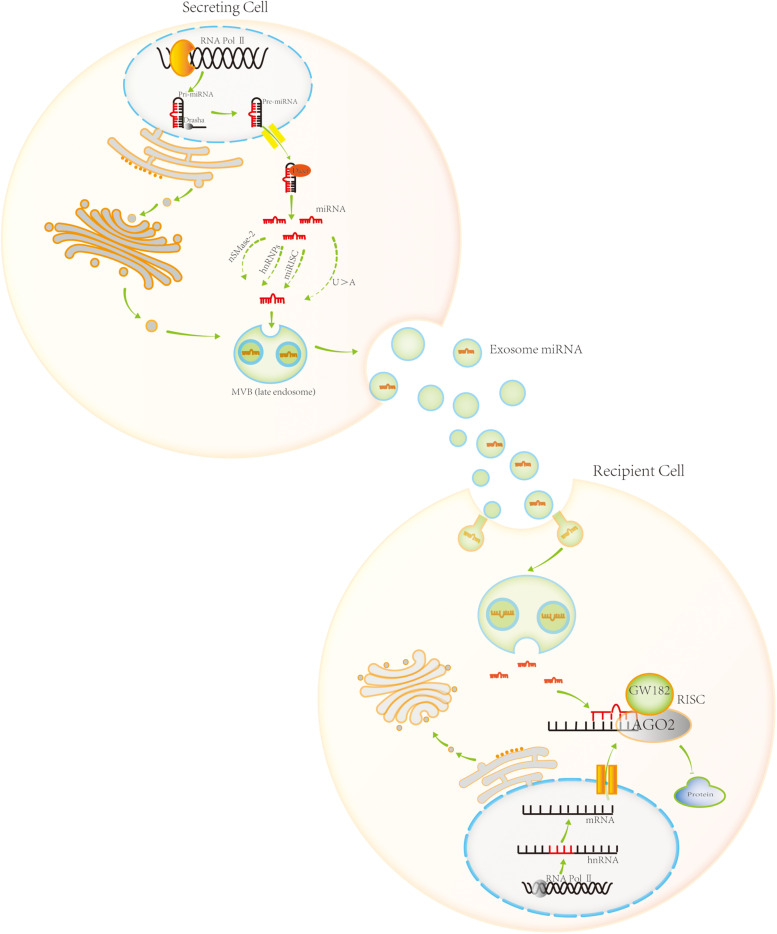
Exosomes are small vesicles (30-150 nm in diameter) enclosed by a lipid membrane bilayer, secreted by most cells in the body. They carry various molecules, including proteins, lipids, mRNA, and other RNA species, such as long non-coding RNA, circular RNA, and microRNA (miRNA). miRNAs are the most numerous cargo molecules in the exosome. They are endogenous non-coding RNA molecules, approximately 19-22-nt-long, and important regulators of protein biosynthesis. Exosomes can be taken up by neighboring or distant cells, where they play a role in post-transcriptional regulation of gene expression by targeting mRNA. Exosomal miRNAs have diverse functions, such as participation in inflammatory reactions, cell migration, proliferation, apoptosis, autophagy, and epithelial-mesenchymal transition. There is increasing evidence that exosomal miRNAs play an important role in cardiovascular health. Exosomal miRNAs are widely involved in the occurrence and development of cardiovascular diseases, such as atherosclerosis, acute coronary syndrome, heart failure (HF), myocardial ischemia reperfusion injury, and pulmonary hypertension. In this review, we present a systematic overview of the research progress into the role of exosomal miRNAs in cardiovascular diseases, and present new ideas for the diagnosis and treatment of cardiovascular diseases.
外泌体是一种小囊泡(直径30 - 150纳米),由脂质膜双层包裹,由体内大多数细胞分泌。它们携带各种分子,包括蛋白质、脂质、信使核糖核酸(mRNA)和其他RNA种类,如长链非编码RNA、环状RNA和微小核糖核酸(miRNA)。miRNA是外泌体中数量最多的货物分子。它们是内源性非编码RNA分子,长度约为19 - 22个核苷酸,是蛋白质生物合成的重要调节因子。外泌体可以被邻近或远处的细胞摄取,在那里它们通过靶向mRNA在基因表达的转录后调节中发挥作用。外泌体miRNA具有多种功能,如参与炎症反应、细胞迁移、增殖、凋亡、自噬和上皮 - 间质转化。越来越多的证据表明,外泌体miRNA在心血管健康中起重要作用。外泌体miRNA广泛参与心血管疾病的发生和发展,如动脉粥样硬化、急性冠状动脉综合征、心力衰竭(HF)、心肌缺血再灌注损伤和肺动脉高压。在本综述中,我们系统概述了外泌体miRNA在心血管疾病中作用的研究进展,并为心血管疾病的诊断和治疗提出新思路。