Kwak Min Seob, Lee Hun Hee, Yang Jae Min, Cha Jae Myung, Jeon Jung Won, Yoon Jin Young, Kim Ha Il
Department of Internal Medicine, Kyung Hee University Hospital at Gangdong, Kyung Hee University College of Medicine, Seoul, South Korea.
Department of Computer Science and Engineering, Konkuk University, Seoul, South Korea.
Front Oncol. 2021 Jan 13;10:619803. doi: 10.3389/fonc.2020.619803. eCollection 2020.
Human evaluation of pathological slides cannot accurately predict lymph node metastasis (LNM), although accurate prediction is essential to determine treatment and follow-up strategies for colon cancer. We aimed to develop accurate histopathological features for LNM in colon cancer.
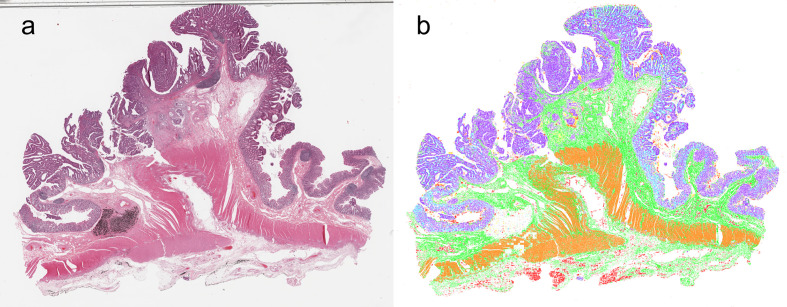
We developed a deep convolutional neural network model to distinguish the cancer tissue component of colon cancer using data from the tissue bank of the National Center for Tumor Diseases and the pathology archive at the University Medical Center Mannheim, Germany. This model was applied to whole-slide pathological images of colon cancer patients from The Cancer Genome Atlas (TCGA). The predictive value of the peri-tumoral stroma (PTS) score for LNM was assessed.
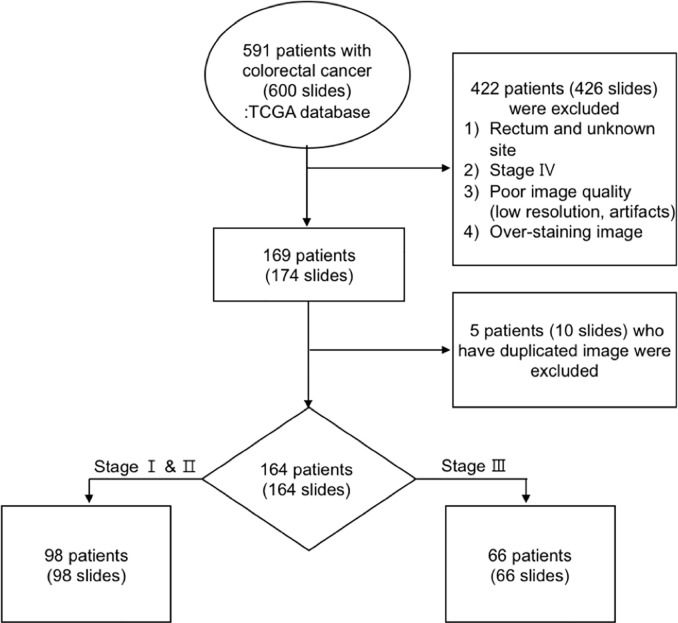
A total of 164 patients with stages I, II, and III colon cancer from TCGA were analyzed. The mean PTS score was 0.380 (± SD = 0.285), and significantly higher PTS scores were observed in patients in the LNM-positive group than those in the LNM-negative group ( < 0.001). In the univariate analyses, the PTS scores for the LNM-positive group were significantly higher than those for the LNM-negative group ( < 0.001). Further, the PTS scores in lymphatic invasion and any one of perineural, lymphatic, or venous invasion were significantly increased in the LNM-positive group ( < 0.001 and < 0.001).
We established the PTS score, a simplified reproducible parameter, for predicting LNM in colon cancer using computer-based analysis that could be used to guide treatment decisions. These findings warrant further confirmation through large-scale prospective clinical trials.
尽管准确预测对于确定结肠癌的治疗和随访策略至关重要,但对病理切片的人工评估无法准确预测淋巴结转移(LNM)。我们旨在开发用于预测结肠癌LNM的准确组织病理学特征。
我们利用德国国家肿瘤疾病中心组织库和曼海姆大学医学中心病理档案的数据,开发了一个深度卷积神经网络模型,以区分结肠癌的癌组织成分。该模型应用于来自癌症基因组图谱(TCGA)的结肠癌患者的全切片病理图像。评估肿瘤周围基质(PTS)评分对LNM的预测价值。
共分析了来自TCGA的164例I、II和III期结肠癌患者。PTS评分的平均值为0.380(±标准差=0.285),LNM阳性组患者的PTS评分显著高于LNM阴性组患者(<0.001)。在单因素分析中,LNM阳性组的PTS评分显著高于LNM阴性组(<0.001)。此外,LNM阳性组中淋巴管侵犯以及神经周围、淋巴管或静脉侵犯中任何一种情况下的PTS评分均显著升高(<0.001和<0.001)。
我们建立了PTS评分,这是一个简化的可重复参数,用于通过基于计算机的分析预测结肠癌的LNM,可用于指导治疗决策。这些发现需要通过大规模前瞻性临床试验进一步证实。