Beig Niha, Bera Kaustav, Tiwari Pallavi
Department of Biomedical Engineering, Case Western Reserve University, Cleveland, Ohio, USA.
Neurooncol Adv. 2021 Jan 23;2(Suppl 4):iv3-iv14. doi: 10.1093/noajnl/vdaa148. eCollection 2020 Dec.
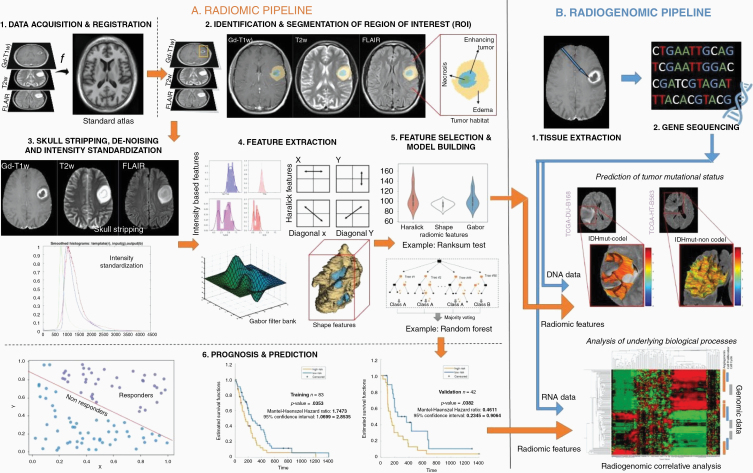
Neuro-oncology largely consists of malignancies of the brain and central nervous system including both primary as well as metastatic tumors. Currently, a significant clinical challenge in neuro-oncology is to tailor therapies for patients based on a priori knowledge of their survival outcome or treatment response to conventional or experimental therapies. Radiomics or the quantitative extraction of subvisual data from conventional radiographic imaging has recently emerged as a powerful data-driven approach to offer insights into clinically relevant questions related to diagnosis, prediction, prognosis, as well as assessing treatment response. Furthermore, radiogenomic approaches provide a mechanism to establish statistical correlations of radiomic features with point mutations and next-generation sequencing data to further leverage the potential of routine MRI scans to serve as "virtual biopsy" maps. In this review, we provide an introduction to radiomic and radiogenomic approaches in neuro-oncology, including a brief description of the workflow involving preprocessing, tumor segmentation, and extraction of "hand-crafted" features from the segmented region of interest, as well as identifying radiogenomic associations that could ultimately lead to the development of reliable prognostic and predictive models in neuro-oncology applications. Lastly, we discuss the promise of radiomics and radiogenomic approaches in personalizing treatment decisions in neuro-oncology, as well as the challenges with clinical adoption, which will rely heavily on their demonstrated resilience to nonstandardization in imaging protocols across sites and scanners, as well as in their ability to demonstrate reproducibility across large multi-institutional cohorts.
神经肿瘤学主要包括脑和中枢神经系统的恶性肿瘤,涵盖原发性肿瘤和转移性肿瘤。目前,神经肿瘤学面临的一项重大临床挑战是,根据患者对传统或实验性疗法的生存结果或治疗反应的先验知识,为其量身定制治疗方案。放射组学,即从传统放射影像中定量提取亚视觉数据,最近已成为一种强大的数据驱动方法,有助于深入了解与诊断、预测、预后以及评估治疗反应相关的临床问题。此外,放射基因组学方法提供了一种机制,可建立放射组学特征与点突变及下一代测序数据之间的统计相关性,从而进一步利用常规磁共振成像扫描的潜力,使其成为 “虚拟活检” 图谱。在本综述中,我们介绍了神经肿瘤学中的放射组学和放射基因组学方法,包括对工作流程的简要描述,该流程涉及预处理、肿瘤分割以及从分割后的感兴趣区域提取 “手工制作” 的特征,还包括识别放射基因组关联,这些关联最终可能促成神经肿瘤学应用中可靠的预后和预测模型的开发。最后,我们讨论了放射组学和放射基因组学方法在神经肿瘤学个性化治疗决策中的前景,以及临床应用面临的挑战,这将在很大程度上依赖于它们在跨站点和扫描仪的成像协议非标准化情况下所展现出的适应性,以及在大型多机构队列中证明可重复性的能力。