Institute of Plasma Technology, Korea Institute of Fusion Energy, Gunsan, 54004, Republic of Korea.
Sci Rep. 2021 Feb 3;11(1):2924. doi: 10.1038/s41598-021-82487-8.
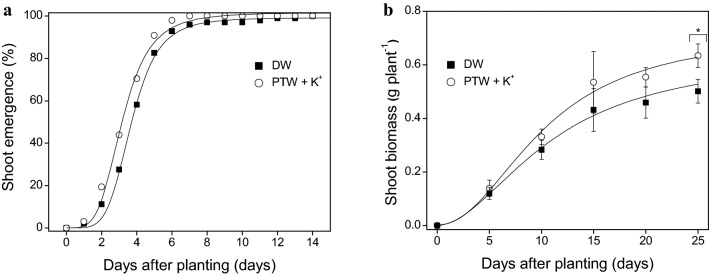
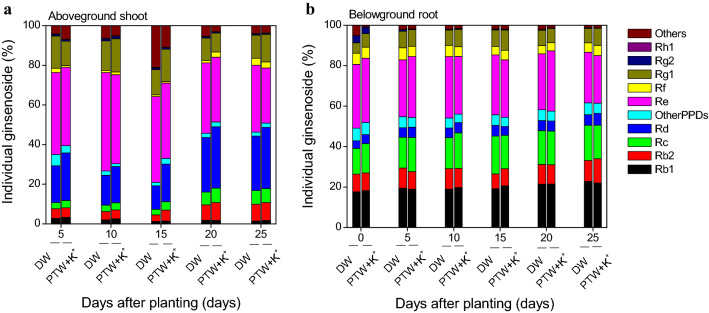
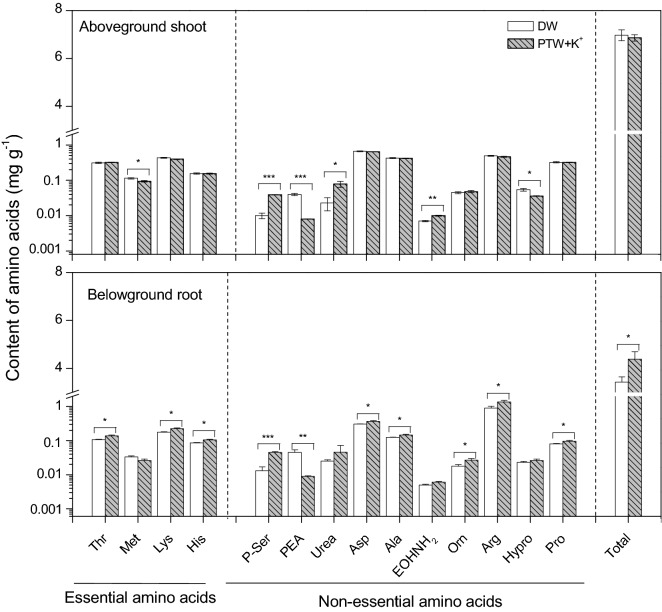
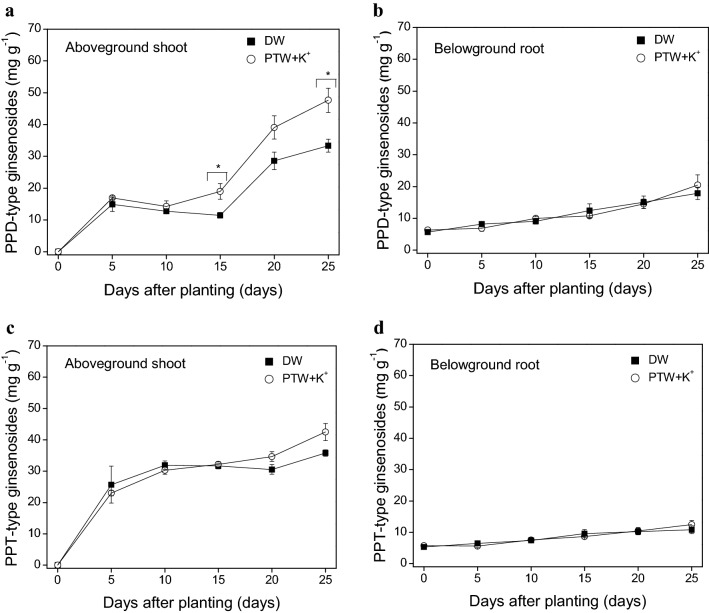
Ginseng (Panax ginseng Meyer) sprouts are grown to whole plants in 20 to 25 days in a soil-less cultivation system and then used as a medicinal vegetable. As a nitrogen (N) source, plasma-treated water (PTW) has been used to enhance the seed germination and seedling growth of many crops but has not been investigated for its effects on ginseng sprouts. This study established an in-situ system for N-containing water production using plasma technology and evaluated the effects of the PTW on ginseng growth and its bioactive phytochemicals compared with those of an untreated control. The PTW became weakly acidic 30 min after the air discharge at the electrodes because of the formation of nitrate (NO) and nitrite (NO) in the water. The NO and NO in the PTW, together with potassium ions (K), enhanced the shoot biomass of the ginseng sprout by 26.5% compared to the untreated control. The ginseng sprout grown in the PTW had accumulated more free amino acids and ginsenosides in the sprout at 25 days after planting. Therefore, PTW can be used as a liquid N fertilizer for P. ginseng growth and phytochemical accumulation during sprouting under aeroponic conditions.
人参(Panax ginseng Meyer)芽在无土栽培系统中生长 20-25 天即可长成全株,然后用作药用蔬菜。等离子体处理水(PTW)已被用作许多作物的氮(N)源,以促进种子发芽和幼苗生长,但尚未研究其对人参芽的影响。本研究建立了一种使用等离子体技术原位生产含 N 水的系统,并评估了 PTW 对人参生长及其生物活性植物化学物质的影响,与未处理对照相比。由于电极处水中形成硝酸盐(NO)和亚硝酸盐(NO),PTW 在空气放电 30 分钟后变成弱酸性。PTW 中的 NO 和 NO 与钾离子(K)一起,使人参芽的芽生物量比未处理的对照增加了 26.5%。与在未处理的对照中相比,在种植后 25 天,在 PTW 中生长的人参芽在芽中积累了更多的游离氨基酸和人参皂苷。因此,PTW 可在气培条件下用于促进 P. ginseng 在发芽期间的生长和植物化学物质积累。