Rahman Ehab Ur, Zhang Yihong, Ahmad Sohail, Ahmad Hafiz Ishfaq, Jobaer Sayed
College of Information Science and Technology, Engineering Research Center of Digitized Textile & Fashion Technology, Ministry of Education, Donghua University, Shanghai 201620, China.
School of Computing, Faculty of Engineering, Universiti Teknologi Malaysia, Johor 79100, Malaysia.
Sensors (Basel). 2021 Feb 2;21(3):974. doi: 10.3390/s21030974.
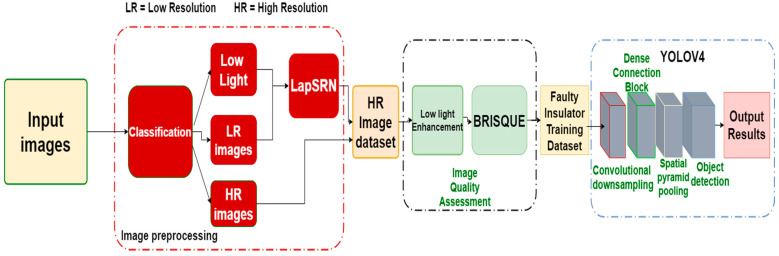
The early detection of damaged (partially broken) outdoor insulators in primary distribution systems is of paramount importance for continuous electricity supply and public safety. Unmanned aerial vehicles (UAVs) present a safer, autonomous, and efficient way to examine the power system components without closing the power distribution system. In this work, a novel dataset is designed by capturing real images using UAVs and manually generated images collected to overcome the data insufficiency problem. A deep Laplacian pyramid-based super-resolution network is implemented to reconstruct high-resolution training images. To improve the visibility of low-light images, a low-light image enhancement technique is used for the robust exposure correction of the training images. A different fine-tuning strategy is implemented for fine-tuning the object detection model to increase detection accuracy for the specific faulty insulators. Several flight path strategies are proposed to overcome the shuttering effect of insulators, along with providing a less complex and time- and energy-efficient approach for capturing a video stream of the power system components. The performance of different object detection models is presented for selecting the most suitable one for fine-tuning on the specific faulty insulator dataset. For the detection of damaged insulators, our proposed method achieved an F1-score of 0.81 and 0.77 on two different datasets and presents a simple and more efficient flight strategy. Our approach is based on real aerial inspection of in-service porcelain insulators by extensive evaluation of several video sequences showing robust fault recognition and diagnostic capabilities. Our approach is demonstrated on data acquired by a drone in Swat, Pakistan.
早期检测一次配电系统中损坏(部分破损)的户外绝缘子对于持续供电和公共安全至关重要。无人机提供了一种更安全、自主且高效的方式,无需关闭配电系统即可检查电力系统组件。在这项工作中,通过使用无人机捕捉真实图像并收集人工生成的图像来设计一个新颖的数据集,以克服数据不足的问题。实现了一种基于深度拉普拉斯金字塔的超分辨率网络来重建高分辨率训练图像。为了提高低光照图像的可视性,使用了一种低光照图像增强技术对训练图像进行鲁棒的曝光校正。实施了不同的微调策略来微调目标检测模型,以提高对特定故障绝缘子的检测精度。提出了几种飞行路径策略来克服绝缘子的快门效应,同时为捕获电力系统组件的视频流提供一种不太复杂且省时节能的方法。展示了不同目标检测模型的性能,以选择最适合在特定故障绝缘子数据集上进行微调的模型。对于损坏绝缘子的检测,我们提出的方法在两个不同数据集上分别达到了0.81和0.77的F1分数,并提出了一种简单且更高效的飞行策略。我们的方法基于对在用瓷绝缘子的实际空中检查,通过对多个视频序列的广泛评估,显示出强大的故障识别和诊断能力。我们的方法在巴基斯坦斯瓦特由无人机获取的数据上得到了验证。