Key Laboratory for NeuroInformation of Ministry of Education, High-Field Magnetic Resonance Brain Imaging Key Laboratory of Sichuan Province, Center for Psychiatry and Psychology, School of Life Science and Technology, University of Electronic Science and Technology of China, Chengdu, 610054, China.
Sci Rep. 2021 Feb 4;11(1):3072. doi: 10.1038/s41598-021-82663-w.
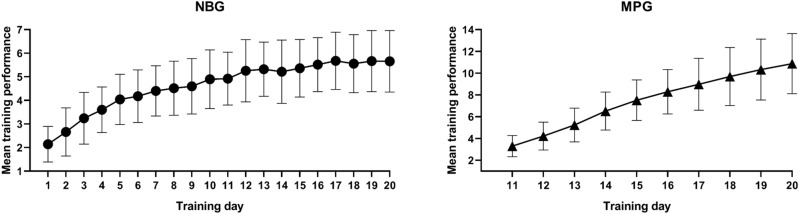
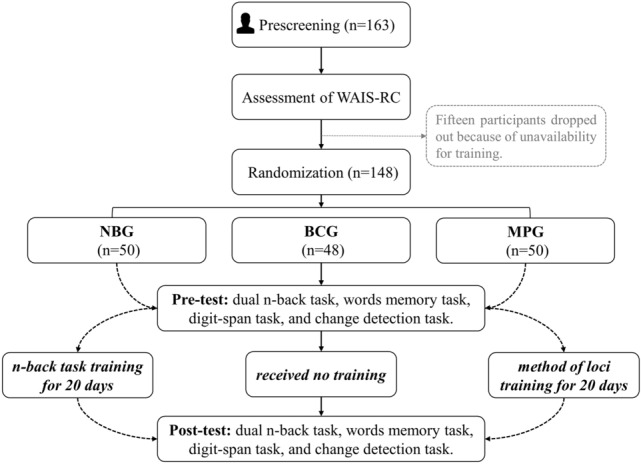
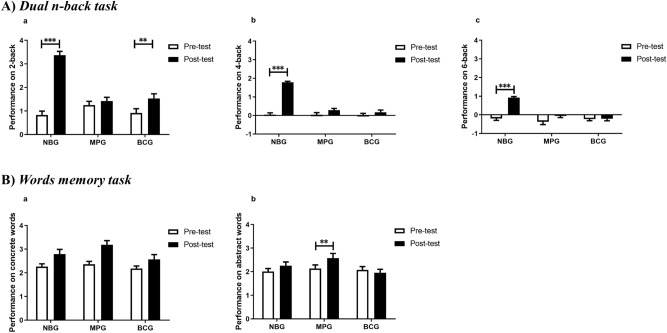
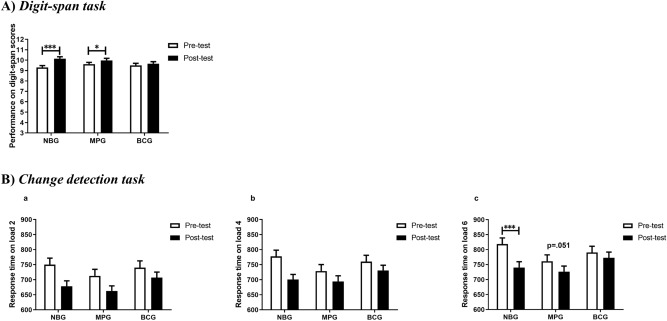
Working memory (WM) training is a prevalent intervention for multiple cognitive deficits, however, the transfer effects to other cognitive tasks from gains in WM induced by different training techniques still remains controversial. Therefore, the current study recruited three groups of young adults to investigate the memory training transference, with N-back group (NBG) (n = 50) training on dual n-back task, Memory Palace group (MPG) (n = 50) on method of loci, and a blank control group (BCG) (n = 48) receiving no training. Our results showed that both training groups separately improved WM capacity on respective trained task. For untrained tasks, both training groups enhanced performance on digit-span task, while on change detection task, significant improvement was only observed in NBG. In conclusion, while both techniques can be used as effective training methods to improve WM, the dual n-back task training method, perhaps has a more prominent transfer effect than that of method of loci.
工作记忆 (WM) 训练是一种常见的干预措施,可以改善多种认知缺陷,然而,不同训练技术引起的 WM 增益对其他认知任务的迁移效应仍存在争议。因此,本研究招募了三组年轻成年人来探究记忆训练的迁移效应,其中 N 回任务训练组(N-back group,NBG)(n=50)接受双 N 回任务训练,记忆宫殿训练组(Memory Palace group,MPG)(n=50)接受记忆宫殿法训练,空白对照组(blank control group,BCG)(n=48)不接受训练。我们的结果表明,两个训练组分别在各自接受的训练任务上提高了 WM 容量。对于未训练的任务,两个训练组在数字跨度任务上的表现都有所提高,而在变化检测任务上,只有 NBG 组观察到显著的改善。总之,虽然这两种技术都可以作为有效的训练方法来提高 WM,但双 N 回任务训练方法可能比记忆宫殿法具有更显著的迁移效应。