Nutrition and Speech Pathology Department, Peter MacCallum Cancer Centre, Melbourne, 3000, Australia.
Faculty of Health Sciences and Medicine, Bond University, Gold Coast 4226, Australia.
Nutrients. 2021 Feb 4;13(2):514. doi: 10.3390/nu13020514.
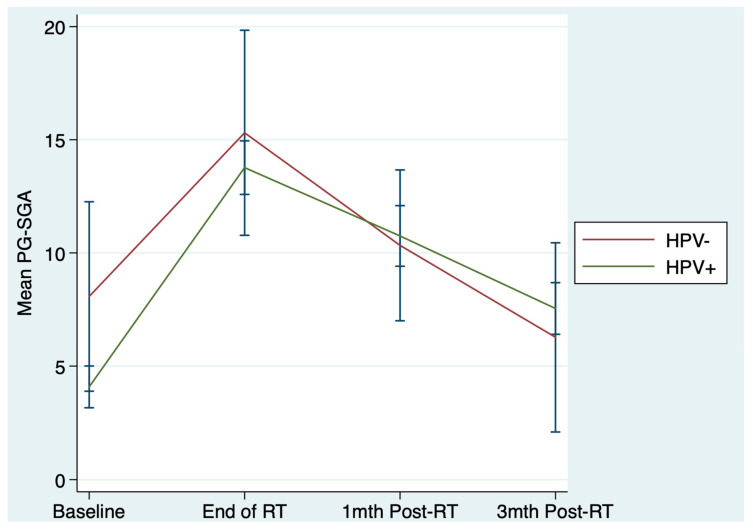
Patients undergoing (chemo) radiotherapy for oropharyngeal squamous cell carcinoma (OPSCC) are at high risk of malnutrition during and after treatment. Malnutrition can lead to poor tolerance to treatment, treatment interruptions, poor quality of life (QOL) and potentially reduced survival rate. Human papillomavirus (HPV) is now known as the major cause of OPSCC. However, research regarding its effect on nutritional outcomes is limited. The aim of this study was to examine the relationship between HPV status and nutritional outcomes, including malnutrition and weight loss during and after patients' (chemo) radiotherapy treatment for OPSCC. This was a longitudinal cohort study comparing the nutritional outcomes of HPV-positive and negative OPSCC patients undergoing (chemo) radiotherapy. The primary outcome was nutritional status as measured using the Patient Generated-Subjective Global Assessment (PG-SGA). Secondary outcomes included loss of weight, depression, QOL and adverse events. Although HPV-positive were less likely to be malnourished according to PG-SGA at the beginning of treatment, we found that the difference between malnutrition rates in response to treatment was not significantly different over the course of radiotherapy and 3 months post treatment. HPV-positive participants had significantly higher odds of experiencing >10% weight loss at three months post-treatment than HPV-negative participants (OR = 49.68, 95% CI (2.7, 912.86) ≤ 0.01). The nutritional status of HPV positive and negative patients were both negatively affected by treatment and require similarly intense nutritional intervention. In acute recovery, HPV positive patients may require more intense intervention. At 3- months post treatment, both groups still showed nutritional symptoms that require nutritional intervention so ongoing nutritional support is essential.
接受头颈部鳞状细胞癌(OPSCC)放化疗的患者在治疗期间和治疗后存在发生营养不良的高风险。营养不良可导致治疗耐受性差、治疗中断、生活质量(QOL)差,并可能降低生存率。人乳头瘤病毒(HPV)现在被认为是 OPSCC 的主要病因。然而,关于其对营养结局影响的研究有限。本研究旨在探讨 HPV 状态与营养结局之间的关系,包括 OPSCC 患者接受放化疗期间和治疗后的营养不良和体重减轻。 这是一项比较 HPV 阳性和阴性 OPSCC 患者在接受放化疗期间营养结局的纵向队列研究。主要结局是使用患者生成的主观整体评估(PG-SGA)测量的营养状况。次要结局包括体重减轻、抑郁、QOL 和不良事件。 尽管根据治疗开始时的 PG-SGA,HPV 阳性患者营养不良的可能性较低,但我们发现,在放疗过程中和治疗后 3 个月,治疗反应中营养不良发生率的差异无统计学意义。HPV 阳性患者在治疗后 3 个月时体重减轻 >10%的可能性显著高于 HPV 阴性患者(OR=49.68,95%CI(2.7,912.86)≤0.01)。 HPV 阳性和阴性患者的营养状况均受到治疗的负面影响,需要进行类似强度的营养干预。在急性恢复期,HPV 阳性患者可能需要更强烈的干预。在治疗后 3 个月,两组仍表现出需要营养干预的营养症状,因此需要持续的营养支持。