Ding Li, Zhang Ning, Zhu Bin, Liu Jinlin, Wang Xue, Liu Feng, Mao Ying
School of Humanities and Social Science, Xi'an Jiaotong University, Xi'an, China.
Health Commission of Xi'an, Xi'an, China.
BMC Public Health. 2021 Feb 17;21(1):374. doi: 10.1186/s12889-021-10385-9.
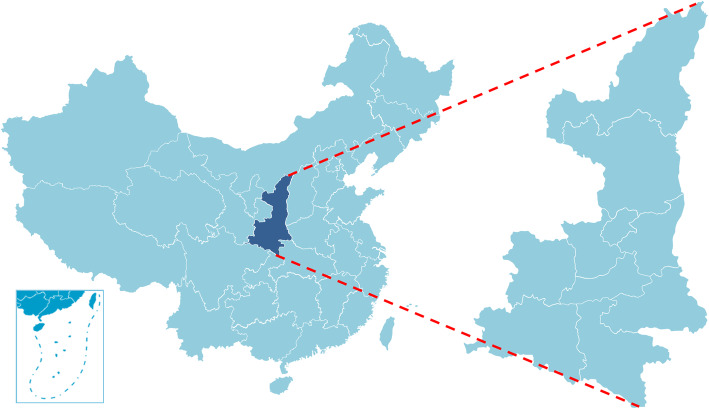
Hand, foot and mouth disease (HFMD) is one of the common intestinal infectious diseases worldwide and has caused huge economic and disease burdens in many countries. The average annual incidence rate of HFMD was 11.66% in Shaanxi during the time span from 2009 to 2018. There are distinct differences within Shaanxi, as it is a special region that crosses three temperature zones. Hence, in this study, a spatiotemporal analysis of Shaanxi was performed to reveal the characteristics of the distribution of HFMD and to explore the meteorological determinants of HFMD.
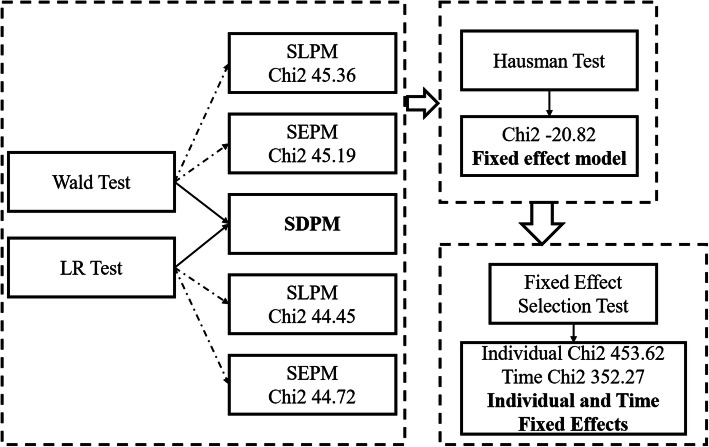
The county-level and municipal data from Shaanxi Province from 2009 to 2018 were applied to research the spatiotemporal characteristics of HFMD and its meteorological determinants. Time series and spatial autocorrelation analyses were applied to assess the spatiotemporal characteristics of HFMD. This study used spatial econometric panel models to explore the relationship between HFMD and meteorological factors based on the data of 107 counties and 10 municipalities.
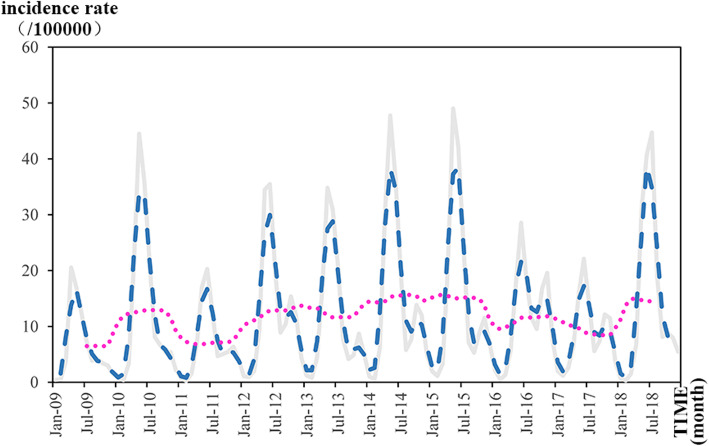
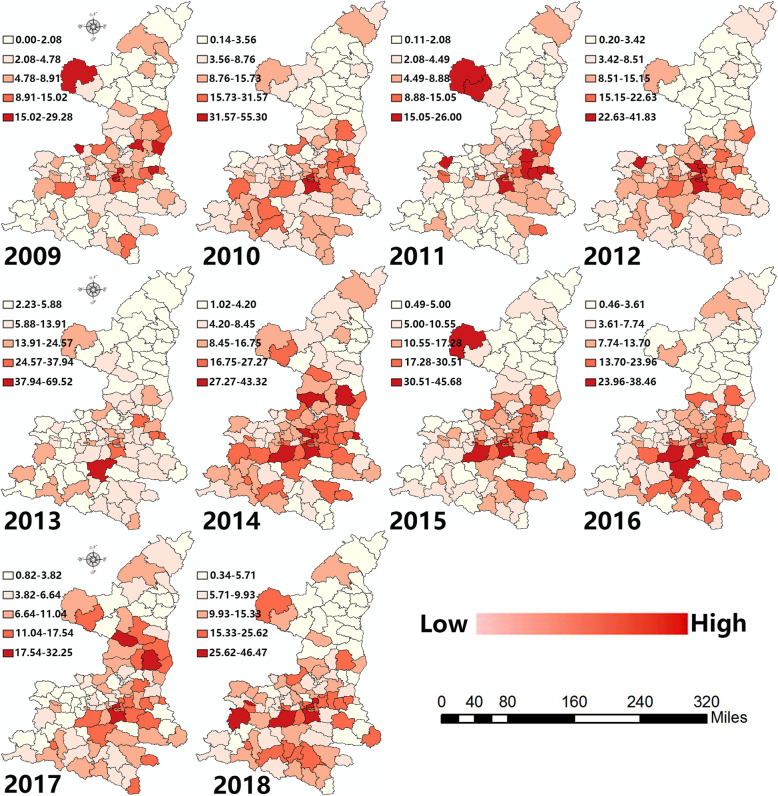
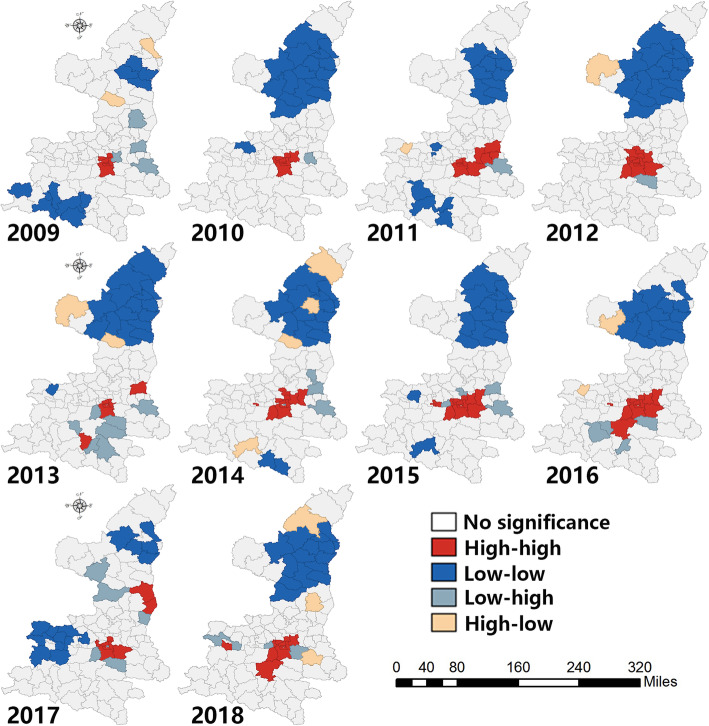
The incidence rate of HFMD displayed no variable trend throughout the whole research period. A high incidence rate of HFMD was observed from June to September, corresponding to a time when the climate is characterized by heavy rain, high temperature, and high humidity. The high-incidence areas were mainly located in the central region in Shaanxi, whereas the low-incidence spots were mainly found in Northern Shaanxi. Regarding the meteorological factors analysed in this study, in general, the incidence rate of HFMD in specific regions was positively associated with the rainfall, temperature and humidity.
These results could be applied by the government and the general public to take effective measures to prevent disease. Region-targeted policies could be enacted and implemented in the future according to specific situations in different areas and the relevant meteorological determinants. Additionally, meteorological conditions normally extend to a wide-ranging region; thus, cooperation among surrounding regions is necessary.
手足口病(HFMD)是全球常见的肠道传染病之一,在许多国家造成了巨大的经济和疾病负担。2009年至2018年期间,陕西省手足口病的年平均发病率为11.66%。陕西省内部存在明显差异,因为它是一个跨越三个温度带的特殊地区。因此,本研究对陕西省进行了时空分析,以揭示手足口病的分布特征,并探索手足口病的气象决定因素。
应用陕西省2009年至2018年的县级和市级数据,研究手足口病的时空特征及其气象决定因素。采用时间序列和空间自相关分析来评估手足口病的时空特征。本研究基于107个县和10个市的数据,使用空间计量面板模型来探索手足口病与气象因素之间的关系。
在整个研究期间,手足口病的发病率没有呈现出变化趋势。手足口病的高发率出现在6月至9月,这一时期的气候特点是暴雨、高温和高湿度。高发地区主要位于陕西中部,而低发地区主要在陕北。关于本研究中分析的气象因素,总体而言,特定地区手足口病的发病率与降雨量、温度和湿度呈正相关。
这些结果可供政府和公众采取有效措施预防疾病。未来可根据不同地区的具体情况和相关气象决定因素制定和实施针对性的区域政策。此外,气象条件通常会延伸到广泛的区域;因此,周边地区之间的合作是必要的。