Department of Veterinary Clinical Sciences, University of Copenhagen, Copenhagen, Denmark.
J Vet Intern Med. 2021 Mar;35(2):867-877. doi: 10.1111/jvim.16084. Epub 2021 Feb 27.
Few studies have investigated management and outcome in dogs with acute hemorrhagic diarrhea syndrome (AHDS), and there is a paucity of data on dogs with concurrent signs of sepsis.
To report outcome in dogs with suspected AHDS according to disease severity and antimicrobial treatment, and to evaluate effect of fluid resuscitation on clinical criteria.
Two hundred thirty-seven dogs hospitalized with suspected AHDS.
Retrospective study based on medical records. Disease severity was evaluated using AHDS index, systemic inflammatory response syndrome (SIRS) criteria, and serum C-reactive protein (CRP) according to 3 treatment groups: No, 1, or 2 antimicrobials.
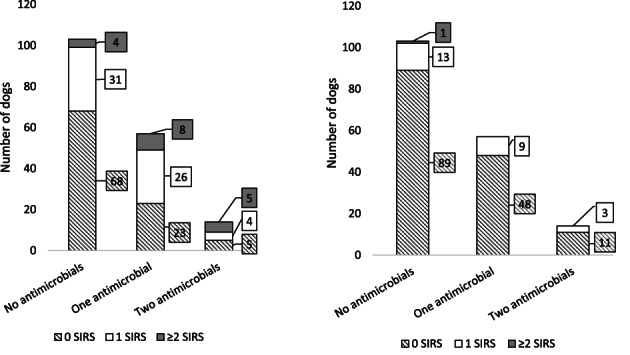
Sixty-two percent received no antimicrobials, 31% received 1 antimicrobial, predominantly aminopenicillins, and 7% received 2 antimicrobials. At admission, median AHDS index was 13 (interquartile range, 11-15), which decreased significantly after the first day's hospitalization (P < .001) for all groups. Compared with no antimicrobials (7%), more dogs had ≥2 SIRS criteria in the antimicrobial groups (15% and 36%, respectively). C-reactive protein (CRP) correlated positively with AHDS index at hospitalization (P < .001). Across treatment groups, rehydration markedly reduced number of clinical SIRS criteria. Survival to discharge was 96%, lower for dogs receiving 2 antimicrobials (77%, P < .05).
The majority of dogs hospitalized with suspected AHDS improve rapidly with symptomatic treatment only, despite signs of systemic disease on initial presentation. The often-used SIRS criteria might be a poor proxy for identifying dogs with AHDS in need of antimicrobial treatment, in particular when hypovolemic. The role of CRP in clinical decision-making or prognostication warrants further investigation.
鲜有研究调查急性出血性腹泻综合征(AHDS)犬的管理和预后,同时伴有败血症迹象的犬的相关数据也很少。
根据疾病严重程度和抗菌治疗报告疑似 AHDS 犬的预后,并评估液体复苏对临床标准的影响。
237 只因疑似 AHDS 住院的犬。
基于病历的回顾性研究。使用 AHDS 指数、全身炎症反应综合征(SIRS)标准和血清 C 反应蛋白(CRP)评估疾病严重程度,根据 3 种治疗组:无、1 种或 2 种抗菌药物。
62%的犬未接受抗菌药物治疗,31%的犬接受 1 种抗菌药物治疗,主要为氨基青霉素,7%的犬接受 2 种抗菌药物治疗。所有组的犬在入院时的中位 AHDS 指数为 13(四分位距,11-15),在住院的第 1 天显著降低(P < .001)。与无抗菌药物组(7%)相比,抗菌药物组有更多的犬出现≥2 个 SIRS 标准(分别为 15%和 36%)。入院时 CRP 与 AHDS 指数呈正相关(P < .001)。在各治疗组中,补液明显减少了临床 SIRS 标准的数量。出院时的存活率为 96%,接受 2 种抗菌药物治疗的犬存活率较低(77%,P < .05)。
尽管最初表现出全身疾病迹象,但大多数因疑似 AHDS 住院的犬仅通过对症治疗即可迅速改善。常用的 SIRS 标准可能无法准确识别需要抗菌治疗的 AHDS 犬,特别是低血容量的犬。CRP 在临床决策或预后判断中的作用值得进一步研究。