Sha Ning, Wang Hua-Wei, Sun Bin, Gong Min, Miao Po, Jiang Xiao-Lu, Yang Xiao-Feng, Li Mei, Xu Li-Xiao, Feng Chen-Xi, Yang Yuan-Yuan, Zhang Jie, Zhu Wen-Jing, Gao Yuan-Yuan, Feng Xing, Ding Xin
Soochow Key Laboratory of Prevention and Treatment of Child Brain injury, Children's Hospital of Soochow University, Suzhou; Department of Pediatrics, Affiliated Huai'an Hospital of Xuzhou Medical University, Huai'an, Jiangsu Province, China.
Soochow Key Laboratory of Prevention and Treatment of Child Brain injury, Children's Hospital of Soochow University, Suzhou, Jiangsu Province, China.
Neural Regen Res. 2021 Oct;16(10):2071-2077. doi: 10.4103/1673-5374.308101.
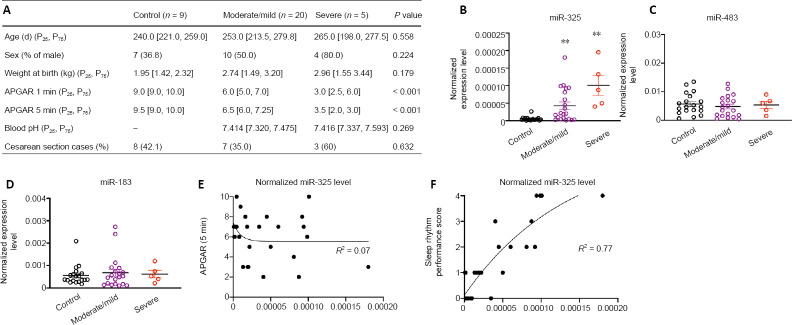
Circadian rhythm disorder is a common, but often neglected, consequence of neonatal hypoxic-ischemic brain damage (HIBD). However, the underlying molecular mechanisms remain largely unknown. We previously showed that, in a rat model of HIBD, up-regulation of microRNA-325 (miR-325) in the pineal gland is responsible for the suppression of Aanat, a key enzyme involved in melatonin synthesis and circadian rhythm regulation. To better understand the mechanism by which miR-325 affects circadian rhythms in neonates with HIBD, we compared clinical samples from neonates with HIBD and samples from healthy neonates recruited from the First Affiliated Hospital of Soochow University (Dushuhu Branch) in 2019. We found that circulating miR-325 levels correlated positively with the severity of sleep and circadian rhythm disorders in neonates with HIBD. Furthermore, a luciferase reporter gene assay revealed that LIM homeobox 3 (LHX3) is a novel downstream target of miR-325. In addition, in miR-325 knock-down mice, the transcription factor LHX3 exhibited an miR-325-dependent circadian pattern of expression in the pineal gland. We established a neonatal mouse model of HIBD by performing double-layer ligation of the left common carotid artery and exposing the pups to a low-oxygen environment for 2 hours. Lhx3 mRNA expression was significantly down-regulated in these mice and partially rescued in miR-325 knockout mice subjected to the same conditions. Finally, we showed that improvement in circadian rhythm-related behaviors in animals with HIBD was dependent on both miR-325 and LHX3. Taken together, our findings suggest that the miR-325-LHX3 axis is responsible for regulating circadian rhythms and provide novel insights into the identification of potential therapeutic targets for circadian rhythm disorders in patients with neonatal HIBD. The clinical trial was approved by Institutional Review Board of Children's Hospital of Soochow University (approval No. 2015028) on July 20, 2015. Animal experiments were approved by Animal Care and Use Committee, School of Medicine, Soochow University, China (approval No. XD-2016-1) on January 15, 2016.
昼夜节律紊乱是新生儿缺氧缺血性脑损伤(HIBD)常见但常被忽视的后果。然而,其潜在的分子机制仍 largely 未知。我们先前表明,在 HIBD 大鼠模型中,松果体中 microRNA - 325(miR - 325)的上调导致 Aanat 受到抑制,Aanat 是参与褪黑素合成和昼夜节律调节的关键酶。为了更好地理解 miR - 325 影响 HIBD 新生儿昼夜节律的机制,我们比较了 2019 年从苏州大学附属第一医院(独墅湖院区)招募的 HIBD 新生儿的临床样本和健康新生儿的样本。我们发现,循环 miR - 325 水平与 HIBD 新生儿睡眠和昼夜节律紊乱的严重程度呈正相关。此外,荧光素酶报告基因检测显示 LIM 同源盒 3(LHX3)是 miR - 325 的一个新的下游靶点。另外,在 miR - 325 敲低小鼠中,转录因子 LHX3 在松果体中呈现出 miR - 325 依赖性的昼夜表达模式。我们通过对左颈总动脉进行双层结扎并使幼崽暴露于低氧环境 2 小时,建立了 HIBD 新生小鼠模型。在这些小鼠中,Lhx3 mRNA 表达显著下调,而在接受相同条件的 miR - 325 基因敲除小鼠中部分得到挽救。最后,我们表明 HIBD 动物中昼夜节律相关行为的改善依赖于 miR - 325 和 LHX3。综上所述,我们的研究结果表明 miR - 325 - LHX3 轴负责调节昼夜节律,并为识别新生儿 HIBD 患者昼夜节律紊乱的潜在治疗靶点提供了新的见解。该临床试验于 2015 年 7 月 20 日获得苏州大学附属儿童医院机构审查委员会批准(批准号 2015028)。动物实验于 2016 年 1 月 15 日获得中国苏州大学医学院动物护理和使用委员会批准(批准号 XD - 2016 - 1)。