Diotaiuti Pierluigi, Corrado Stefano, Mancone Stefania, Falese Lavinia, Dominski Fábio Hech, Andrade Alexandro
Department of Human, Social and Health Sciences, University of Cassino, Cassino, Italy.
Santa Catarina State University, Florianopolis, Brazil.
Front Psychol. 2021 Feb 12;12:585477. doi: 10.3389/fpsyg.2021.585477. eCollection 2021.
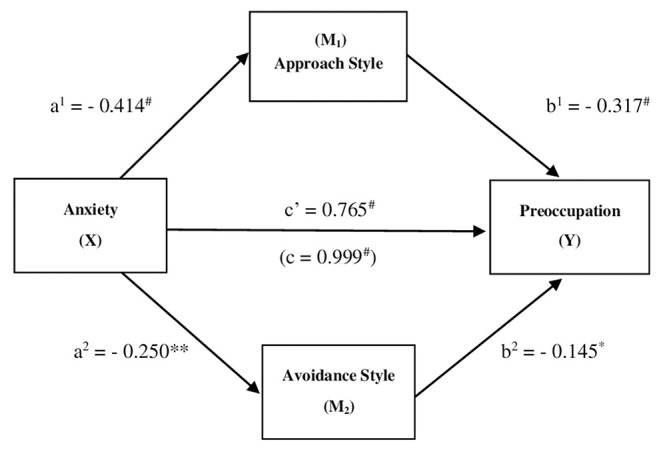
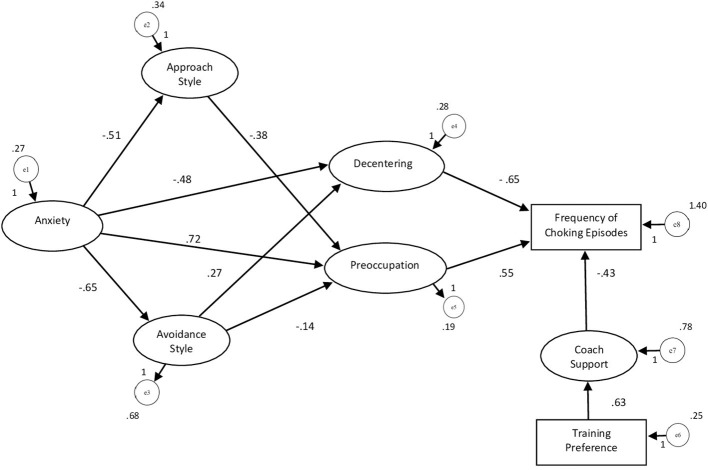
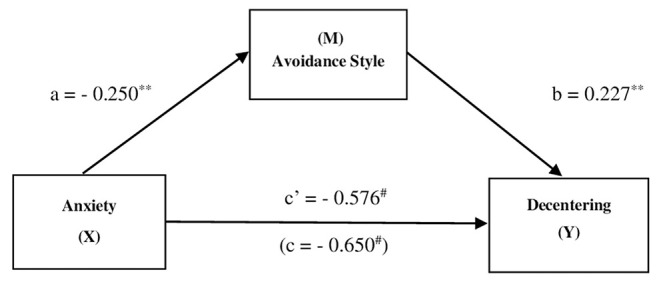
The aim of our study is to test the fit of an explanatory model of the frequency of the phenomenon of choking under pressure in archers, focusing on both the individual components (anxiety, coping styles, and decentralization) and environmental components (perception of coach assistance). 115 competitive athletes including 72 males (62.6%) and 43 females (37.4%) participated in the study, with average age of 39 years (±15.47). Participants reported personal data and completed measures of self-consciousness, anxiety, coping styles, and decentering. The ruminative component of concern was found to be the factor directly influencing the frequency of choking episodes in performance. Two significant mediations of personal coping style were also identified on the effects of anxiety on brooding thinking and on the athlete's ability to decentralize. The latter personal self-regulative component has been shown to be able to strongly limit the frequency of choking under pressure. Finally, among the environmental components, a further facilitating influence for the athlete resulted in the perception of being supported by the coach. The results therefore suggest that the athlete in choking should not face alone the hard upcoming period, but should preferably be supported with an articulated program focused on the cognitive remodeling of disturbing thoughts, on the strengthening of the capacity of decentralization, on the enhancement of the relationship of support and trust with the coach.
我们研究的目的是检验一个关于弓箭手在压力下出现窒息现象频率的解释模型的拟合度,重点关注个体因素(焦虑、应对方式和去中心化)和环境因素(对教练支持的感知)。115名竞技运动员参与了该研究,其中包括72名男性(62.6%)和43名女性(37.4%),平均年龄为39岁(±15.47)。参与者报告了个人数据,并完成了自我意识、焦虑、应对方式和去中心化的测量。结果发现,担忧的反刍成分是直接影响表现中窒息发作频率的因素。研究还确定了个人应对方式在焦虑对沉思思维的影响以及对运动员去中心化能力的影响方面的两个显著中介作用。后者的个人自我调节成分已被证明能够强烈限制压力下窒息的频率。最后,在环境因素中,运动员感受到教练的支持对其有进一步的促进作用。因此,研究结果表明,出现窒息现象的运动员不应独自面对即将到来的艰难时期,而最好通过一个明确的计划得到支持,该计划侧重于对干扰性思维的认知重塑、去中心化能力的强化以及与教练的支持和信任关系的加强。