R&D Division, Topcon Corporation, Tokyo, Japan.
Graduate School of System Informatics, Kobe University, Kobe, Japan.
Sci Rep. 2021 Mar 1;11(1):4250. doi: 10.1038/s41598-021-83503-7.
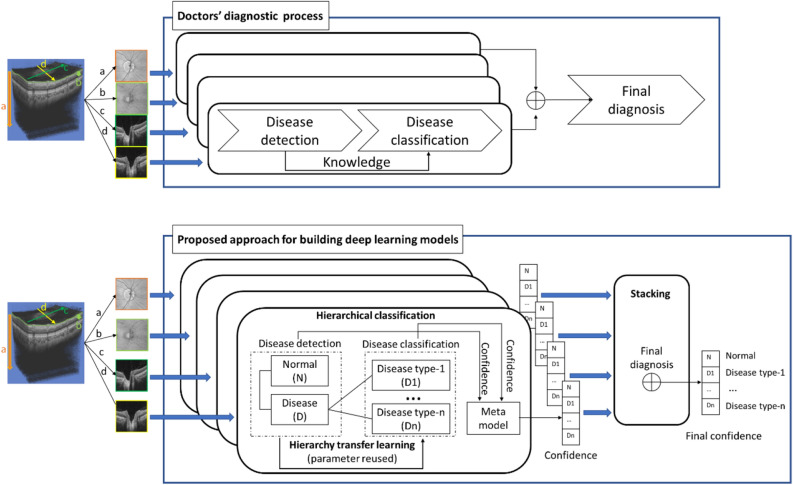
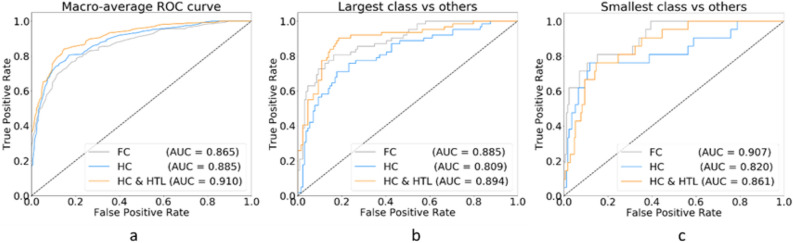
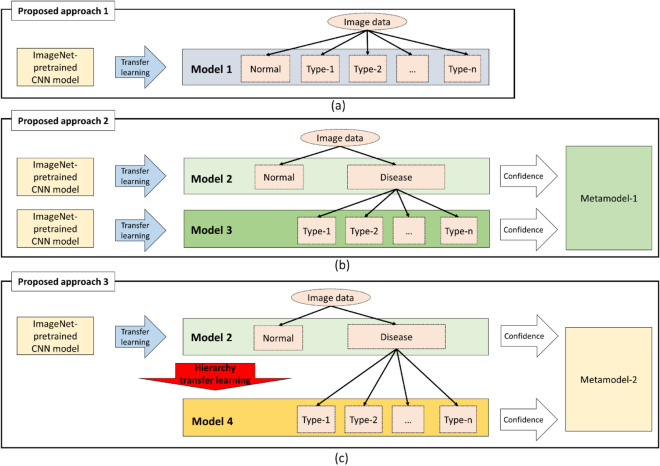
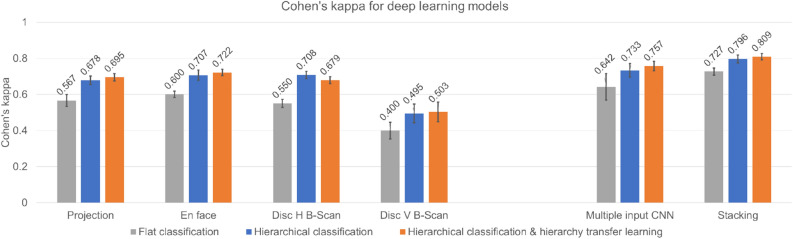
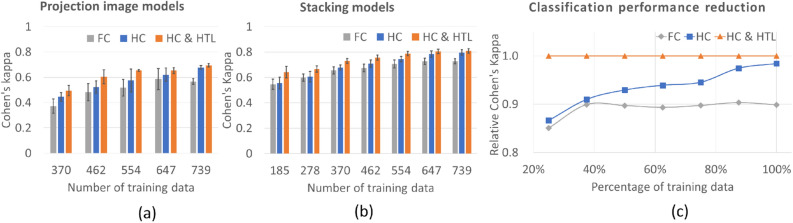
Deep learning is being employed in disease detection and classification based on medical images for clinical decision making. It typically requires large amounts of labelled data; however, the sample size of such medical image datasets is generally small. This study proposes a novel training framework for building deep learning models of disease detection and classification with small datasets. Our approach is based on a hierarchical classification method where the healthy/disease information from the first model is effectively utilized to build subsequent models for classifying the disease into its sub-types via a transfer learning method. To improve accuracy, multiple input datasets were used, and a stacking ensembled method was employed for final classification. To demonstrate the method's performance, a labelled dataset extracted from volumetric ophthalmic optical coherence tomography data for 156 healthy and 798 glaucoma eyes was used, in which glaucoma eyes were further labelled into four sub-types. The average weighted accuracy and Cohen's kappa for three randomized test datasets were 0.839 and 0.809, respectively. Our approach outperformed the flat classification method by 9.7% using smaller training datasets. The results suggest that the framework can perform accurate classification with a small number of medical images.
深度学习正被应用于基于医学图像的疾病检测和分类,以辅助临床决策。它通常需要大量的标记数据,但此类医学图像数据集的样本量通常较小。本研究提出了一种新颖的训练框架,用于利用小数据集构建疾病检测和分类的深度学习模型。我们的方法基于分层分类方法,通过迁移学习方法,利用第一个模型的健康/疾病信息来有效地构建后续模型,以将疾病分类为亚型。为了提高准确性,我们使用了多个输入数据集,并采用堆叠集成方法进行最终分类。为了演示该方法的性能,我们使用了从容积式眼科光学相干断层扫描数据中提取的标记数据集,其中包含 156 只健康眼和 798 只青光眼眼,这些青光眼眼进一步被标记为四个亚型。对于三个随机测试数据集,平均加权准确性和 Cohen's kappa 分别为 0.839 和 0.809。我们的方法在使用较小的训练数据集时,比平面分类方法的准确率高出 9.7%。研究结果表明,该框架可以用少量的医学图像进行准确分类。