Abduraimova Aiganym, Molkenova Anara, Duisembekova Assem, Mulikova Tomiris, Kanayeva Damira, Atabaev Timur Sh
Department of Biology, Nazarbayev University, Nur-Sultan 010000, Kazakhstan.
Department of Chemistry, Nazarbayev University, Nur-Sultan 010000, Kazakhstan.
Nanomaterials (Basel). 2021 Feb 13;11(2):477. doi: 10.3390/nano11020477.
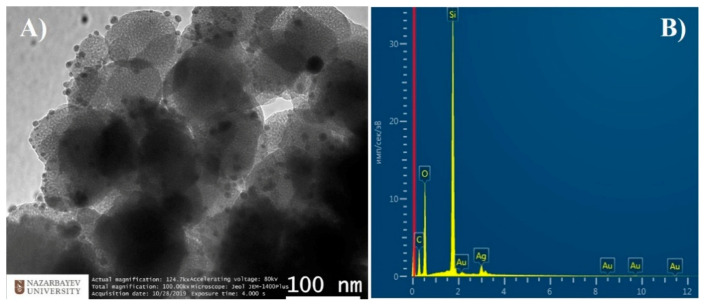
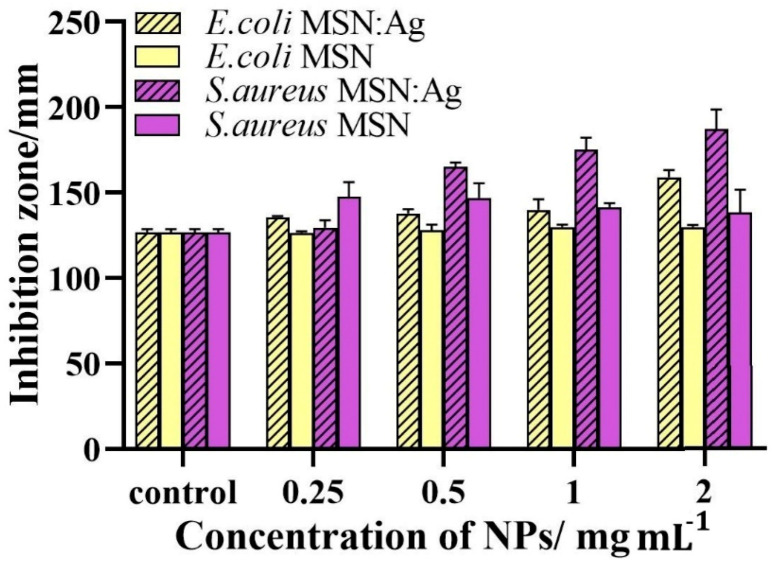
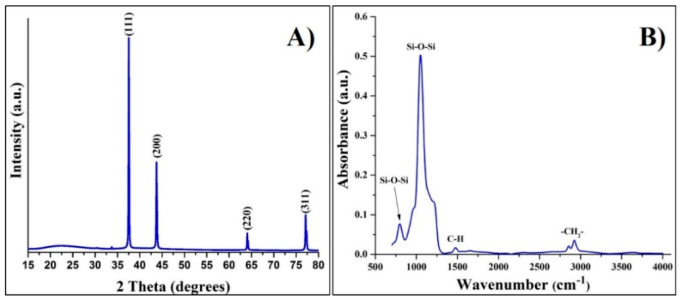
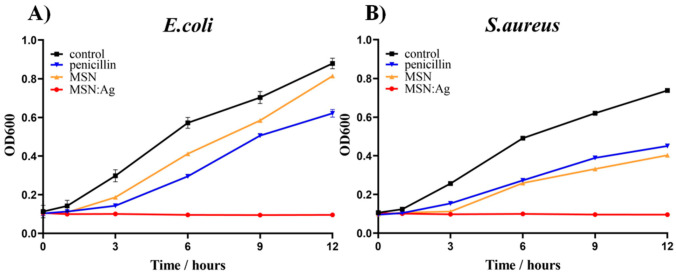
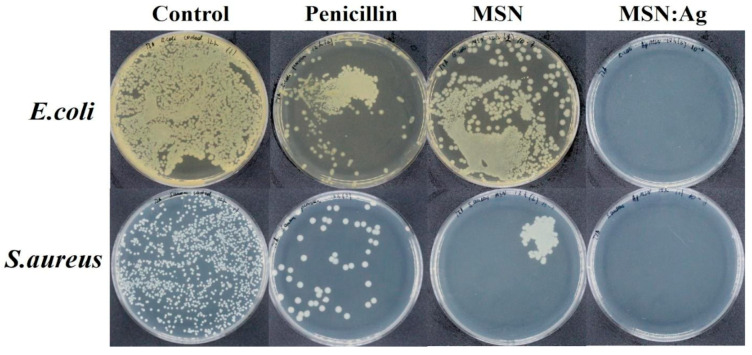
To date, Ag-based nanomaterials have demonstrated a high potential to overcome antibiotic resistance issues. However, bare Ag nanomaterials are prone to agglomeration in the biological environment, which results in a loss of antibacterial activity over time. Furthermore, it is still challenging to collect small-sized Ag nanomaterials right after the synthesis process. In this study, spherical-shaped Ag nanoparticles (NPs) (6-10 nm) were attached on the surface of cetyltrimethylammonium bromide (CTAB)-loaded mesoporous silica nanoparticles (MSNs) (100-110 nm). Antibacterial activity tests suggested that the obtained nanocomposite can be used as a highly efficient antibacterial agent against both Gram-negative and Gram-positive bacterial strains. The minimum inhibitory concentration (MIC) recalculated to pure Ag weight in nanocomposite was found to be ~1.84 µg/mL (for ) and ~0.92 µg/mL (for )-significantly smaller compared to values reported to date. The improved antibacterial activity of the prepared nanocomposite can be attributed to the even distribution of non-aggregated Ag NPs per volume unit and the presence of CTAB in the nanocomposite pores.
迄今为止,银基纳米材料已显示出克服抗生素耐药性问题的巨大潜力。然而,裸露的银纳米材料在生物环境中容易团聚,这会导致抗菌活性随时间丧失。此外,在合成过程后立即收集小尺寸的银纳米材料仍然具有挑战性。在本研究中,球形银纳米颗粒(NPs)(约6 - 10纳米)附着在负载十六烷基三甲基溴化铵(CTAB)的介孔二氧化硅纳米颗粒(MSNs)(约100 - 110纳米)表面。抗菌活性测试表明,所获得的纳米复合材料可作为针对革兰氏阴性和革兰氏阳性细菌菌株的高效抗菌剂。重新计算为纳米复合材料中纯银重量的最低抑菌浓度(MIC)被发现为约1.84微克/毫升(对于 )和约0.92微克/毫升(对于 ),与迄今为止报道的值相比显著更小。所制备的纳米复合材料抗菌活性的提高可归因于每体积单位中未聚集的银纳米颗粒的均匀分布以及纳米复合材料孔隙中CTAB的存在。