Research Institute of Health Sciences (IUNICS), University of Balearic Islands, 07122 Palma de Mallorca, Spain.
Health Research Institute of the Balearic Islands (IdiSBa), 07120 Palma de Mallorca, Spain.
Int J Environ Res Public Health. 2021 Feb 11;18(4):1774. doi: 10.3390/ijerph18041774.
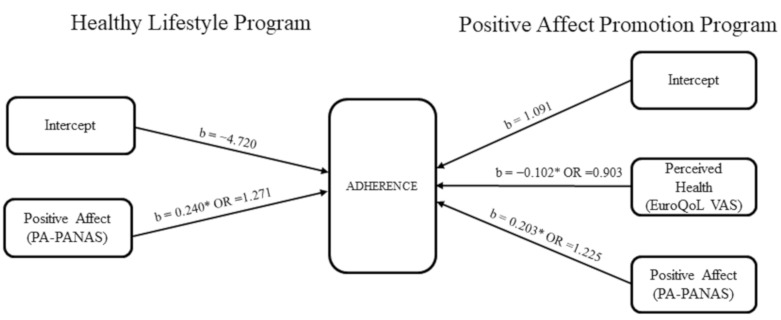
Depression is one of the most common disorders in psychiatric and primary care settings, and is associated with disability, loss in quality of life, and economic costs. Internet-based psychological interventions have been shown to be effective in depression treatment but present problems with a low degree of adherence. The main aim of this study is to analyze the adherence predictors in three low-intensity interventions programs applied by Information and Communication Technologies (ICTs) for depression. A multi-center, randomized, controlled clinical trial was conducted with 164 participants with depression, who were allocated to: Healthy Lifestyle Program, Positive Affect Promotion Program or Mindfulness Program. Sociodemographic characteristics, Patient Health Questionnaire-9, Visual Analog Scale, Short Form Health Survey, Positive and Negative Affect Schedule, Five Facets Mindfulness Questionnaire, Pemberton Happiness Index and Treatment Expectancy Questionnaire were used to study adherence. Results showed that positive affect resulted in a predictor variable for Healthy Lifestyle Program and Positive Affect Promotion Program. Perceived health was also a negative adherence predictor for the Positive Affect Promotion Program. Our findings demonstrate that there are differences in clinical variables between treatment completers and non-completers and we provide adherence predictors in two intervention groups. Although new additional predictors have been examined, further research is essential in order to improve tailored interventions and increase adherence treatment.
抑郁症是精神科和初级保健环境中最常见的疾病之一,与残疾、生活质量下降和经济成本有关。基于互联网的心理干预已被证明对抑郁症治疗有效,但存在着低依从性的问题。本研究的主要目的是分析三种应用于信息和通信技术(ICTs)的低强度干预方案对抑郁症治疗的依从性预测因素。一项多中心、随机、对照临床试验纳入了 164 名抑郁症患者,他们被分配到健康生活方式计划、积极情绪促进计划或正念计划中。采用人口统计学特征、患者健康问卷-9、视觉模拟量表、健康调查简表、正负情绪量表、五因素正念量表、彭伯顿幸福感指数和治疗期望问卷来研究依从性。结果表明,积极情绪是健康生活方式计划和积极情绪促进计划的预测变量。感知健康也是积极情绪促进计划中消极依从性的预测因素。我们的研究结果表明,在治疗完成者和未完成者之间存在临床变量的差异,我们提供了两个干预组的依从性预测因素。尽管已经检查了新的附加预测因素,但仍需要进一步研究,以改进个性化干预措施并提高治疗的依从性。