Hasanaliyeva Gultakin, Chatzidimitrou Eleni, Wang Juan, Baranski Marcin, Volakakis Nikolaos, Pakos Panagiotis, Seal Chris, Rosa Eduardo A S, Markellou Emilia, Iversen Per Ole, Vigar Vanessa, Willson Adam, Barkla Bronwyn, Leifert Carlo, Rempelos Leonidas
Department of Sustainable Crop and Food Protection, Faculty of Agriculture, Food and Environmental Sciences, Universita Catollica del Sacro Cuore, I-29122 Piacenza, Italy.
Nafferton Ecological Farming Group, School of Agriculture, Food and Rural Development, Newcastle University, Newcastle upon Tyne NE1 7RU, UK.
Foods. 2021 Feb 22;10(2):476. doi: 10.3390/foods10020476.
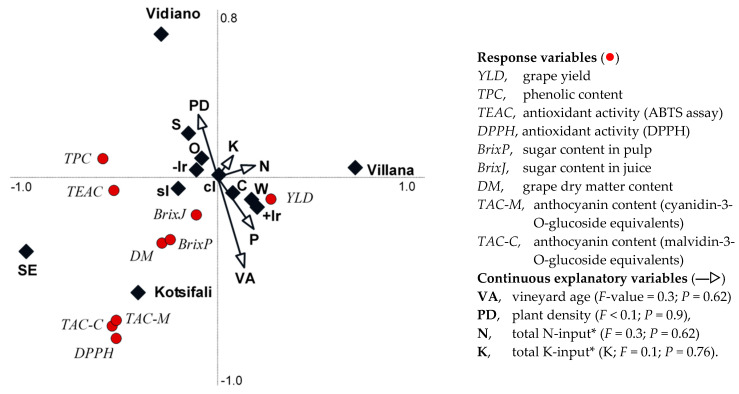
The antioxidants found in grapes and wine have been linked to health benefits in humans, but may be affected by agronomic parameters, grape type/variety, and processing. Here, we report results of a farm survey which investigated the effects of production system (organic vs. conventional) and grape variety on fruit yield, total antioxidant activity/capacity (TAA, assessed by the Trolox Equivalent Antioxidant Capacity (TEAC) and 2,2-diphenyl-1-picrylhydrazyl (DPPH) radical scavenging assays), and total concentrations of total phenolics (TPC) and anthocyanins (TAC) in grapes of one red (Kotsifali) and two white (Villana and/or Vidiano) traditional Cretan grape varieties. Analysis of variance (ANOVA) results showed that grape variety choice had a more substantial effect on TPC, TAA, and TAC than primary production protocols, and significant interactions were identified between production system and grape variety choice for TAA. Specifically, TAA was significantly (57%) higher in organic than conventional Vidiano grapes, while there was no significant effect of production system on TAA in Kotsifali and Villana grapes. As expected from previous studies, the TAC was substantially higher in red Kotsifali grapes. Redundancy analysis (RDA) identified grape variety as the only strong explanatory variable/driver for yield, TPC, TAA, and TAC of table grapes, and positive associations were detected between the variety Vidiano and both TPC and TAA. All other explanatory variables included in the RDA (including supplementary irrigation, orchard orientation, production system, soil type, vineyard age, plant density, and fertiliser inputs) explained only a small proportion of the additional variation.
葡萄和葡萄酒中发现的抗氧化剂已被证明对人类健康有益,但可能会受到农艺参数、葡萄类型/品种和加工的影响。在此,我们报告了一项农场调查的结果,该调查研究了生产系统(有机与传统)和葡萄品种对一种红色(科齐法利)和两种白色(维拉纳和/或维迪亚诺)传统克里特葡萄品种的果实产量、总抗氧化活性/能力(TAA,通过Trolox等效抗氧化能力(TEAC)和2,2-二苯基-1-苦基肼(DPPH)自由基清除试验评估)以及葡萄中总酚类(TPC)和花青素(TAC)的总浓度的影响。方差分析(ANOVA)结果表明,葡萄品种的选择对TPC、TAA和TAC的影响比初级生产方案更大,并且在TAA方面,生产系统和葡萄品种选择之间存在显著的相互作用。具体而言,有机种植的维迪亚诺葡萄的TAA比传统种植的显著高(57%),而生产系统对科齐法利和维拉纳葡萄的TAA没有显著影响。正如先前研究所预期的,红色科齐法利葡萄的TAC显著更高。冗余分析(RDA)确定葡萄品种是鲜食葡萄产量、TPC、TAA和TAC的唯一强有力的解释变量/驱动因素,并且在维迪亚诺品种与TPC和TAA之间检测到正相关。RDA中包括的所有其他解释变量(包括补充灌溉、果园朝向、生产系统、土壤类型、葡萄园年龄、种植密度和肥料投入)仅解释了一小部分额外变异。