Department of Electrical and Electronic Engineering, Bangladesh University of Engineering and Technology, Dhaka 1205, Bangladesh.
Department of Electrical and Electronic Engineering, Bangladesh University of Engineering and Technology, Dhaka 1205, Bangladesh.
Comput Biol Med. 2021 May;132:104296. doi: 10.1016/j.compbiomed.2021.104296. Epub 2021 Feb 28.
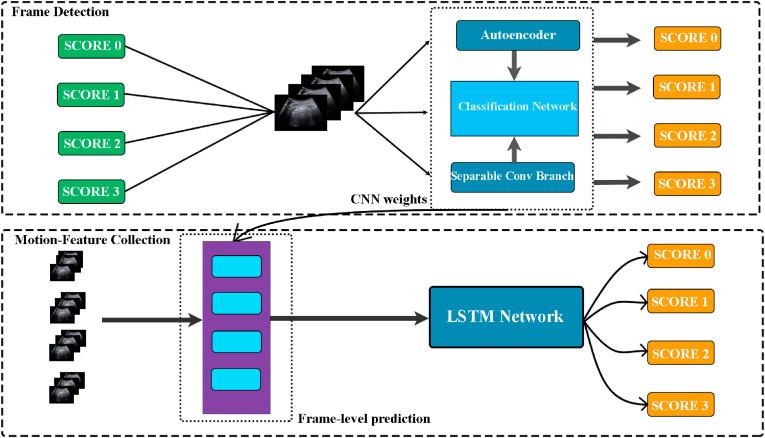
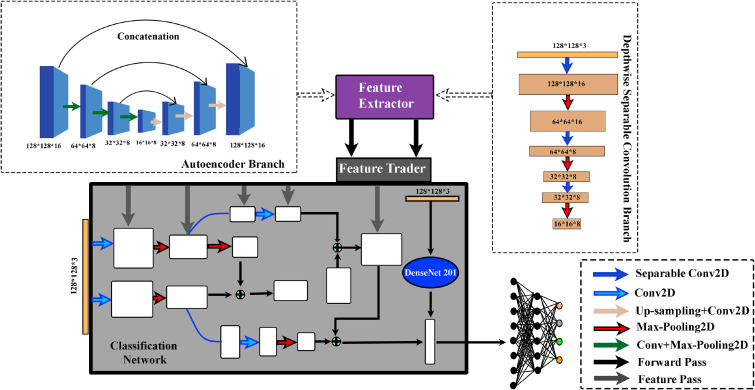
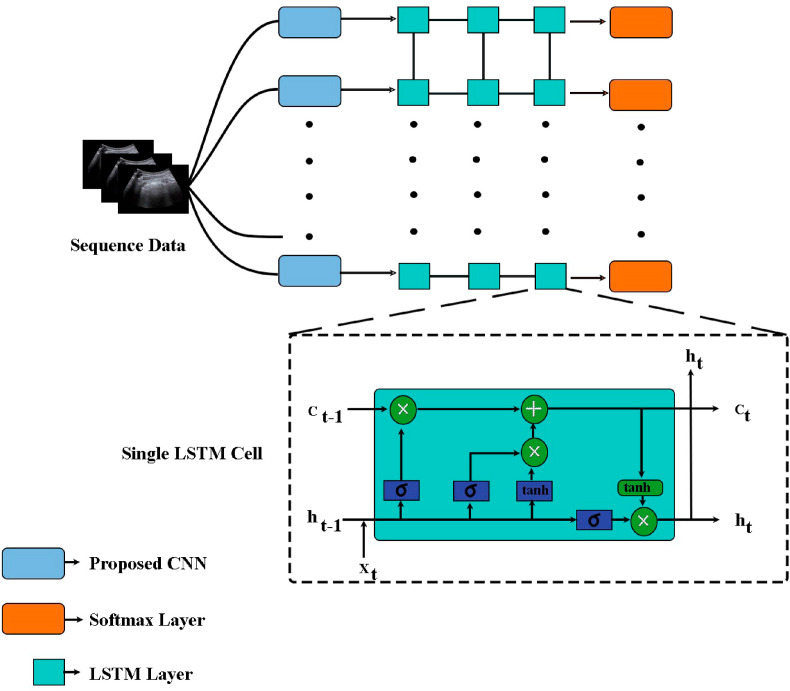
The COVID-19 pandemic has become one of the biggest threats to the global healthcare system, creating an unprecedented condition worldwide. The necessity of rapid diagnosis calls for alternative methods to predict the condition of the patient, for which disease severity estimation on the basis of Lung Ultrasound (LUS) can be a safe, radiation-free, flexible, and favorable option. In this paper, a frame-based 4-score disease severity prediction architecture is proposed with the integration of deep convolutional and recurrent neural networks to consider both spatial and temporal features of the LUS frames. The proposed convolutional neural network (CNN) architecture implements an autoencoder network and separable convolutional branches fused with a modified DenseNet-201 network to build a vigorous, noise-free classification model. A five-fold cross-validation scheme is performed to affirm the efficacy of the proposed network. In-depth result analysis shows a promising improvement in the classification performance by introducing the Long Short-Term Memory (LSTM) layers after the proposed CNN architecture by an average of 7-12%, which is approximately 17% more than the traditional DenseNet architecture alone. From an extensive analysis, it is found that the proposed end-to-end scheme is very effective in detecting COVID-19 severity scores from LUS images.
新冠疫情已成为全球医疗体系面临的最大威胁之一,在全球范围内造成了前所未有的局面。快速诊断的必要性需要寻找替代方法来预测患者的病情,而基于肺部超声(LUS)的疾病严重程度估计可以是一种安全、无辐射、灵活且有利的选择。在本文中,提出了一种基于框架的 4 分疾病严重程度预测架构,该架构结合了深度卷积和循环神经网络,以考虑 LUS 帧的空间和时间特征。所提出的卷积神经网络(CNN)架构实现了自动编码器网络和可分离卷积分支,并与改进的 DenseNet-201 网络融合,以构建强大、无噪声的分类模型。采用五折交叉验证方案来验证所提出网络的有效性。深入的结果分析表明,通过在所提出的 CNN 架构后引入长短时记忆(LSTM)层,分类性能有了显著的提高,平均提高了 7-12%,比传统的 DenseNet 架构 alone 提高了约 17%。通过广泛的分析发现,所提出的端到端方案在从 LUS 图像中检测 COVID-19 严重程度评分方面非常有效。