Institute of Psychology, The John Paul II Catholic University of Lublin, al. Racławickie 14, 20-950, Lublin, Poland.
J Gambl Stud. 2021 Dec;37(4):1079-1098. doi: 10.1007/s10899-021-10015-4. Epub 2021 Mar 10.
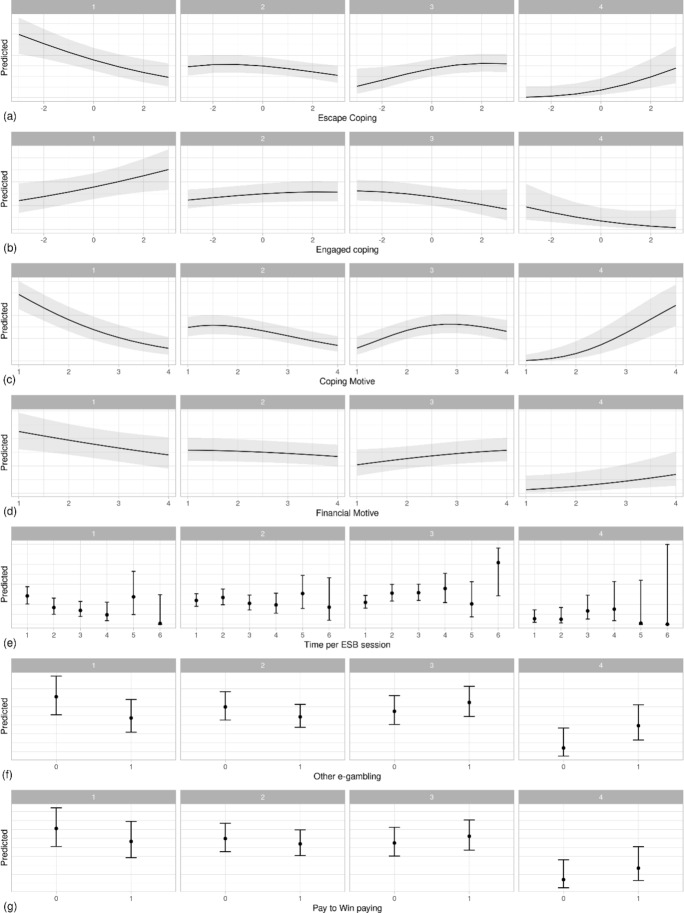
Research on esports activity usually captures it from the perspective of involvement in gaming. This study presents the results of the first research in Poland (N = 438) on esports betting (ESB). ESB is compared to other forms of e-gambling and involvement in pay-to-win games. The aim was to build a predictive model of gambling disorder among people betting on esports. A predictive model of gambling disorder based on ordinal regression was built, including sociodemographic variables, involvement in esports betting, involvement in other Internet activities connected to ESB, as well as psychological variables-motivation to gamble and coping strategies. The results showed that gambling disorder among esports bettors is associated with time spent on one game session, placing other forms of online gambling bets once a week or more often, and paying in pay-to-win games. Gambling disorder was also predicted by escape coping strategies and lower engaged strategies as well as financial and coping motivation to bet on esports results. The results show the crucial role of psychological factors (motivation, coping) in the development of esports betting addiction. Esports betting is an activity associated with both gambling and gaming-involvement in both activities explains the development of ESB addiction. There is a need for further research focused on the specificity of esports betting behavior to discover the direction of links among gaming, gambling, and esports gambling.
对电子竞技活动的研究通常从参与游戏的角度来捕捉。本研究展示了波兰(N=438)首次关于电子竞技博彩(ESB)的研究结果。ESB 与其他形式的电子赌博和参与付费赢取游戏进行了比较。目的是建立一个针对参与电子竞技博彩的人赌博障碍的预测模型。建立了基于有序回归的赌博障碍预测模型,包括人口统计学变量、参与电子竞技博彩、参与与 ESB 相关的其他互联网活动,以及心理变量——赌博动机和应对策略。结果表明,电子竞技博彩者的赌博障碍与单次游戏时间、每周或更频繁地进行其他形式的在线赌博投注以及在付费赢取游戏中付费有关。逃避应对策略和较低的参与应对策略以及对电子竞技结果下注的财务和应对动机也预测了赌博障碍。结果表明,心理因素(动机、应对)在电子竞技博彩成瘾的发展中起着至关重要的作用。电子竞技博彩是一种既与赌博又与游戏参与有关的活动,这两种活动的参与解释了 ESB 成瘾的发展。需要进一步关注电子竞技博彩行为的特殊性,以发现游戏、赌博和电子竞技赌博之间联系的方向。