Yu Chaoran, Helwig Ernest Johann
Department of Oncology, Shanghai Medical College, Fudan University, Shanghai, China.
Fudan University Shanghai Cancer Center, Shanghai, China.
Ann Transl Med. 2021 Feb;9(3):269. doi: 10.21037/atm-20-6337.
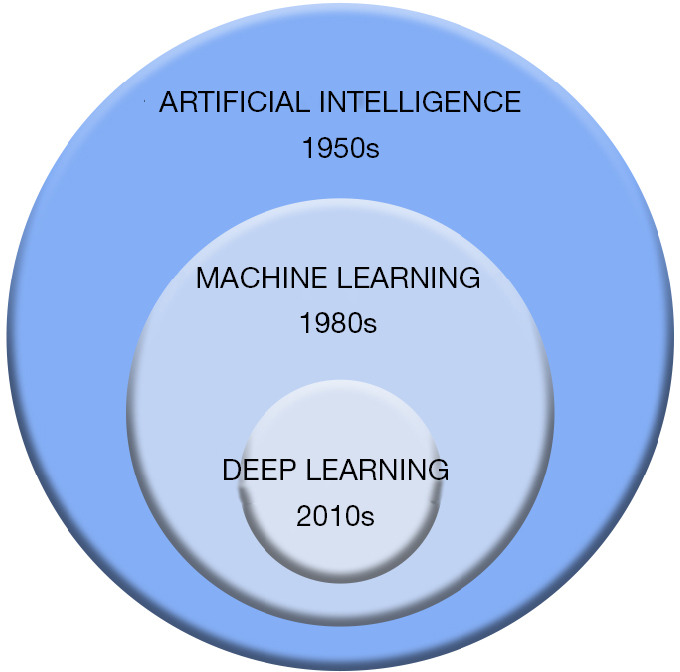
Increasing clinical contributions and novel techniques have been made by artificial intelligence (AI) during the last decade. The role of AI is increasingly recognized in cancer research and clinical application. Cancers like gastric cancer, or stomach cancer, are ideal testing grounds to see if early undertakings of applying AI to medicine can yield valuable results. There are numerous concepts derived from AI, including machine learning (ML) and deep learning (DL). ML is defined as the ability to learn data features without being explicitly programmed. It arises at the intersection of data science and computer science and aims at the efficiency of computing algorithms. In cancer research, ML has been increasingly used in predictive prognostic models. DL is defined as a subset of ML targeting multilayer computation processes. DL is less dependent on the understanding of data features than ML. Therefore, the algorithms of DL are much more difficult to interpret than ML, even potentially impossible. This review discussed the role of AI in the diagnostic, therapeutic and prognostic advances of gastric cancer. Models like convolutional neural networks (CNNs) or artificial neural networks (ANNs) achieved significant praise in their application. There is much more to be fully covered across the clinical administration of gastric cancer. Despite growing efforts, adapting AI to improving diagnoses for gastric cancer is a worthwhile venture. The information yield can revolutionize how we approach gastric cancer problems. Though integration might be slow and labored, it can be given the ability to enhance diagnosing through visual modalities and augment treatment strategies. It can grow to become an invaluable tool for physicians. AI not only benefits diagnostic and therapeutic outcomes, but also reshapes perspectives over future medical trajectory.
在过去十年中,人工智能(AI)在临床方面的贡献不断增加,新技术也不断涌现。人工智能在癌症研究和临床应用中的作用日益得到认可。像胃癌这样的癌症是检验人工智能早期应用于医学是否能产生有价值结果的理想试验场。人工智能衍生出了许多概念,包括机器学习(ML)和深度学习(DL)。机器学习被定义为在没有明确编程的情况下学习数据特征的能力。它出现在数据科学和计算机科学的交叉领域,旨在提高计算算法的效率。在癌症研究中,机器学习越来越多地用于预测预后模型。深度学习被定义为针对多层计算过程的机器学习子集。与机器学习相比,深度学习对数据特征的理解依赖性较小。因此,深度学习的算法比机器学习更难解释,甚至可能无法解释。本综述讨论了人工智能在胃癌诊断、治疗和预后进展中的作用。卷积神经网络(CNN)或人工神经网络(ANN)等模型在其应用中获得了高度评价。胃癌的临床管理还有很多方面需要全面涵盖。尽管付出了越来越多的努力,但使人工智能适应改善胃癌诊断是一项值得的尝试。所产生的信息可以彻底改变我们处理胃癌问题的方式。尽管整合可能缓慢且费力,但它能够通过视觉模式增强诊断并改进治疗策略。它可以发展成为医生的宝贵工具。人工智能不仅有益于诊断和治疗结果,还重塑了对未来医学轨迹的看法。