Gullón Pedro, Bilal Usama, Sánchez Patricia, Díez Julia, Lovasi Gina S, Franco Manuel
Public Health and Epidemiology Research Group, School of Medicine and Health Sciences, Universidad de Alcala, Alcala de Henares, 28871 Madrid, Spain.
Urban Health Collaborative, Drexel Dornsife School of Public Health, Philadelphia, PA, USA.
Cities Health. 2020;4(3):336-344. doi: 10.1080/23748834.2020.1715117. Epub 2020 Jan 27.
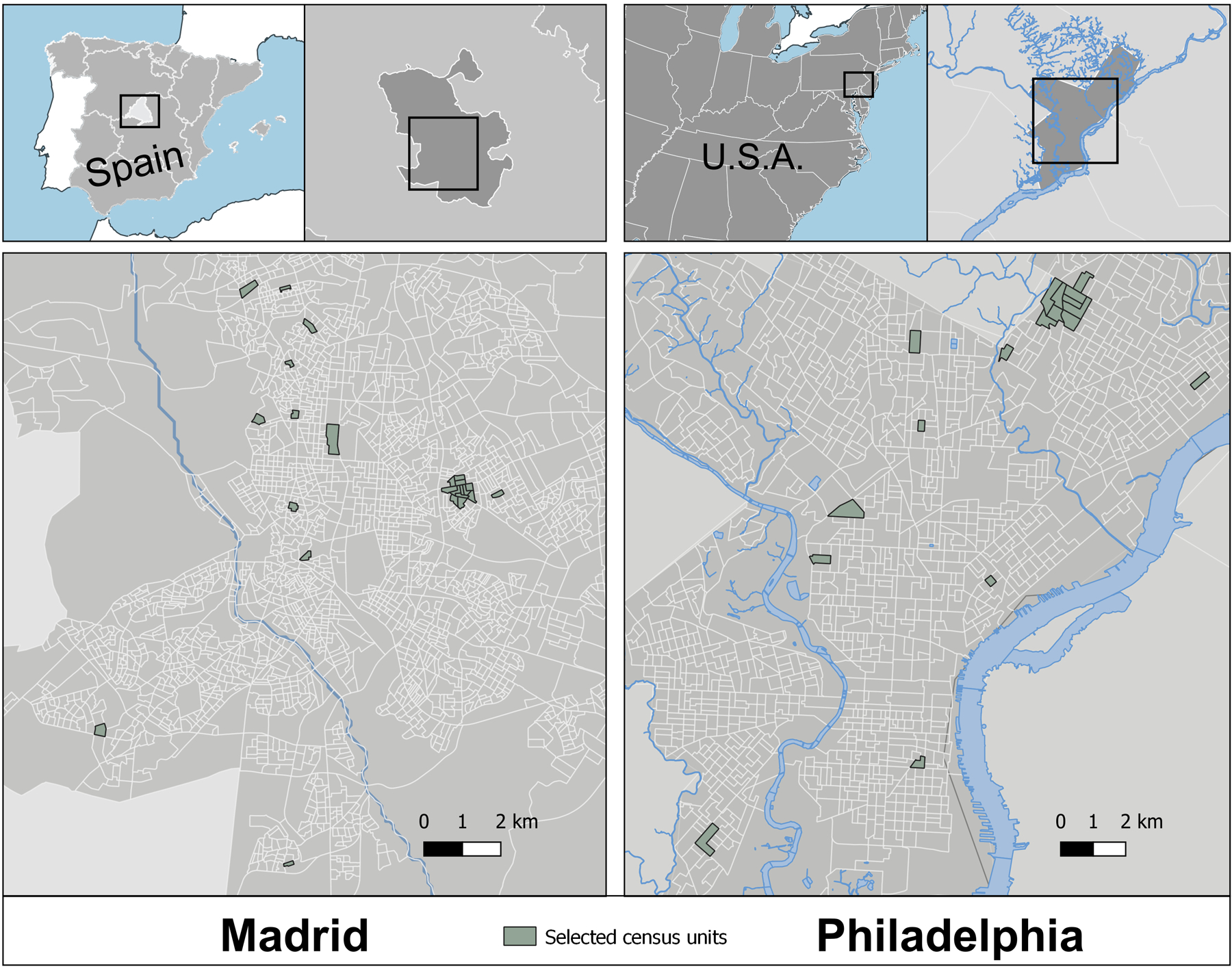
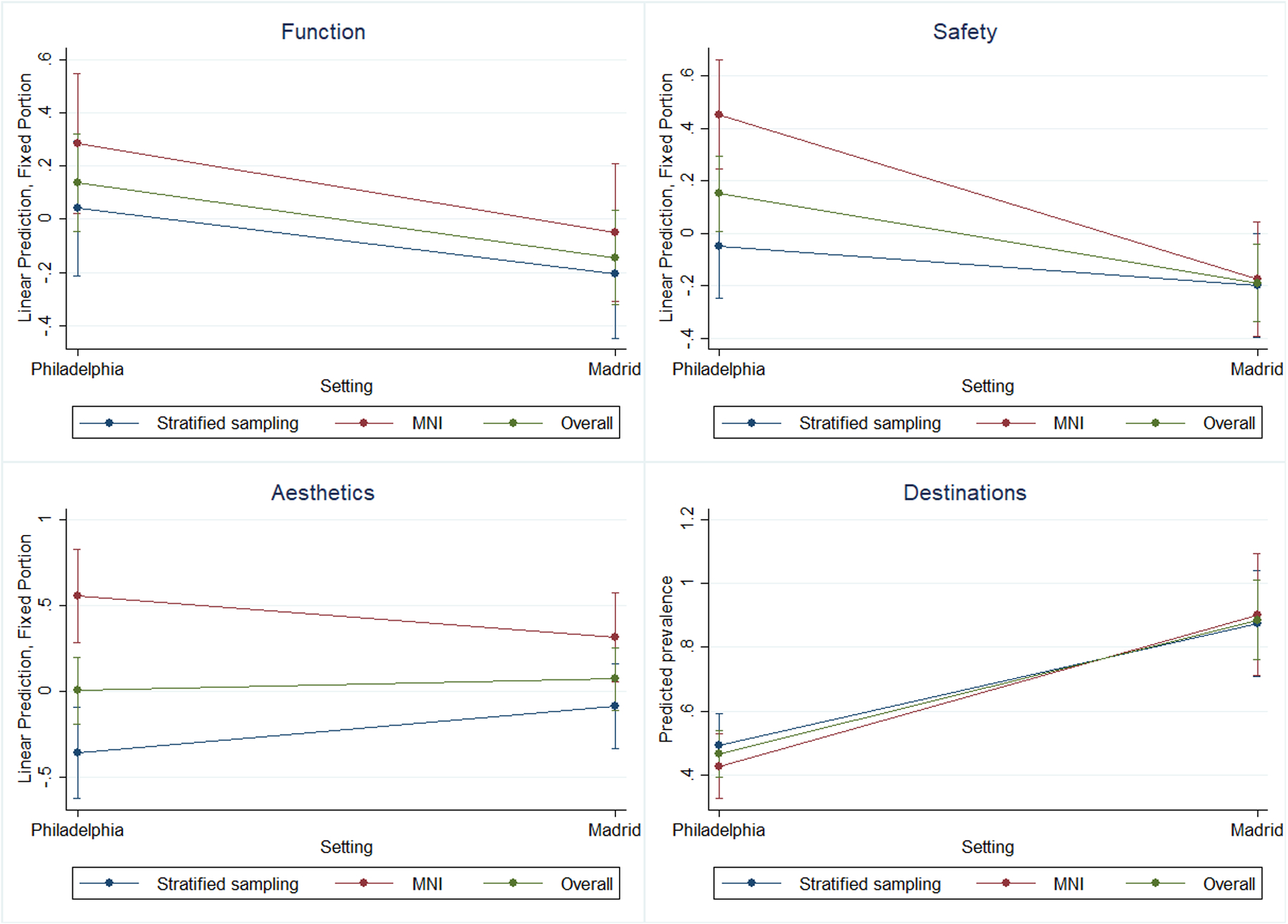
The objective of this study is to quantify, using virtual audits in Madrid and Philadelphia, cross-city differences in the walking environment and to test whether differences vary by sampling method. We used two sampling methods; first, a contiguous area combining census units (~15.000 population area for each setting) was selected using the Median Neighborhood Index (MNI). MNI is a summary index that averages Euclidean distances of sociodemographic and urban form features, used to select the median neighborhood for a given city. Second, we selected a population-density stratified sampling of the same number of census units as above. M-SPACES audit tool was deployed, using street virtual audits to measure function, safety, aesthetics, and destinations along each street segment. Madrid streets had lower scores for function (=-0.29 CI95% -0.55;-0.31) and safety (=-0.38 CI95% -0.61;-0.14). Madrid had a greater proportion of streets having at least one walking destination in the street segment (PR=1.92 95% CI 1.55; 2.39). We did not find a significant difference between Madrid and Philadelphia in aesthetics. We found an interaction between safety and sampling methods. This approach can reveal which elements of the built environment account for between-city differences, key to mass influences that operate at the city level.
本研究的目的是利用马德里和费城的虚拟审计来量化步行环境的城市间差异,并测试差异是否因抽样方法而异。我们使用了两种抽样方法;首先,使用中位数邻里指数(MNI)选择一个由普查单元组成的连续区域(每个区域约15000人口)。MNI是一个汇总指数,它对社会人口和城市形态特征的欧几里得距离进行平均,用于为给定城市选择中位数邻里。其次,我们选择了与上述相同数量普查单元的人口密度分层抽样。部署了M-SPACES审计工具,使用街道虚拟审计来测量每个街道段的功能、安全性、美观性和目的地。马德里街道在功能(=-0.29,95%置信区间-0.55;-0.31)和安全性(=-0.38,95%置信区间-0.61;-0.14)方面得分较低。马德里在街道段中至少有一个步行目的地的街道比例更高(PR=1.92,95%置信区间1.55;2.39)。我们没有发现马德里和费城在美观性方面有显著差异。我们发现安全性和抽样方法之间存在交互作用。这种方法可以揭示建成环境的哪些要素导致了城市间的差异,这是在城市层面发挥作用的大规模影响的关键。