Maharjan Sushila, Alva Jacqueline, Cámara Cassandra, Rubio Andrés G, Hernández David, Delavaux Clément, Correa Erandy, Romo Mariana D, Bonilla Diana, Santiago Mille Luis, Li Wanlu, Cheng Feng, Ying Guoliang, Zhang Yu Shrike
Division of Engineering in Medicine, Department of Medicine, Brigham and Women's Hospital, Harvard Medical School, Cambridge, MA 02139, USA.
Matter. 2021 Jan 6;4(1):217-240. doi: 10.1016/j.matt.2020.10.022. Epub 2020 Nov 18.
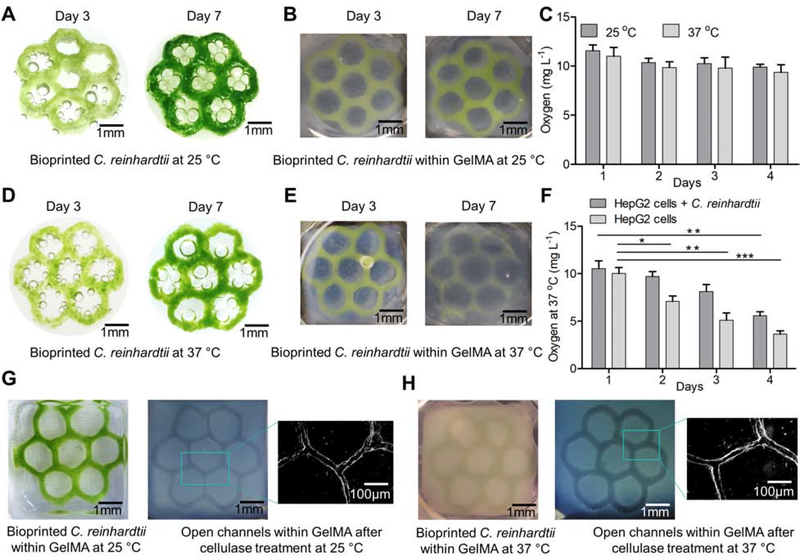
In this study, we present the photosynthetic oxygen (O) supply to mammalian cells within a volumetric extracellular matrix-like construct, whereby a three-dimensional (3D)-bioprinted fugitive pattern encapsulating unicellular green algae, (), served as a natural photosynthetic O-generator. The presence of bioprinted enhanced the viability and functionality of mammalian cells while reducing the hypoxic conditions within the tissues. We were able to subsequently endothelialize the hollow perfusable microchannels formed after enzymatic removal of the bioprinted -laden patterns from the matrices following the initial oxygenation period, to obtain biologically relevant vascularized mammalian tissue constructs. The feasibility of co-culture of with human cells, the printability and the enzymatic degradability of the fugitive bioink, as well as the exploration of as a natural, eco-friendly, cost-effective, and sustainable source of O would likely promote the development of engineered tissues, tissue models, and food for various applications.
在本研究中,我们展示了在一种类似细胞外基质的三维构建物中,光合氧气(O)向哺乳动物细胞的供应情况,其中一种包裹单细胞绿藻的三维生物打印可降解图案()作为天然的光合氧气发生器。生物打印图案的存在提高了哺乳动物细胞的活力和功能,同时减少了组织内的缺氧状况。在初始充氧期后,通过酶法从基质中去除负载生物打印图案的部分,形成中空可灌注微通道,随后我们成功地使这些微通道内皮化,从而获得具有生物学相关性的血管化哺乳动物组织构建物。绿藻与人类细胞共培养的可行性、可降解生物墨水的可打印性和酶促降解性,以及将绿藻作为一种天然、环保、经济高效且可持续的氧气来源进行探索,可能会推动用于各种应用的工程组织、组织模型和食品的发展。