Shickel Benjamin, Davoudi Anis, Ozrazgat-Baslanti Tezcan, Ruppert Matthew, Bihorac Azra, Rashidi Parisa
Department of Computer and Information Science and Engineering, University of Florida, Gainesville, FL, United States.
Precision and Intelligent Systems in Medicine (PRISMAP), University of Florida, Gainesville, FL, United States.
Front Digit Health. 2021 Feb;3. doi: 10.3389/fdgth.2021.640685. Epub 2021 Feb 22.
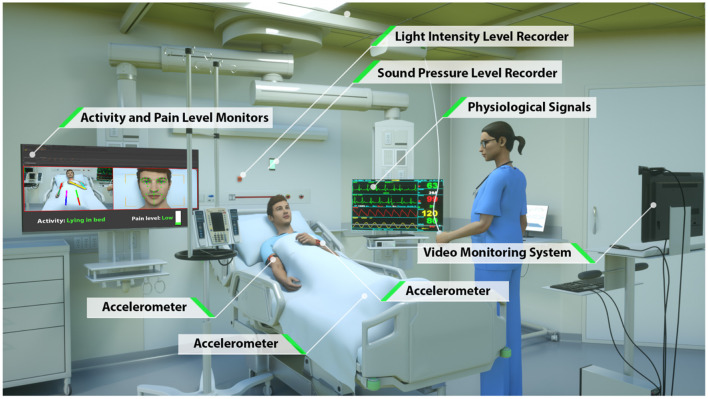
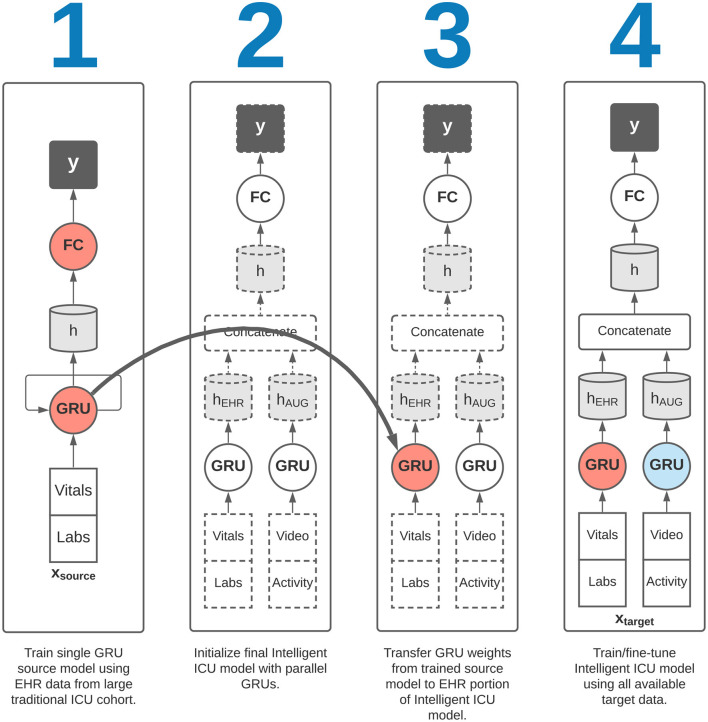
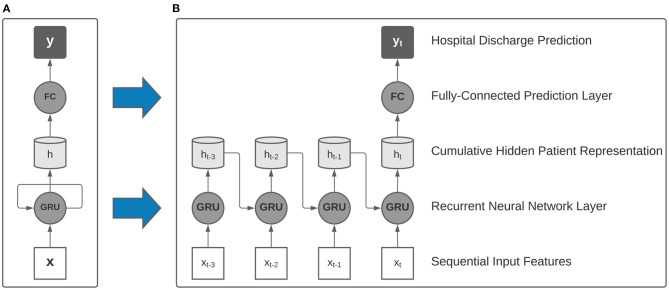
Accurate prediction and monitoring of patient health in the intensive care unit can inform shared decisions regarding appropriateness of care delivery, risk-reduction strategies, and intensive care resource use. Traditionally, algorithmic solutions for patient outcome prediction rely solely on data available from electronic health records (EHR). In this pilot study, we explore the benefits of augmenting existing EHR data with novel measurements from wrist-worn activity sensors as part of a clinical environment known as the Intelligent ICU. We implemented temporal deep learning models based on two distinct sources of patient data: (1) routinely measured vital signs from electronic health records, and (2) activity data collected from wearable sensors. As a proxy for illness severity, our models predicted whether patients leaving the intensive care unit would be successfully or unsuccessfully discharged from the hospital. We overcome the challenge of small sample size in our prospective cohort by applying deep transfer learning using EHR data from a much larger cohort of traditional ICU patients. Our experiments quantify added utility of non-traditional measurements for predicting patient health, especially when applying a transfer learning procedure to small novel Intelligent ICU cohorts of critically ill patients.
在重症监护病房中准确预测和监测患者健康状况,可为有关护理提供的适当性、风险降低策略以及重症监护资源使用的共同决策提供依据。传统上,用于患者预后预测的算法解决方案仅依赖于电子健康记录(EHR)中的可用数据。在这项试点研究中,我们探索了将腕部佩戴的活动传感器的新测量数据与现有EHR数据相结合的益处,这是智能重症监护病房临床环境的一部分。我们基于两种不同的患者数据源实现了时间深度学习模型:(1)电子健康记录中常规测量的生命体征,以及(2)从可穿戴传感器收集的活动数据。作为疾病严重程度的指标,我们的模型预测离开重症监护病房的患者出院是否成功。我们通过使用来自更大规模传统重症监护病房患者队列的EHR数据进行深度迁移学习,克服了前瞻性队列中样本量小的挑战。我们的实验量化了非传统测量对于预测患者健康状况的附加效用,特别是在将迁移学习程序应用于小型新型重症监护病房危重症患者队列时。