Boutin Denis, Mastine Susan C, Beaubien Luc, Berthiaume Maryse, Boilard Denise, Borja Jaime, Botton Edouard, Boulianne-Gref Janie, Breton Sylvie, Castellano Christian-Alexandre, Charpentier Gisèle, Counil Francois-Pierre, Cozmano Marie-Josée, Dagenais Pierre, Drouin Guy, Fortier Marie-Josée, Francoeur Caroline, Gagné Louise, Héraud David, Hêtu Denise, Houde Marie-Pier, Ladouceur Ginette, Landry Marjolaine, Leblanc Elisabeth, Loignon Christine, Lussier Valéry, Morin Annie, Ouellet Nathalie, Quintin Claude, Ramnarine Avinash, Wilhelmy Catherine, Svotelis Amy, Thibault Marie-Ève, Fraser William D, Battista Marie-Claude
Centre de recherche du CHUS, Sherbrooke, Québec, Canada.
Direction de la coordination de la mission universitaire, Centre Intégré Universitaire de Santé et des Services Sociaux de l'Estrie - Centre Hospitalier Universitaire de Sherbrooke, Sherbrooke, Québec, Canada.
Res Involv Engagem. 2021 Mar 16;7(1):15. doi: 10.1186/s40900-021-00258-1.
Medical societies and funding agencies strongly recommend that patients be included as partners in research publications and grant applications. Although this "top-down" approach is certainly efficient at forcing this new and desirable type of collaboration, our past experience demonstrated that it often results in an ambiguous relationship as not yet well integrated into the cultures of either patients' or the researchers'. The question our group raised from this observation was: "How to generate a cultural shift toward a fruitful and long-lasting collaboration between patients and researchers? A "bottom-up" approach was key to our stakeholders. The overall objective was to build a trusting and bidirectional-ecosystem between patients and researchers. The specific objectives were to document: 1) the steps that led to the development of the first patient-partner strategic committee within a research center in the Province of Québec; 2) the committee's achievements after 3 years.
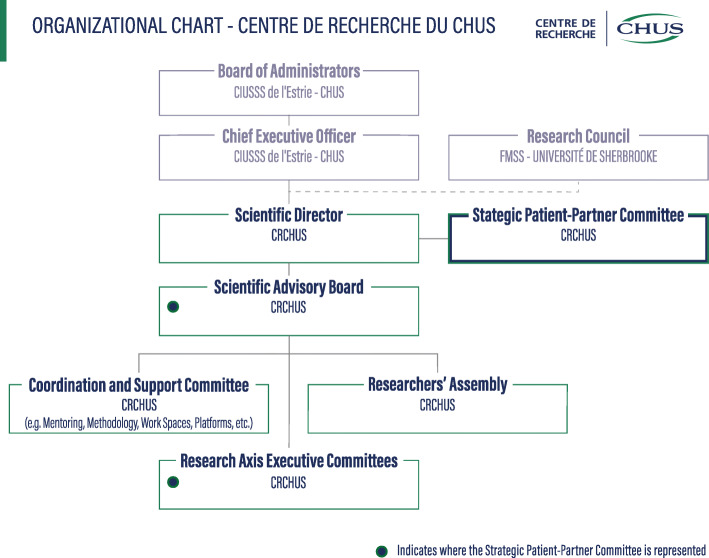
Eighteen volunteer members, 12 patient-partners and 6 clinician/institutional representatives, were invited to represent the six research themes of the Centre de recherche du CHU de Sherbrooke (CRCHUS) (Quebec, Canada). Information on the services offered by Committee was disseminated internally and to external partners. Committee members satisfaction was evaluated.
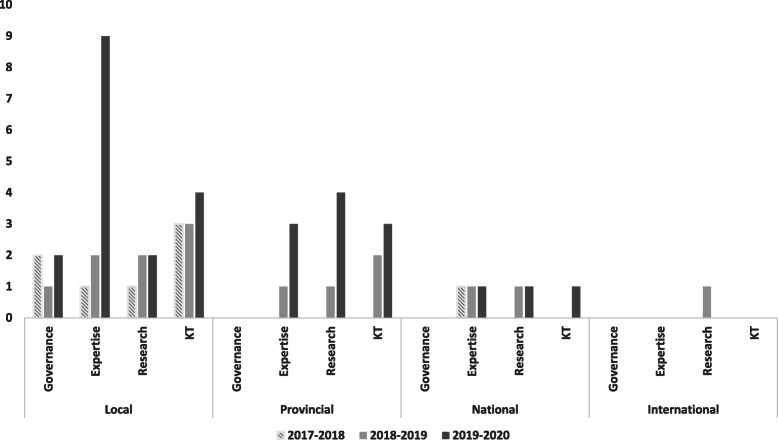
From May 2017 to April 2020, members attended 29 scheduled and 6 ad hoc meetings and contributed to activities requiring over 1000 h of volunteer time in 2018-2019 and 1907 h in the 2019-2020 period. The Committee's implication spanned governance, expertise, and knowledge transfer in research. Participation in these activities increased annually at local, provincial, national and international levels. The Patient-Partner Committee collaborated with various local (n = 7), provincial (n = 6) and national (n = 4) partners. Member satisfaction with the Committee's mandate and format was 100%.
The CRCHUS co-constructed a Patient-Partner Strategic Committee which resulted in meaningful bilateral, trusting and fruitful collaborations between patients, researchers and partners. The "bottom-up" approach - envisioned and implemented by the Committee, where the expertise and the needs of patients complemented those of researchers, foundations, networks and decision-makers - is key to the success of a cultural shift. The CRCHUS Committee created a hub to develop the relevant intrinsic potential aimed at changing the socio-cultural environment of science.
医学协会和资助机构强烈建议让患者作为合作伙伴参与研究出版物和资助申请。尽管这种“自上而下”的方法在推动这种新型且理想的合作方面肯定是有效的,但我们过去的经验表明,它往往会导致一种模糊的关系,因为这种合作尚未很好地融入患者或研究人员的文化之中。我们团队基于这一观察提出的问题是:“如何实现文化转变,以促成患者与研究人员之间富有成效且持久的合作?” 一种“自下而上”的方法对我们的利益相关者来说至关重要。总体目标是在患者和研究人员之间建立一个相互信任的双向生态系统。具体目标是记录:1)导致魁北克省一个研究中心内首个患者伙伴战略委员会成立的步骤;2)该委员会在3年后取得的成果。
邀请了18名志愿者成员,其中12名是患者伙伴,6名是临床医生/机构代表,以代表加拿大魁北克省舍布鲁克大学医学研究中心(CRCHUS)的六个研究主题。委员会提供的服务信息在内部以及向外部合作伙伴进行了传播。对委员会成员的满意度进行了评估。
从2017年5月到2020年4月,成员们参加了29次定期会议和6次特别会议,并在2018 - 2019年贡献了超过1000小时的志愿时间,在2019 - 2020年期间贡献了1907小时。委员会的参与涵盖了研究中的治理、专业知识和知识转移。在地方、省级、国家级和国际层面,参与这些活动的人数逐年增加。患者伙伴委员会与各种地方(n = 7)、省级(n = 6)和国家级(n = 4)合作伙伴进行了合作。成员对委员会的任务和形式的满意度为100%。
CRCHUS共同构建了一个患者伙伴战略委员会,促成了患者、研究人员和合作伙伴之间有意义的双边、相互信任且富有成效的合作。委员会设想并实施的“自下而上”方法,即患者的专业知识和需求与研究人员、基金会、网络及决策者的专业知识和需求相辅相成,是文化转变成功的关键。CRCHUS委员会创建了一个中心,以挖掘相关的内在潜力,旨在改变科学的社会文化环境。